How Mechanistic Interpretability Backstops AI Safety: A Deep Dive into One Survey

A survey systematically reviews how mechanistic interpretability provides causal evidence for AI safety and assesses its limits.
This survey examines whether understanding model internals can genuinely improve AI safety, mapping the landscape of mechanistic interpretability. It contrasts mechanistic evidence with behavioral evaluation, introduces foundational concepts like features, polysemanticity, and circuits, and covers methods from feature extraction to causal verification and training data attribution. It proposes a unified framework for assessing interpretability claims, categorizes six research orientations, and discusses safety applications including knowledge editing, steering, and monitoring alongside their limitations, with a reproducible code notebook repository.
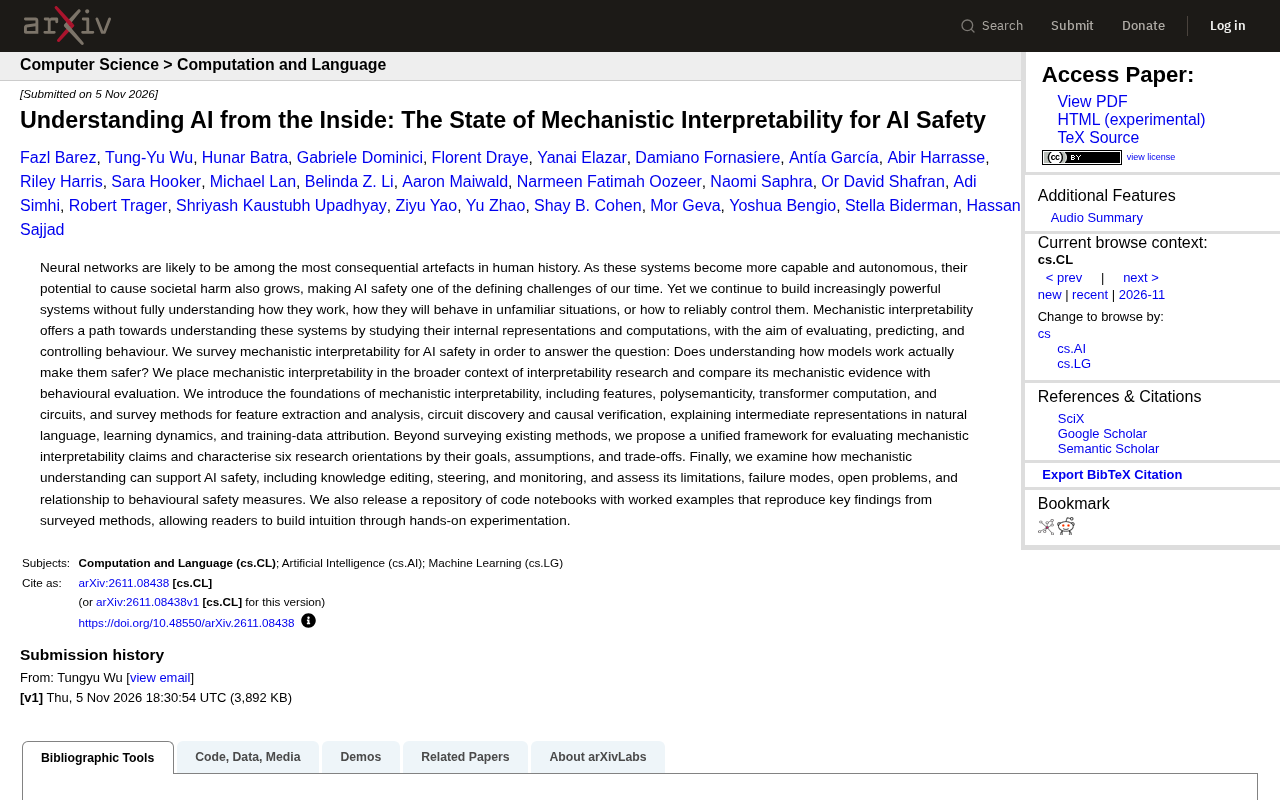
Neural networks may be among the most consequential creations in human history. As systems grow more capable and autonomous, their potential social harms scale alongside them, making AI safety a defining challenge of our time. Yet the reality is that we continue to build increasingly powerful systems without fully understanding them—we don't know how they work internally, how they will behave in unfamiliar situations, or how to reliably control them. A survey on mechanistic interpretability focused on AI safety attempts to answer a blunt but weighty question: Can understanding how models work actually make them safer?
Two Paths to Interpretability: Mechanistic Evidence vs. Behavioral Evaluation
The survey first situates mechanistic interpretability within the broader landscape of interpretability research and systematically compares it with its counterpart—behavioral evaluation. Behavioral evaluation judges whether a model is safe through input-output testing. It is intuitive and scalable, but it cannot cover novel situations outside the training distribution: a model may perform well on certain tests yet behave dangerously in unseen circumstances, and behavioral testing is nearly powerless against this.
Mechanistic interpretability takes a different path: it opens up the model's internals, studies its representations and computations, and uses mechanism-level evidence to evaluate, predict, and control behavior. The value of this evidence lies in the fact that it doesn't depend on "happening to measure it" but instead attempts to provide a causal explanation behind behavior. One of the survey's core contributions is proposing a unified framework for assessing the reliability of mechanistic interpretability claims—after all, if an interpretability conclusion cannot itself be verified, its value for safety is moot.
Foundational Concepts: Features, Polysemanticity, and Circuits
To understand mechanistic interpretability, one must first grasp several foundational building blocks. The survey systematically introduces concepts such as features, polysemanticity, the Transformer computation process, and circuits.
Features can be understood as the semantic units of a model's internal representations; polysemanticity refers to the fact that a single neuron or direction often encodes multiple unrelated concepts simultaneously, which creates a fundamental difficulty in "reading out" the model's internal meaning; circuits are the connection structures through which features collaborate to accomplish specific computational tasks. Together, these concepts form the analytical language of mechanistic interpretability—from microscopic semantic units to macroscopic computational circuits, researchers attempt to reconstruct the mechanisms of model behavior at different levels of granularity.
Mechanistic Interpretability is a branch of interpretability research whose goal is to reverse-engineer the internal computations of neural networks into human-understandable algorithms or circuits. Unlike traditional post-hoc interpretability methods (such as saliency maps or LIME), it is not content to identify "which inputs influenced the output" but instead attempts to precisely describe the specific operations performed by each layer and each component within the model, and how these operations combine into complete behavior. The field often borrows metaphors from neuroscience: just as researchers understand the brain by recording neuronal activity with probes, mechanistic interpretability "reads" networks through analysis of activations, attention patterns, and weights. Its core belief is that only by understanding the causal structure inside a model can one reliably predict its behavior in novel situations and implement precise interventions.
Method Landscape: From Feature Extraction to Training Data Attribution
The survey covers a remarkably complete chain of methods. Feature extraction and analysis address the question of "what is inside the model"; circuit discovery and causal verification address the question of "which structures actually cause behavior," with causal verification being particularly critical, as it distinguishes correlational observation from causal mechanism.
Beyond this, there are several extended paths: explaining intermediate representations in natural language so that the model's internal states can be understood in human-readable terms; studying learning dynamics to trace how mechanisms form during training; and training data attribution, which traces model behavior back to specific training data. Together, these methods answer not only "what does the inside of the model look like" but also "where does this internal structure come from, and what behavior will it lead to."
The survey also proposes a taxonomy of six research orientations, characterized by their respective goals, assumptions, and trade-offs. The significance of this taxonomy lies in the fact that different orientations have different standards for "what counts as a good explanation," and mixing standards leads to conclusions that cannot be mutually verified.
Causal Verification in mechanistic interpretability specifically refers to using intervention experiments to test whether a discovered internal structure is actually responsible for behavior, rather than merely correlated with it. Common techniques include ablation (removing a component or direction and observing changes in output), activation patching (replacing the internal activations of one input with those of another), and path patching. These methods draw on the interventionist ideas of causal inference: if changing an internal state predictably changes the output, then that state has a causal role. The survey emphasizes that causal verification is the key step distinguishing "plausible explanations" from "tested mechanisms," and is the core component in assessing the reliability of interpretability claims.
From Understanding to Intervention: How Mechanistic Knowledge Serves Safety
The survey finally connects mechanistic understanding with safety practice, discussing three categories of applications: knowledge editing, steering, and monitoring. Knowledge editing attempts to correct specific knowledge in a model at the mechanistic level; steering changes the direction of model behavior by intervening in internal representations; and monitoring leverages understanding of internal states to detect anomalies or danger signals.
These applications demonstrate the practical safety value of mechanistic interpretability—it is not just about "seeing" but also about "acting." However, the survey also candidly assesses its limitations, failure modes, and open problems, and discusses the relationship between mechanistic methods and behavioral safety measures. Mechanistic understanding cannot replace behavioral evaluation; the two are more complementary: mechanistic evidence provides causal explanation and predictive capability, while behavioral evidence provides real-world validation.
Steering is a class of techniques that change a model's behavior by directly intervening in its internal representations. A typical approach is to add a "steering vector" to the activations of a specific layer during the forward pass; this vector is usually computed from the difference in activations between contrasting positive and negative examples, such as the difference between the average activations for "honest" and "dishonest" responses. The appeal of steering lies in the ability to adjust model tendencies without retraining, and it acts more directly on internal states than prompts; its risk is that interventions may produce unintended side effects, such as simultaneously altering unrelated behavioral dimensions. The survey lists steering alongside knowledge editing and monitoring as safety applications of mechanistic understanding, but also notes that its effectiveness depends on an accurate grasp of the semantics of internal representations.
A Noteworthy Engineering Detail
The survey comes with a repository of code notebooks that reproduce key findings of the surveyed methods with runnable examples. For readers who want to build intuition, this is more effective than simply reading papers—many concepts in mechanistic interpretability (polysemanticity, circuits, causal verification) only truly land after hands-on experimentation. This also echoes the survey's stance: interpretability claims need to be reproducible and verifiable, and code is part of that verification.
One-line Summary
The survey systematically reviews how mechanistic interpretability provides causal evidence for AI safety and assesses its limitations.
Paragraph Summary
This survey centers on the question of whether understanding model internals can genuinely improve AI safety, systematically mapping the research landscape of mechanistic interpretability. It first contrasts mechanistic evidence with behavioral evaluation: the latter relies on input-output testing and struggles to cover novel situations outside the training distribution, while the former attempts to provide causal explanations behind behavior. It then introduces foundational concepts such as features, polysemanticity, Transformer computation, and circuits, and covers a chain of methods including feature extraction, circuit discovery, causal verification, natural language explanation, learning dynamics, and training data attribution. The survey proposes a unified framework for assessing the reliability of interpretability claims and divides research into six orientations by goals, assumptions, and trade-offs. Finally, it discusses three categories of safety applications—knowledge editing, steering, and monitoring—candidly assesses their limitations and failure modes, and includes a reproducible code notebook repository.
Related articles

AI Coding Enters the Team Collaboration Era: Interpreting Three Major Moves from Meta, GitHub, and Mistral
Meta acquires Conductor, GitHub Copilot Fusion becomes available, Mistral opens Large 4 weights—three moves show AI coding shifting from code generation to organizing development workflows. This article explains task orchestration, model collaboration, and cost control for developers.

Building a RAG Assistant with Dify: A Practical Guide to Knowledge Bases, Workflows, and Agent Nodes
How should knowledge bases, workflows, and Agent nodes connect in a Dify RAG assistant? We break down the division of labor and wiring logic for a shippable app.
 Tech Frontiers
The AI Industry Doesn't Lack Marketing—It Lacks Good Products
AI faces market selloffs and public skepticism—is marketing really the problem? This analysis of market signals and product experience argues the core困境 is incomplete products and a gap between promises and experience; the only way to change perceptions is to ship better products.