How Much Does Reviewer Confidence Matter in ICLR Decisions? A Case Study of 3/3/2 Ratings

In ICLR reviews, confidence scores are an auxiliary signal for ACs, but substantive review content and rebuttal are more critical.
This article analyzes the role of confidence scores when ratings diverge in ICLR reviews. Using an author's submission as an example: ratings 3/3/2 with confidence scores 1/3/3, where a low-confidence weak accept pointed out key issues. The article notes that confidence reflects a reviewer's certainty, low confidence does not equate to poor quality, and the AC synthesizes rating distribution, review content, and rebuttal responses. When ratings split, a high-confidence weak reject may be seen as a stronger negative signal, but high-quality opinions from low-confidence reviewers are still valued. Authors should focus on addressing high-confidence reviewers' concerns while properly handling issues raised by low-confidence reviewers. Ultimately, there is no fixed formula for AC decisions; substantive content and discussion progress often matter more than confidence scores.
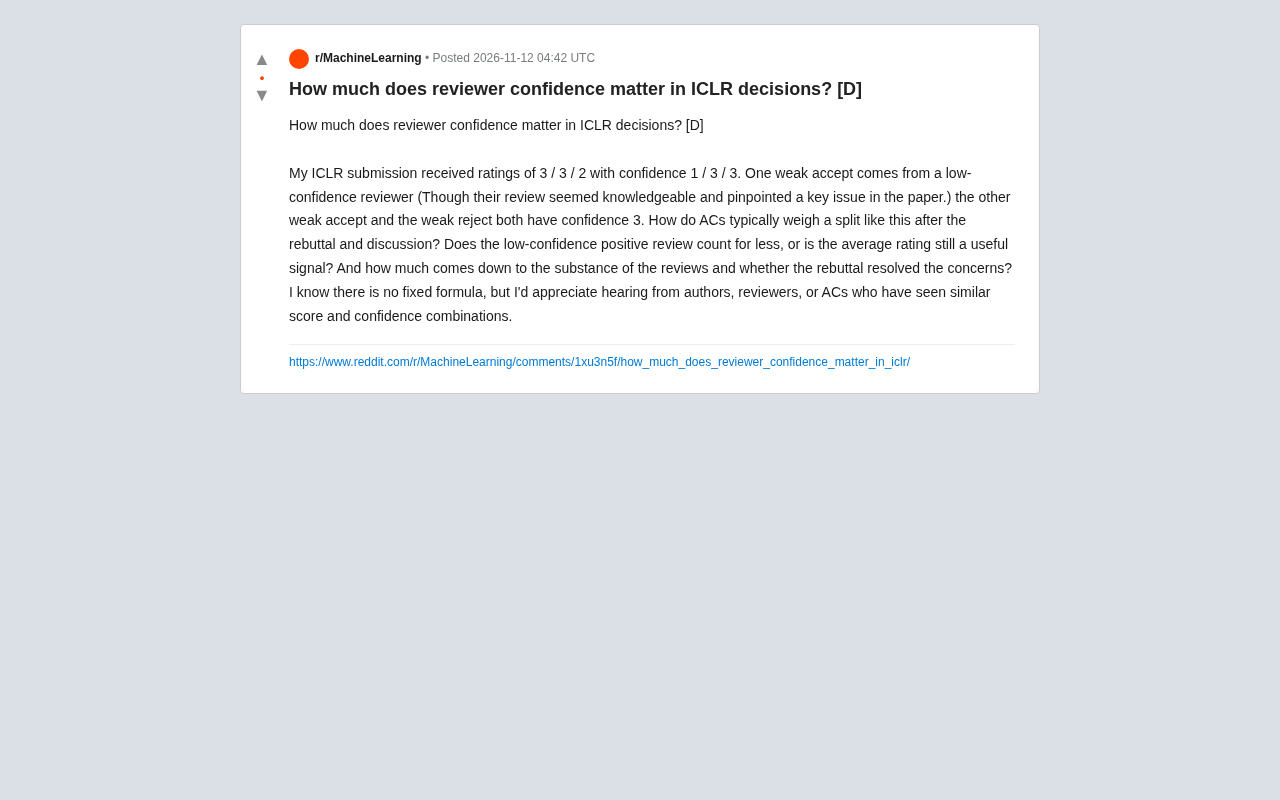
In the ICLR review system, each paper receives ratings and confidence scores from multiple reviewers. When ratings diverge, does the confidence score influence the AC's (Area Chair's) final decision? An author shared their ICLR submission case on Reddit: ratings of 3/3/2, with corresponding confidence scores of 1/3/3. One weak accept came from a low-confidence reviewer (confidence 1), but that review appeared professional and pointed out key issues in the paper; the other weak accept and weak reject both had confidence 3. The author wants to know how the AC typically weighs this split combination of ratings and confidence after rebuttal and discussion. Is a low-confidence positive review weighted less? Does the average rating still carry reference value? And how much weight is given to the substantive content of reviews and whether the rebuttal addresses the concerns?
The Role of Confidence Scores in Reviewing
In the ICLR review form, the confidence score is typically used to indicate how certain a reviewer is about their assessment. A low confidence score may mean the reviewer is not sufficiently familiar with the paper's area, or is hesitant about the rating itself. But low confidence does not equate to poor review quality—as in this case, the reviewer with confidence 1, despite giving a weak accept, precisely pointed out the core issues of the paper.
From the AC's perspective, the confidence score is an auxiliary signal, not a decisive factor. The AC will comprehensively consider the distribution of ratings, the specific content of the reviews, and the author's responses in the rebuttal. When ratings diverge, the AC often focuses more on whether the points of disagreement among reviewers are clarified during discussion.
ICLR (International Conference on Learning Representations) is one of the top conferences in machine learning, and its review process uses an open review model, where all reviews, author responses, and discussions are made public after the conference. The review form typically includes two dimensions: rating and confidence. The rating reflects the reviewer's overall judgment of the paper's quality, while confidence reflects the reviewer's certainty about their own judgment. Confidence scores are generally on a 1-5 scale, with 1 meaning "very uncertain" and 5 meaning "very certain." The AC (Area Chair) is responsible for synthesizing all reviews and the author's rebuttal to make the final acceptance decision. Understanding the difference between these two dimensions helps authors set reasonable expectations for review outcomes.
Common Logic for Handling Split Ratings
For a rating combination like 3/3/2, the average score is 2.67, which is on the weaker side of the ICLR rating system (assuming a 1-10 scale, but the specific scale should refer to the current year's conference regulations). The disagreement between two weak accepts (3 points) and one weak reject (2 points) is not extreme, but enough that the AC needs to make further judgment.
The role of confidence scores here is reflected in: a weak reject with confidence 3 may be seen as a stronger negative signal, while a weak accept with confidence 1 may be considered slightly lower weight by the AC. However, if the low-confidence reviewer's opinion is of high quality with sufficient evidence, the AC will still give it attention. The key is whether the review is built on solid technical understanding, rather than relying solely on the confidence score.
The ICLR rating scale is typically 1-10, where 1-3 generally corresponds to reject or weak reject, 4-5 to borderline, and 6 and above to weak accept or accept. A 3/3/2 combination means two weak accepts and one weak reject, with an average of 2.67 falling in the lower range of the 1-10 scale, but the actual acceptance threshold varies by year and submission volume. When weighing, the AC also refers to the paper's meta-review, which is the summary evaluation written by the AC, explicitly stating which reviews are adopted and why.
How Rebuttal and Discussion Affect the Final Decision
In the ICLR review process, rebuttal and subsequent discussion are important stages for changing reviewers' opinions. If authors can effectively respond to the issues raised by reviewers, especially those highlighted by high-confidence reviewers, the AC may lean toward considering the paper's flaws as resolved or mitigated.
In this case, the author should focus on the opinions of the weak reject reviewer with confidence 3, because their high confidence means the AC may give more weight to their concerns. At the same time, the key issues pointed out by the low-confidence weak accept reviewer should not be ignored—if the rebuttal can properly address these issues, the AC may lean toward a positive evaluation.
Strategies Authors Can Adopt
When facing split ratings, authors should do the following in their rebuttal:
- Respond to each reviewer's specific concerns one by one, especially those of high-confidence reviewers;
- Fully explain the key issues raised by low-confidence reviewers and demonstrate the paper's room for improvement;
- Maintain professional communication during the discussion phase and avoid emotional responses;
- Emphasize the paper's contributions and the reliability of experiments, but avoid over-defending.
Ultimately, the AC's decision is the result of multiple factors, with no fixed formula. The confidence score is one reference, but the substantive content of the reviews and the progress of discussion are often more critical.
Conclusion
In ICLR reviews, confidence scores influence the AC's weighting of review opinions, but they are not the sole determining factor. When ratings diverge, the AC focuses more on the substantive content of the disagreements and how well the rebuttal resolves them. For authors, taking every review seriously—especially feedback from high-confidence reviewers—and providing clear, strong responses in the rebuttal is the best way to cope with uncertainty.
Related articles

Prompt Engineering for Beginners: From Writing Prompts to Engineering Thinking
Starting from the essence and four functions of prompts, this article systematically explains the six-step process, four success criteria, learning value, and practical limitations of prompt engineering to help you build a complete understanding.

Anthropic Launches Nasdaq IPO: AI Giant's Listing and Risk Disclosures
Anthropic officially launches its Nasdaq IPO under ticker ANT, with market valuation expected to potentially exceed SpaceX's record. The prospectus devotes nearly 100 pages to AI risks, while first-half revenue grew over 14x but net losses widened sharply, reigniting the AI bubble debate.

Rust cURL Clone Uses 4,832 unsafe Blocks—Is the Memory Safety Myth Broken?
A Rust cURL clone uses 4,832 unsafe keywords, challenging Rust's memory safety narrative. We analyze what unsafe really means, compare Fil-C, and examine rewrite motives.