How Multi-Agent AI Is Reshaping Incident Debugging: From Logs to Root Cause

A three-agent AI pipeline replaces black-box diagnosis with traceable, evidence-driven root cause analysis.
This article introduces a multi-agent Root Cause Analysis system composed of three purpose-built AI agents: a log parser, a hypothesis generator, and an evidence validator. Using a real-world HTTP 403 deployment failure as a case study, it shows how separating observation, reasoning, and verification prevents anchoring bias, surfaces competing hypotheses, and exposes uncertainty rather than manufacturing false confidence. The architecture's core value lies not in the final answer, but in the traceable evidence trail it produces.
When AI Stops Just Explaining Errors and Starts Investigating Them
Most AI debugging demos start with a clean error message and deliver a confident answer. But real-world production incidents are rarely that simple.
Imagine a deployment pipeline where authentication passes, resources are created successfully, configuration is linked, backend health checks all come back green — and then, at the very last step, fetching the installer download URL suddenly fails. The logs show an HTTP 403, and the JSON parser complains about an unexpected character. Several explanations seem plausible: Is it an authentication issue? A gateway failure? A missing artifact? Or an environment-specific configuration drift?
As Vikram Boddupalli emphasizes in his open-source project AI-Incident-Root-Cause-Analyzer: the real challenge isn't finding an explanation — it's determining which explanation the evidence actually supports. This is the core problem that a multi-agent Root Cause Analysis (RCA) architecture is designed to solve.
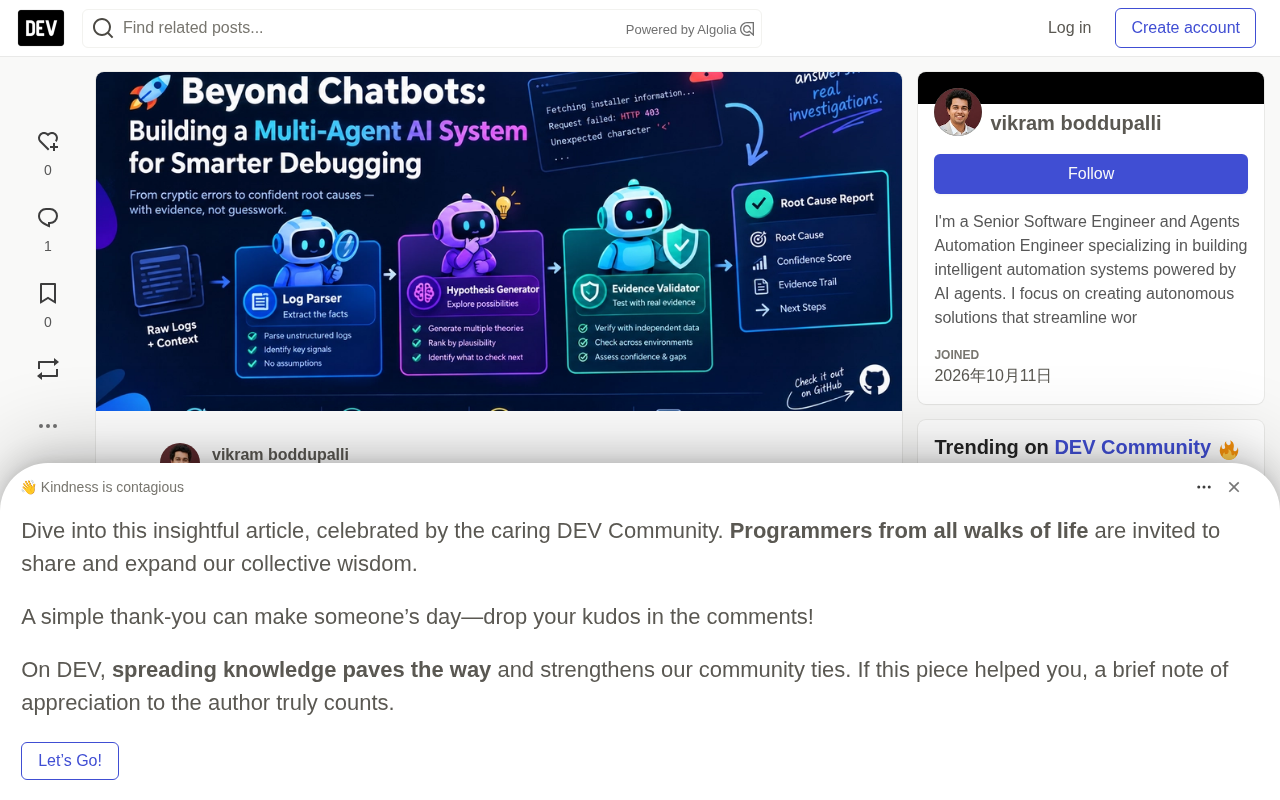
Three Agents, Three Responsibilities
Rather than asking a single LLM to complete the entire diagnosis in one shot, the investigation is broken into three stages, each carrying exactly one clearly defined responsibility.
- 🔍 Log Parser: What facts do we actually know?
- 🧠 Hypothesis Generator: What are the possible explanations?
- 🛡️ Evidence Validator: Which explanation does the evidence actually support?
The elegance of this separation lies in fully decoupling the three cognitive phases of investigation: observation, reasoning, and verification. The pipeline begins with raw logs and incident context, flows through parsing, hypothesis generation, and validation, and outputs a root cause report complete with evidence, confidence levels, and recommended next steps.
A Multi-Agent System is an architectural paradigm that distributes a complex task across multiple collaborating AI agents. Each agent has its own prompt, toolset, and decision logic, handling only what falls within its defined scope. An orchestrator layer then chains the outputs of each stage together. This is conceptually similar to prompt chaining, but places greater emphasis on isolating responsibility boundaries — the output format of each agent serves as the input contract for the next, allowing any individual component to be iterated and tested independently without breaking the rest of the pipeline. In RCA scenarios, this isolation is especially critical: when a single LLM simultaneously plays the roles of observer, reasoner, and verifier, it tends to treat early inferences as implicit premises for later ones, producing a diagnosis that is internally consistent but disconnected from actual evidence.
Reconstructing the Incident: All Green Until the Last Step
Back to that representative case. The error thrown at the final step of the pipeline, simplified and anonymized, looks roughly like this:
Fetching installer information...
Request failed: HTTP 403 Forbidden
Error: Unable to retrieve the download URL.
The response could not be parsed as valid JSON.
Unexpected character '<' at the beginning of the response.
At first glance, this looks like a JSON parsing problem. But there's a clue hiding in plain sight: the response starts with <, which typically means the client expected JSON but received HTML instead. That HTML could be an access-denied page, a gateway response, a proxy error, or some other upstream return.
The key insight emerges: the parsing anomaly is likely a symptom of the failure, not the root cause itself. Chasing the JSON error alone would lead investigators in completely the wrong direction.
Agent 1: The Log Parser — Turning Noise into Facts
The first agent performs no diagnosis. Its only job is to transform unstructured logs into a structured incident summary, without introducing any assumptions.
For this case, the signals it extracts are: HTTP status code is 403 Forbidden; the expected response type is JSON; the actual response begins with <; the failing operation is fetching an artifact download URL; the failure occurs at the final stage of deployment; and the initial scope is narrowed to a specific environment and a specific artifact request.
Notice what is deliberately absent — no premature conclusions. The parser doesn't say "authentication is broken." It records only what the logs actually show.
This matters enormously. Once an early stage labels a problem as "authentication failure," all subsequent analysis unconsciously gravitates toward that interpretation — a classic anchoring bias. Separating extraction from diagnosis keeps the entire investigation grounded in observable facts.
In cognitive science, anchoring bias refers to the tendency to rely too heavily on the first piece of information encountered when making decisions, even when subsequent evidence contradicts it. This bias is extremely common in incident response: once an engineer or AI system categorizes a problem as "authentication failure" early on, they prioritize evidence that supports that conclusion while discounting signals pointing elsewhere. Separating the extraction phase from the diagnosis phase cuts this bias off at the architectural level — the Parser produces a list of facts about what happened, not explanations of why it happened, ensuring that downstream agents face raw observations rather than pre-colored conclusions.
Agent 2: The Hypothesis Generator — Reasoning in Possibilities
The second agent takes the structured facts and generates multiple competing explanations, rather than locking onto the first plausible-sounding answer.
Hypothesis 1: Authentication or Authorization Failure
Perhaps a token expired, credentials were invalidated, or the request lacked required permissions. The 403 status code makes this plausible. But the status code alone doesn't tell us which component rejected the request or why.
Hypothesis 2: Gateway, Proxy, or Middleware Interference
A reverse proxy, gateway, CDN, or security layer may have intercepted the request and returned its own HTML error page. This would simultaneously explain both the 403 and the unexpected response format, making it a strong candidate — but without corroborating evidence, it remains just a hypothesis.
Hypothesis 3: Artifact Availability or Configuration Issue
The artifact itself may be unavailable, misconfigured, or inaccessible via the selected download path. Even though the failure occurs when fetching the download URL, artifact metadata and environment-specific configuration are still worth investigating.
How Should These Hypotheses Be Ranked?
The goal isn't to pick the most familiar explanation, but to identify which hypothesis best fits the available evidence — and to determine what additional checks are needed to distinguish between the alternatives. Useful evidence includes response headers and the HTML error body, gateway or proxy logs, authentication and authorization traces, and a comparison against successful requests from other environments.
Agent 3: The Evidence Validator — Trust Evidence, Not Confidence
This is where the investigation gets genuinely interesting. A plausible explanation isn't necessarily a correct one, and the third agent tests whether the leading hypothesis can survive scrutiny from independent observations.
Check 1: Reproduce the failure outside the automated pipeline. Repeat the same request through an independent path, using the same environment and equivalent authorization context. If the failure reproduces, it isn't confined to the automated code path alone.
Check 2: Compare environments. Attempt to retrieve the same artifact, same version, same platform in other environments. If it succeeds elsewhere but fails in one specific environment, investigate differences in environment-specific permissions, gateway security policies, routing proxy configurations, and credential and access control settings.
Check 3: Correlate recent changes. Review configuration changes, credential updates, routing modifications, and gateway logs around the time the failure began. Notably, "no application code changes were made" is useful context — but it doesn't prove the application and its dependencies are entirely unrelated.
If independent reproduction, cross-environment comparison, and gateway logs all point to the same explanation, confidence in that hypothesis rises accordingly. And if key evidence is missing, the report should say so honestly.
Without evidence, don't pretend the root cause is confirmed. This is an important design principle: AI systems should be able to communicate uncertainty rather than manufacture false confidence.
Why Not Just Use a Single LLM Call?
That's a fair question. For summarizing logs or diagnosing simple errors, a single LLM call works perfectly well. But for complex incidents, separating responsibilities makes the entire process more inspectable, testable, and improvable.
| Single AI Call | Multi-Stage RCA |
|---|---|
| Generates diagnosis immediately | Separates facts from hypotheses |
| May anchor on early guesses | Compares competing explanations |
| May conflate observations with assumptions | Explicitly tracks evidence |
| May appear confident even with insufficient evidence | Surfaces uncertainty and missing evidence |
| Typically returns a flat summary | Builds a structured investigation trail |
The author makes a point that's easy to misunderstand: the real innovation isn't stacking more agents — it's drawing a clear boundary between observation, reasoning, and verification. He also offers an important warning: multiple agents don't automatically improve accuracy. They may share the same flawed assumptions, and LLM-generated confidence scores aren't necessarily calibrated probabilities. The value comes from anchoring conclusions to independent evidence and making uncertainty visible.
Where This Architecture Can Go Next
This approach isn't limited to HTTP 403 errors. It applies equally to CI/CD pipeline failures, Kubernetes startup and readiness issues, API authentication and authorization failures, cross-environment configuration drift, dependency failures and intermittent service errors, and automated test failures and regressions.
Taken further, the system can learn from historical incidents, identify recurring failure patterns, and recommend targeted diagnostic checks. But the principle never changes: use historical patterns to generate leads, not to substitute for validation.
For the author, the most valuable part of a multi-agent RCA pipeline has never been the final answer — it's the evidence trail that explains why that answer is worth trusting and what still needs to be verified. When a root cause analysis turns out to be wrong, engineers can trace back through the entire investigation chain and pinpoint whether the failure was in extraction, in hypothesis generation, or in validation. That traceability is the greatest advantage this architecture holds over black-box single-pass diagnosis.
Root Cause Analysis (RCA) is a core practice in software engineering and SRE (Site Reliability Engineering), aimed at identifying the underlying cause of an incident rather than merely patching surface symptoms. Traditional RCA relies on structured methods like the 5 Whys and Ishikawa (fishbone) diagrams to guide engineers in tracing causal chains layer by layer. The challenge of bringing AI into RCA is that LLMs excel at pattern matching but lack genuine understanding of causality — they readily conflate highly correlated phenomena with causal relationships. In AI-assisted RCA systems, having the model explicitly distinguish between correlated evidence and confirmatory evidence, and annotating conclusions with confidence levels and items still requiring verification, are the key engineering safeguards against misleading diagnoses.
Related articles

JobRunner MCP Server: AI Agents Can Now Fix Failed Java Jobs
JobRunner launches an open-source MCP server enabling AI agents to view cluster status, diagnose failures, and recover Java jobs—incident response from any cloud coding environment or existing agent.

MLAI Digital Launches 9 Security Agents: MCP Server Safeguards the Full Lifecycle of Agentic AI
MLAI Digital launches Security MCP Server with nine built-in specialized security agents covering vulnerability discovery, attack simulation, prompt injection detection, API and infrastructure assessment, and accelerated remediation—embedding security validation across the full Agentic AI lifecycle from development to production.

Running Isaac Lab on H100 GPUs: Exploring Better Approaches
Exploring optimization methods for running Isaac Lab on NVIDIA H100 GPUs, including MIG configuration, mixed precision, TensorRT acceleration, and community experience to improve robotics simulation and reinforcement learning efficiency.