How Reef Infra Draws the Line Between RL Algorithms and Serving Infrastructure

Reef Infra formalizes the RL algorithm vs. serving infrastructure boundary through a four-layer component split.
Reef Infra is an infrastructure framework for RL engineering that formalizes the long-blurry boundary between algorithm logic and serving lifecycle management. It decomposes a training update into four components — Processor, Objective, Schedule, and Recipe — so researchers can modify reward functions without touching data lifecycle code. The service layer handles record intake, restart replay, checkpointing, and version publishing. A key warning: the default evaluator accepts any training output, so explicit candidate evaluation plugins are required if deployment should be gated on benchmarks.
In the engineering practice of reinforcement learning (RL), one recurring pain point is the blurry boundary between algorithm logic and serving infrastructure. Tweaking a reward function or batching rule shouldn't force you to redesign how inference records survive a service restart. Conversely, a serving framework shouldn't quietly decide on your behalf what counts as a "useful update" to the policy. Reef Infra makes this boundary explicit through its weight recipes mechanism.
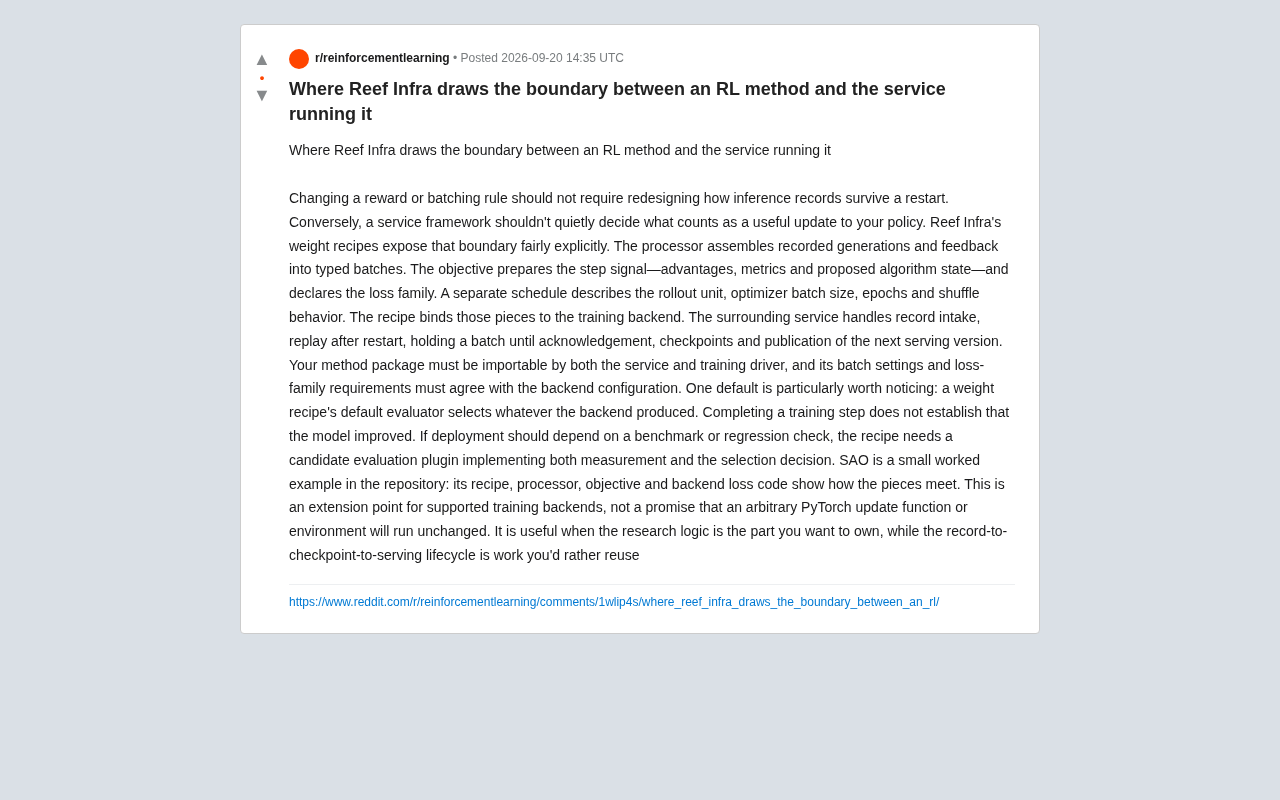
Weight Recipes: Decomposing Responsibilities
At the core of Reef Infra's design is the decomposition of a training update into components with clearly defined responsibilities — so researchers can own only the parts they actually care about.
The mechanism involves several collaborating roles:
- Processor: Assembles recorded generations and feedback into typed batches.
- Objective: Prepares the signals needed for a training step — advantages, metrics, and proposed algorithm state — and declares the associated loss family.
- Schedule: Independently describes rollout units, optimizer batch size, number of epochs, and shuffle behavior.
- Recipe: Binds all of the above to a specific training backend.
The value of this layering is that each component has a well-defined input/output contract. When researchers adjust reward rules, they touch the Objective or Processor — without disturbing the underlying data lifecycle.
This kind of componentized decomposition isn't unheard of in distributed RL systems, but Reef Infra's contribution is formalizing the boundary. In traditional RL engineering, advantage computation (e.g., GAE — Generalized Advantage Estimation) is often tangled up with data sampling and batch construction, frequently scattered across rollout buffers or trainer classes — making algorithm swaps require widespread changes. Reef Infra extracts the Objective into a standalone unit responsible solely for "given a batch of existing records, compute training signals and declare a loss family." The loss family concept describes the type of backend dependency the objective function requires (e.g., policy gradient, value regression), serving as the contract interface between a recipe and its backend. This means implementing a new RL algorithm only requires writing Processor and Objective — scheduling and checkpointing logic remain untouched.
What the Serving Framework Owns
Complementing the algorithm components is the service layer that runs around them. This layer handles the unglamorous plumbing that researchers least want to rebuild from scratch:
- Record intake
- Replay after restart
- Holding a batch until acknowledgement
- Checkpoints
- Publication of the next serving version
In other words, the complete lifecycle from "record" to "checkpoint" to "live serving" is managed entirely by the serving framework. Researchers only need to ensure their method package is importable by both the serving and training drivers, and that their batching settings and loss family requirements are consistent with the backend configuration.
The replay after restart capability deserves a closer look — it targets a high-frequency failure scenario in online RL serving: when a service process crashes or undergoes a rolling restart, rollout records that have been collected but haven't yet completed a training step are at risk of being lost. The naive solution is to re-collect, but this wastes environment interaction costs and may be impossible to reproduce in stateful environments. Reef Infra's serving framework persists records and re-injects them after restart, making the training pipeline idempotent with respect to service interruptions. Similarly, the hold-until-acknowledgement mechanism addresses backpressure between the training and serving sides — the serving end won't discard the current batch until the training step completes and is acknowledged, preventing permanent data loss due to training failures. Together, these two mechanisms form the fault-tolerance foundation of Reef Infra's service layer.
A Default Behavior Worth Watching
The original documentation specifically calls out a default setting worth being cautious about: the weight recipe's default evaluator simply accepts whatever the backend produces.
This hides a common misconception — completing a training step does not mean the model got better. A successful training step only tells you the pipeline ran; it is not evidence of improved model quality.
If you want deployment decisions to depend on a benchmark or regression check, you must supply the recipe with a candidate evaluation plugin that implements two things: measurement and a selection decision. This design hands the "should we ship this?" decision back to the researcher, preventing the serving framework from making that call quietly on your behalf.
The candidate evaluation plugin corresponds architecturally to a classic gatekeeper pattern: each training run produces a candidate weight version, and only candidates that pass the evaluator are promoted to the official serving version. Measurement quantifies the candidate model's quality; the selection decision produces a binary judgment based on that measurement. Common implementations include: win-rate comparison against the current production model, checking whether key metrics regress on a held-out test set, or running targeted safety evaluations. Notably, this mechanism echoes the canary release philosophy from continuous delivery — both emphasize that "release" and "deployment" should be controlled, explicit actions, not side effects that the pipeline completes automatically.
SAO: A Complete Example in the Repository
To make the abstract boundaries tangible, Reef Infra includes SAO in the repository as a small but complete example. Its recipe, processor, objective, and backend loss code concretely demonstrate how these components connect to one another. For developers looking to get started, SAO is the best entry point for understanding how the full mechanism fits together.
Positioning: An Extension Point, Not a Universal Container
One important clarification: Reef Infra explicitly positions itself as an extension point for supported training backends, not a promise that any arbitrary PyTorch update function or environment will run unchanged. This is a pragmatic boundary statement — it doesn't try to be an all-encompassing framework, but instead focuses on a specific value proposition:
When the research logic is the part you want to own, and the "record to checkpoint to serving" lifecycle is the work you'd rather reuse, Reef Infra is where it fits.
This tradeoff reflects a mature engineering philosophy. The complexity of RL systems rarely lies in the algorithm itself — it lies in the state management, fault recovery, and version publishing that surrounds it. Standardizing and making reusable these recurring infrastructure concerns, so researchers can focus on reward design, objective functions, and policy updates, is the core problem Reef Infra is trying to solve.
Summary
Reef Infra's value isn't in offering a novel RL algorithm — it's in making the boundary between "algorithm methodology" and "running service" explicit. Through the Processor / Objective / Schedule / Recipe decomposition, combined with the service layer's unified lifecycle management, it lets researchers iterate on algorithm logic without rewriting infrastructure. And that reminder about the default evaluator is a warning for every RL engineer: a training run completing successfully is not the same as the model improving — you need to explicitly define your own deployment gate.
Related articles

Python 3.15 New Feature: Is the sentinel Type Better Than None?
Python 3.15 adds the sentinel type, using named unique sentinel objects to replace None and bare object(), resolving confusion among missing values, explicit emptiness, and invalid input while avoiding type hint failures.

Deep Learning's Three Architectures and the Universal Approximation Theorem: A Complete Guide to MLPs, CNNs, and Transformers
Explaining the inductive bias differences among MLP, CNN, and Transformer, the existence meaning of the Universal Approximation Theorem (UAT), and the role of Taylor expansion in approximation analysis, while clearing up common misconceptions.

GitLab Emergency Patch Release: Analysis of Critical Security Fixes
GitLab releases critical patch 19.5.1, sparking 355 points of discussion on Hacker News. This article analyzes the background, upgrade steps for self-hosted instances, and verification points to help DevOps teams respond quickly to security updates.