How Safe Is Safe Enough for Self-Driving Cars?

There's no universal standard for AV safety — the answer is being negotiated between data, regulation, and public trust.
The article centers on the question of how to determine when an autonomous vehicle is truly safe enough, arguing it's far more than a technical problem. Statistically proving AVs are safer than humans requires billions of real-world miles — an enormous cost in time and resources. Safety itself is multidimensional, and no single metric captures performance in long-tail edge cases. The debate over who sets standards — companies or independent regulators — reflects deep tension between commercial interests and public safety. AI's black-box nature further complicates verification. Ultimately, the piece frames this as a social question: in a world without zero risk, who defines acceptable risk, and how will that definition evolve?
A Question With No Standard Answer
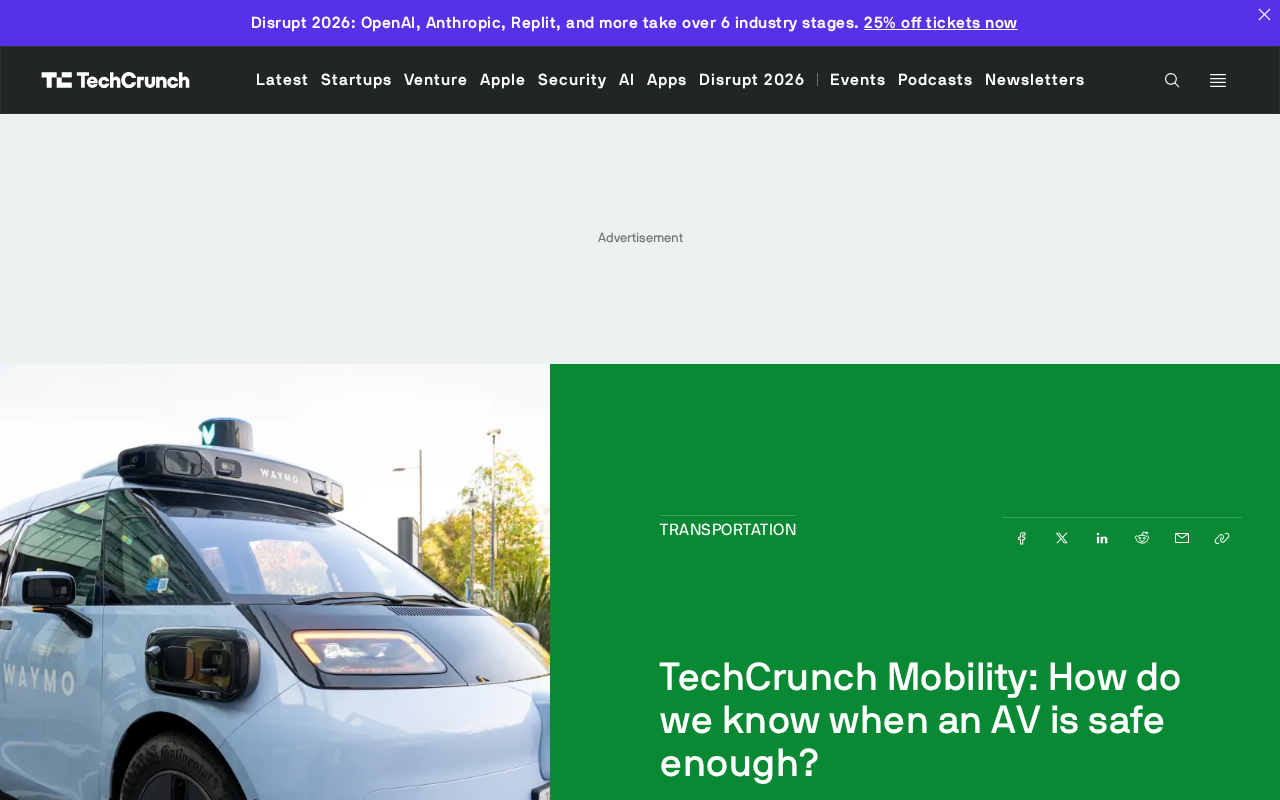
TechCrunch Mobility posed a deceptively simple yet incredibly difficult question: how do we know when an autonomous vehicle (AV) is safe enough? This question runs through the entire development of the self-driving industry and underpins the foundation of trust between regulators, companies, and the public.
As AI takes on an increasingly central role in transportation, autonomous driving is no longer a distant laboratory concept — it's a commercialized product gradually entering real roads. But precisely because it directly involves human lives, the phrase "safe enough" conceals layers of complex technical, ethical, and policy considerations.
Why "Safety" Is So Hard to Quantify
Human driver safety is backed by mountains of statistical data — accidents per miles driven, fatal collisions per year. For an autonomous driving system to prove it's "safer than humans," it theoretically needs to accumulate vast amounts of real-world mileage data. The problem is that achieving statistical significance may require hundreds of millions or even billions of miles of driving — a massive challenge in both time and cost for any company.
What makes this even trickier is that safety isn't one-dimensional. A system might perform excellently on highways yet expose weaknesses at complex urban intersections, in adverse weather, or in unexpected situations. Simply measuring "accidents per mile" fails to fully capture a system's true capabilities in long-tail edge cases.
The challenge of statistical "significance" becomes visceral when you look at the numbers: NHTSA data shows human drivers average one fatal accident per 160 million miles. To prove with 95% confidence that an AV's fatal accident rate is 20% lower than humans, RAND Corporation research estimates roughly 11 billion miles would need to be accumulated — equivalent to about 500 years of operation for a 100-vehicle fleet running around the clock. This reality has spurred alternative approaches like accelerated testing and simulation, where simulators generate massive volumes of scenarios to compensate for the lack of real-world mileage. But the "reality gap" between simulation and the real world itself becomes another layer of debate. "Edge cases" refer to extremely low-frequency situations in real-world distributions that are nonetheless critical for safety — such as a pedestrian darting out unexpectedly, incorrect road markings, or sensor occlusion. These scenarios are difficult to adequately cover in standard testing, yet they're precisely where accidents tend to happen.
Who Gets to Define "Enough"
The core divide in this debate often comes down to who holds the power to set standards. Should companies self-certify their safety, or should independent regulatory bodies establish the thresholds? Different stakeholders have vastly different tolerances for "acceptable risk."
For companies, earlier commercialization means faster returns. For regulators, public safety is a non-negotiable baseline. And for ordinary people, a single high-profile accident is enough to shatter trust in the entire technology. This tension means "safe enough" has never been a purely technical question — it's the product of technology, commerce, and social consensus intertwined.
AI Makes the Problem Even More Complex
With AI deeply embedded in autonomous driving decisions, the "black box" nature of these systems introduces new challenges for safety verification. Perception and decision-making models based on deep learning don't always produce behavior that can be fully explained or predicted. Traditional software testing methods struggle to cover all possible responses of a neural network across the infinite variety of real-world scenarios.
This means that even if a system performs well in simulated environments and closed-course testing, there's no 100% guarantee it will always make the right call in the real world. Establishing a credible evaluation framework for this kind of uncertainty is a challenge the industry and regulators must tackle together.
The core AI architecture of autonomous driving systems is typically divided into three layers: perception, prediction, and planning. The perception layer relies on fused inputs from LiDAR, cameras, and millimeter-wave radar, using deep convolutional neural networks for object recognition. The prediction layer performs probabilistic modeling of the trajectories of nearby vehicles and pedestrians. The planning layer then generates vehicle control commands based on this information. The "black box" problem inherent in this end-to-end or modular deep learning pipeline means it's difficult to explain in rule-based language why a system made a particular decision for a given input — in other words, it lacks explainability. Current industry approaches include: Formal Verification — using mathematical methods to prove the behavioral boundaries of a system under specific constraints — and Operational Design Domain (ODD) restriction, which clearly defines that a system only operates within specific geographic, weather, and speed parameters, compressing uncertainty to a manageable range. Both approaches attempt to draw credible boundaries around safety claims while acknowledging that it's impossible to enumerate every possible scenario.
Final Thoughts
The question raised by TechCrunch Mobility is fundamentally asking about the hallmark of an industry's maturity: when we can't define safety as absolute "zero risk," what level of risk is society willing to accept — and who gets to make that call, and how?
As autonomous vehicles gradually enter everyday life, the answer to this question will not only determine the pace of technology deployment, but will also reshape our collective understanding of transportation safety. There will never be a final answer. Instead, it will be continuously redefined through the ongoing negotiation between accumulating data, evolving regulation, and public trust.
Related articles

JobRunner MCP Server: AI Agents Can Now Fix Failed Java Jobs
JobRunner launches an open-source MCP server enabling AI agents to view cluster status, diagnose failures, and recover Java jobs—incident response from any cloud coding environment or existing agent.

MLAI Digital Launches 9 Security Agents: MCP Server Safeguards the Full Lifecycle of Agentic AI
MLAI Digital launches Security MCP Server with nine built-in specialized security agents covering vulnerability discovery, attack simulation, prompt injection detection, API and infrastructure assessment, and accelerated remediation—embedding security validation across the full Agentic AI lifecycle from development to production.

Running Isaac Lab on H100 GPUs: Exploring Better Approaches
Exploring optimization methods for running Isaac Lab on NVIDIA H100 GPUs, including MIG configuration, mixed precision, TensorRT acceleration, and community experience to improve robotics simulation and reinforcement learning efficiency.