How Should Natural Language Autoencoders Be Evaluated and Improved?

The study builds an NLA auditing evaluation system and proposes several extensions, revealing that early training helps but over-training harms.
To address the lack of systematic evaluation for NLAs, this study builds an auditing-task evaluation system covering revealing latent knowledge, identifying misleading hints, and capturing silent fabrication. It proposes extensions such as fusing multi-layer and multi-position activations, optimizing long-transcript applications, and reducing false claims, achieving improvements on self-built and adapted evaluations. It also finds that all metrics improve early in training but prolonged training may harm some auditing evaluations, suggesting continuous monitoring of auditing capability rather than relying on a single training metric.
Natural Language Autoencoders (NLAs) are a method for generating natural language explanations of LLM activations, with the goal of making a model's internal states readable and auditable. However, there has been a lack of systematic evaluation frameworks for measuring whether these explanations are genuinely useful. A recent study built an evaluation system around auditing tasks and proposed several extensions to improve NLAs, revealing how auditing capability changes during training.
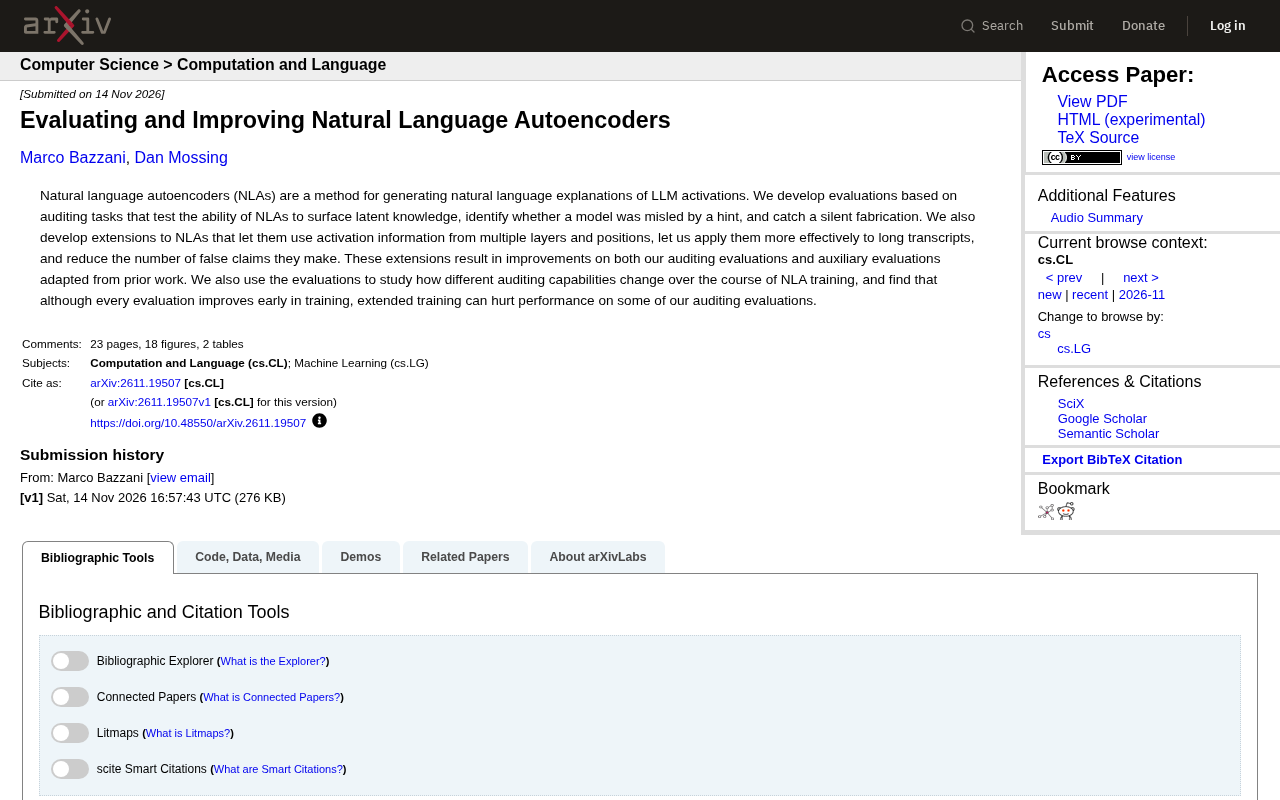
Evaluating NLAs: Three Types of Auditing Tasks
The evaluation designed by the research team is based on auditing tasks, directly testing whether NLAs can be useful in real-world scenarios. It covers three directions:
- Revealing latent knowledge: testing whether NLAs can extract implicit knowledge from activations that the model does not explicitly express in its output.
- Identifying misleading hints: determining whether NLAs can identify whether the model has been misled by hints in the input.
- Capturing silent fabrication: testing whether NLAs can detect unstated fabricated content in model outputs.
Together, these three task types form a multi-dimensional stress test of NLA explanation capability, going beyond previous evaluation approaches that focused only on explanation fluency or surface-level similarity. Introducing the auditing perspective brings evaluation closer to actual safety and interpretability needs.
Activations refer to the hidden state vectors of a certain layer (or a certain position) when an LLM performs forward propagation. The model's external output is only the probability distribution over the final tokens, while activations in intermediate layers carry richer internal representations, including information the model "thought of but did not say." The role of NLAs is precisely to translate these high-dimensional, dense activation vectors into natural language descriptions, allowing auditors to read the model's internal states. Understanding this helps grasp why tasks such as "revealing latent knowledge" are feasible in principle: implicit knowledge is often encoded in activation dimensions that are not explicitly used by the output pathway.
Auditing in this context refers to systematically checking whether model behavior is consistent with what it claims, for example, whether there are hidden intentions, whether it is manipulated by cues in the input, or whether it generates unlabeled fabricated content. Unlike traditional interpretability evaluations (such as explanation fluency or similarity to human annotations), auditing-oriented evaluation focuses on whether explanations can support specific judgments, and is therefore closer to the practical needs of safe deployment.
Extending NLAs: Multi-layer, Long Text, and Reducing False Claims
Building on the evaluation, the researchers developed several extensions to improve the practicality of NLAs:
- Using activation information from multiple layers and positions: no longer limited to a single layer or a single position, but instead fusing activations from multiple layers and positions to provide richer context for explanations.
- Applying more effectively to long transcripts: optimized for long conversations or long documents so that NLAs can maintain explanation quality in long texts.
- Reducing false claims: lowering the number of inaccurate or unsupported assertions generated by NLAs.
These extensions brought improvements on both the self-built auditing evaluation and auxiliary evaluations adapted from prior work, indicating that the improvement directions generalize across evaluations.
False claims refer to assertions in NLA-generated explanations that lack activation evidence or are inconsistent with the model's actual internal states. Such claims are especially dangerous for auditing because they can lead auditors to make judgments based on incorrect cues. Reducing false claims usually requires introducing constraints on explanation faithfulness into the training objective, or performing post-hoc verification of generated content. This extension is complementary to the "revealing latent knowledge" task: the former requires explanations not to fabricate, while the latter requires explanations not to omit key implicit information. Together they define the upper and lower bounds of NLA explanation quality.
Training Dynamics: Early Gains and the Risk of Over-training
The study also used the evaluation system to examine how different auditing capabilities change during NLA training. A key finding is that all evaluation metrics improve early in training, but prolonged training may harm performance on some auditing evaluations. This means that NLA training is not simply better with more training; excessive training may cause the model to degrade on specific auditing tasks. This phenomenon suggests that practitioners need to continuously monitor auditing capability during training rather than relying only on training loss or a single metric.
Over-training refers to the phenomenon in which, after a model continues to optimize on the training objective, its ability to generalize to other related tasks declines. In the NLA setting, the training objective is usually reconstructing activations or matching explanations, while auditing capability is a downstream metric with a different objective. Prolonged training may cause NLAs to overfit to explanation patterns in the training distribution, thereby degrading on auditing tasks that require flexible reasoning. This explains why different auditing metrics can exhibit non-monotonic curves during training, and also indicates that auditing evaluations should be used as independent criteria for early stopping and model selection rather than relying solely on training loss.
Implications and Outlook
This work advances NLA evaluation from "whether explanations sound human" to "whether explanations help with auditing," providing reusable task designs for standardized evaluation of interpretability tools. Extensions such as multi-layer activation fusion and suppression of false claims also demonstrate an effective path combining engineering improvements with evaluation-driven development. The findings on training dynamics remind the research community that there may be tension between the training objectives of interpretability tools and auditing objectives, requiring more refined trade-off strategies.
As LLMs are deployed more deeply in critical scenarios, tools that can reliably reveal model internal states will become increasingly important. The evaluation and improvement work on NLAs lays a methodological foundation for this direction.
One-line Summary
This study builds an NLA auditing evaluation system and proposes several extensions, revealing that early training improves performance but over-training is harmful.
Paragraph Summary
To address the lack of systematic evaluation for Natural Language Autoencoders (NLAs), this study builds an evaluation system based on auditing tasks, covering three capabilities: revealing latent knowledge, identifying misleading hints, and capturing silent fabrication. On this basis, the researchers propose extensions such as fusing activations from multiple layers and positions, optimizing application to long transcripts, and reducing false claims, achieving improvements on both the self-built auditing evaluation and adapted auxiliary evaluations. The study also examines training dynamics and finds that all evaluation metrics improve early in training, but prolonged training may harm performance on some auditing evaluations, suggesting the need to continuously monitor auditing capability rather than relying on a single training metric. The work advances NLA evaluation from explanation fluency to practical auditing utility.
Related articles

Prompt Engineering for Beginners: From Writing Prompts to Engineering Thinking
Starting from the essence and four functions of prompts, this article systematically explains the six-step process, four success criteria, learning value, and practical limitations of prompt engineering to help you build a complete understanding.

Anthropic Launches Nasdaq IPO: AI Giant's Listing and Risk Disclosures
Anthropic officially launches its Nasdaq IPO under ticker ANT, with market valuation expected to potentially exceed SpaceX's record. The prospectus devotes nearly 100 pages to AI risks, while first-half revenue grew over 14x but net losses widened sharply, reigniting the AI bubble debate.

Rust cURL Clone Uses 4,832 unsafe Blocks—Is the Memory Safety Myth Broken?
A Rust cURL clone uses 4,832 unsafe keywords, challenging Rust's memory safety narrative. We analyze what unsafe really means, compare Fil-C, and examine rewrite motives.