How Should the BED Framework Be Redesigned When Experimental Data Is Used by External Decision Makers?

When data users are not experiment designers, standard Bayesian experimental design fails, requiring a usage-aware framework to minimize usage risk.
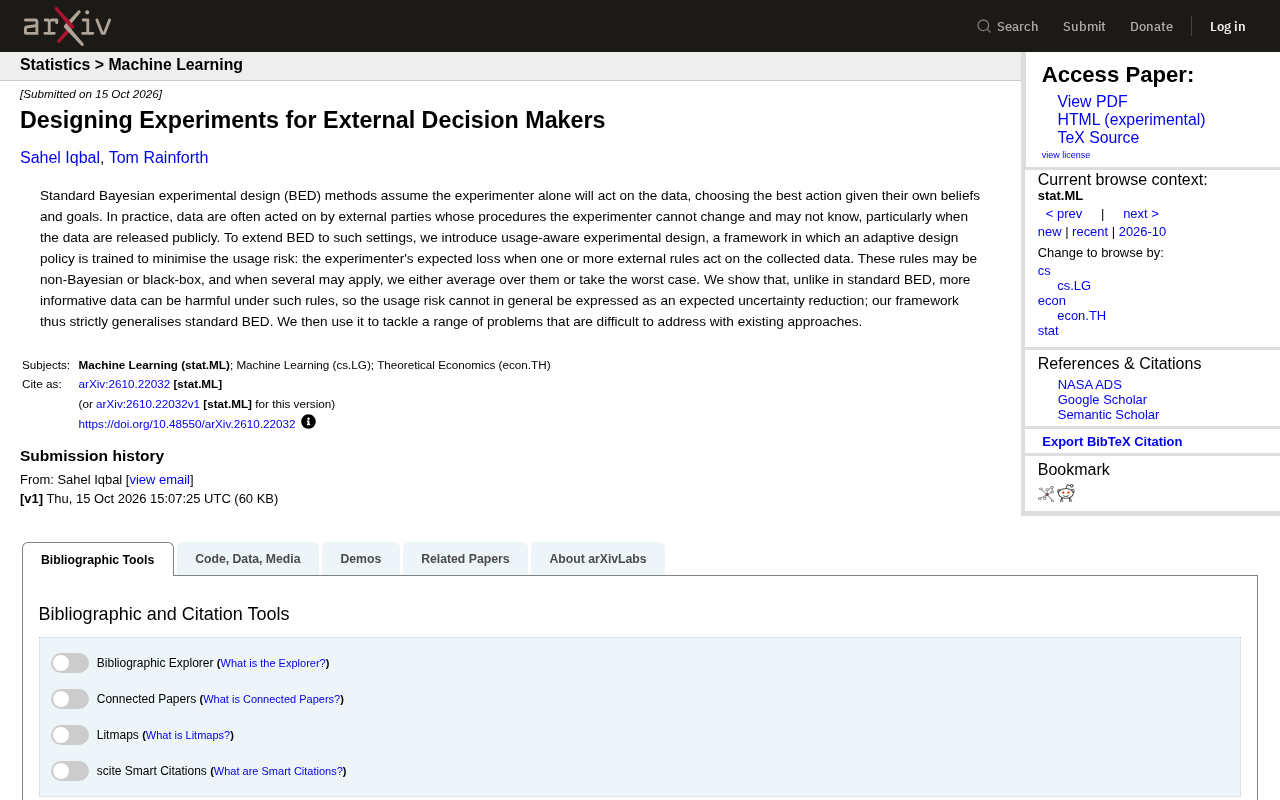
This article discusses a paper on 'usage-aware experimental design' that challenges the implicit assumption in standard Bayesian Experimental Design (BED) that the experimenter is the data user. When data is used by external parties (regulators, downstream developers) with non-Bayesian or black-box rules, traditional BED's expected uncertainty reduction objective no longer applies, and 'more information can be harmful' may occur. The authors formalize the problem as policy learning, training adaptive policies to minimize usage risk under unknown external rules, strictly generalizing standard BED. The article analyzes the significance from both methodological and practical perspectives, noting that as AI experimental design and decision execution become increasingly separated, the framework provides an optimizable formal tool for thinking about how data will be used by others.
Introduction: Who Is Paying for the Data?
Standard Bayesian Experimental Design (BED) has a hidden assumption: the person who designs the experiment is also the person who ultimately uses the data to make decisions. The experimenter selects the experimental design that best reduces uncertainty according to their own prior beliefs and objectives, then takes the optimal action based on the results. This logic is elegant and works well in laboratory settings and controlled industrial processes.
But the real world is far more complex. When a company publishes an A/B test report, a research team releases a dataset, or a pharmaceutical company publishes clinical trial results, the entities actually making decisions based on that data are often external parties—regulators, downstream developers, policymakers, or even the general public. The experimenter can neither control these external decision makers' decision rules nor, in many cases, even know who they are.
This paper proposes a solution precisely for this structural misalignment. The authors formalize the problem as "usage-aware experimental design," using a trainable adaptive policy to minimize "usage risk."
The classic formalization of standard Bayesian Experimental Design (BED) can be traced back to the expected information gain criterion proposed by Lindley (1956): given a prior distribution $p(\theta)$, a candidate design $d$, and possible observations $y$, select the design that maximizes mutual information $I(\theta; y \mid d)$. This criterion corresponds to Bayesian risk minimization in decision theory, and its validity depends on a key assumption—that the experimenter uses the same prior and posterior for decision-making as in the design phase, the so-called "self-usage" assumption. When the actual consumers of the data hold different priors, adopt different loss functions, or even follow non-probabilistic rules, the optimality guarantee of the Lindley criterion no longer holds. The "usage risk" discussed in this paper can be understood as: the expected loss borne by the experimenter under the external decision maker's actual action rule $\pi(a \mid y)$, which replaces the endogenous posterior uncertainty measure in traditional BED.
The Core Problem: When the Data User Is Not the Experiment Designer
The objective function of traditional BED can typically be expressed as expected uncertainty reduction—selecting the experimental design that makes the posterior distribution most concentrated. The implicit premise underlying this objective is that once the experimenter obtains the data, they will update their beliefs and act in a Bayesian-optimal manner.
The paper explicitly points out that once external rules are introduced, this premise fails. External rules may be non-Bayesian (such as fixed threshold rules, heuristic rules) or black-box (such as another machine learning model, a regulatory scorecard). When multiple rules may apply, the authors propose two approaches: averaging over rules, or taking the worst case.
The key insight is: in the presence of external rules, more informative data can actually be harmful. This means that usage risk cannot in general be expressed as expected uncertainty reduction, and standard BED is merely a special case of the usage-aware framework.
The counter-intuitiveness of this conclusion is worth pausing to consider. We typically assume that "more information is always good," but if the external decision maker's rules are non-Bayesian, a more precise estimate may trigger a wrong action—for example, a threshold rule might suddenly change the decision when the estimated value crosses a critical point, and that decision may be costly for the experimenter.
Non-Bayesian decision rules have deep theoretical foundations in statistics and economics. Unlike Bayesian optimal decisions, non-Bayesian rules do not require the decision maker to hold a probability distribution over parameters, nor do they require their actions to minimize posterior expected loss. Common examples include: frequentist hypothesis testing rules (such as rejecting the null hypothesis when the p-value is less than 0.05), Neyman-Pearson tests, fixed threshold rules (such as approving a drug only when the estimated effect size exceeds a certain clinical significance threshold), and various heuristic scorecards. The common feature of these rules is that they contain discontinuities in parameter space—a tiny change in the estimate can cross a decision boundary, causing the action to jump. It is precisely this discontinuity that makes "more precise estimates" not necessarily lead to "better decisions," thereby breaking the intuition that "more information is better." In regulatory science, this phenomenon is known as the "threshold effect" or "boundary effect," and it is a real problem in drug approval and financial risk control.
Technical Approach of the Usage-Aware Framework
The authors' approach transforms the experimental design problem into a policy learning problem. The adaptive design policy selects the next experimental point or condition at each round based on existing data, with the goal of minimizing the experimenter's expected loss under all possible external rules.
The flexibility of this framework lies in the fact that it does not require the experimenter to know the internal logic of external rules. Rules can be black boxes, can change over time, and multiple rules can coexist simultaneously. The training process only needs to be able to evaluate the rule's output on given data, without requiring differentiation or any Bayesian assumptions about it.
From a technical perspective, this transforms the problem from classic combinatorial optimization or greedy selection into a sequential decision-making problem, which can be solved using reinforcement learning or gradient-based policy optimization methods. The authors demonstrate in the paper that this method can handle a range of problem scenarios that existing methods struggle to address.
Modeling experimental design as a sequential decision-making problem is not an entirely new idea. In Bayesian optimization and active learning, experiment selection has long been formalized as a Markov Decision Process (MDP), where the state is the current posterior or data summary, the action is the next experimental point, and the reward is information gain or negative loss. The key difference between this paper's framework and these works lies in the design of the reward function: traditional methods use endogenous information measures (such as entropy reduction, mutual information), while the usage-aware framework directly uses the expected loss under external rules as the reward. This means the policy network (or gradient estimator) does not need to differentiate through the external rules, but only needs to evaluate the rule's output on sampled trajectories, making it compatible with black-box rules. At the algorithmic level, such problems can typically be solved using REINFORCE, pathwise derivatives (reparameterization trick), or value-based Q-learning, with the specific choice depending on whether the experimental space is discrete or continuous, whether the rules are differentiable, etc. The "gradient-based policy optimization" mentioned in the paper likely refers to this class of methods that perform stochastic gradient estimation on policy parameters.
Multi-Source Perspectives: What This Research Means
From discussions across multiple independent sources, the value of this work is mainly reflected at two levels.
At the methodological level, it breaks the long-standing implicit assumption in the BED community that "the experimenter is the decision maker." Commentators from multiple AI research directions have pointed out that as AI systems increasingly participate in scientific discovery and decision-making processes, the separation of experimental design from decision execution will become the norm rather than the exception.
At the practical level, this framework has direct implications for data release strategies. If a company knows that its public data will be interpreted by external regulators or competitors using fixed rules, then the optimal data collection strategy may not be "as accurate as possible," but rather "maintaining sufficient uncertainty near critical rule boundaries."
However, some viewpoints caution that the estimation of usage risk itself depends on assumptions about the distribution of external rules. When the set of rules is completely unknown, worst-case optimization may be overly conservative, leading to a significant decline in experimental design efficiency. This trade-off requires careful calibration in practical applications.
Implications for AI Experimental Design
Experimental design in the AI field is undergoing a paradigm shift. In the past, model developers designed experiments to optimize their own models, and the data users were clearly defined. But now, open-source models are used by countless downstream tasks after release, benchmark results are cited by policymakers, and safety evaluation reports are interpreted by regulatory agencies—the gap between experiment designers and data users continues to widen.
This research provides a formal tool for thinking about this gap. It does not offer a universal answer, but it transforms the vague concern of "how will others use this data" into an optimizable objective function.
For teams working on AI evaluation, benchmark design, and data release strategy research, this framework is worth attention. It reminds us that when designing experiments, we should not only ask "what can this experiment tell me," but also "what will others read from this experiment's results, and will what they read harm me."
One-line Summary
When the data user is not the experiment designer, standard Bayesian experimental design fails, and a usage-aware framework is needed to minimize usage risk.
Paragraph Summary
This article discusses a paper on "usage-aware experimental design" that challenges the implicit assumption in standard Bayesian Experimental Design (BED) that "the experimenter is the data user." When data is used by external parties (such as regulators, downstream developers) following non-Bayesian or black-box rules, the traditional BED objective of expected uncertainty reduction no longer applies, and the counter-intuitive phenomenon that "more information can be harmful" may even occur. The authors formalize the problem as policy learning, training an adaptive policy to minimize usage risk under unknown external rules, with the framework strictly generalizing standard BED. The article analyzes the significance of this work from both methodological and practical perspectives, noting that as AI experimental design and decision execution become increasingly separated, this framework provides an optimizable formal tool for thinking about "how others will use the data."
Related articles

Chain of Thought Isn't Just for AI: How Humans Can Use CoT to Improve Thinking Quality
Chain of Thought isn't just a prompt trick for large models. Starting from a Hacker News discussion, this article analyzes why CoT works for human thinking too, breaks down actionable ways to transfer it, and highlights the key differences between human CoT and machine CoT.
Cloudflare Teams Up with OpenAI: Closi…
Cloudflare Teams Up with OpenAI: Closing the Loop from Vulnerability Discovery to Defense with AI
Cloudflare uses OpenAI Daybreak to investigate security vulnerabilities and generate reviewable remediation plans, while developers use Codex to boost coding efficiency and quality.

Orca Multi-Agent Orchestration in Practice: A Guide to Parallel Collaboration with Claude and Codex
Orca is Stable AI's free open-source agent workbench supporting 34 agents like Claude Code and Codex in parallel. Learn its Git worktree isolation, multi-model orchestration, and mobile management.