How Softmax Attention Learns Decision Thresholds: A Theoretical Study of Training Dynamics

Theory reveals how softmax attention learns decision thresholds via coordinated parameter divergence, enabling in-context learning.
This theoretical ML study uses a minimal two-parameter softmax attention model to analyze how gradient pretraining enables the model to estimate decision-stump thresholds — a statistical boundary-localization problem. Under large-resolution initialization, gradient descent yields a frozen estimator whose error decomposes cleanly into a pretraining accuracy term and an in-context localization term. The core mechanism, "coordinated parameter divergence," sees attention scale grow at rate t^(1/4), progressively sharpening focus on samples near the decision boundary. The study also identifies structural limitations of single-head models and argues theoretically for the value of reflected symmetrization, offering a micro-level rationale for multi-head attention.
Background: How Attention Mechanisms Learn to Locate Boundaries
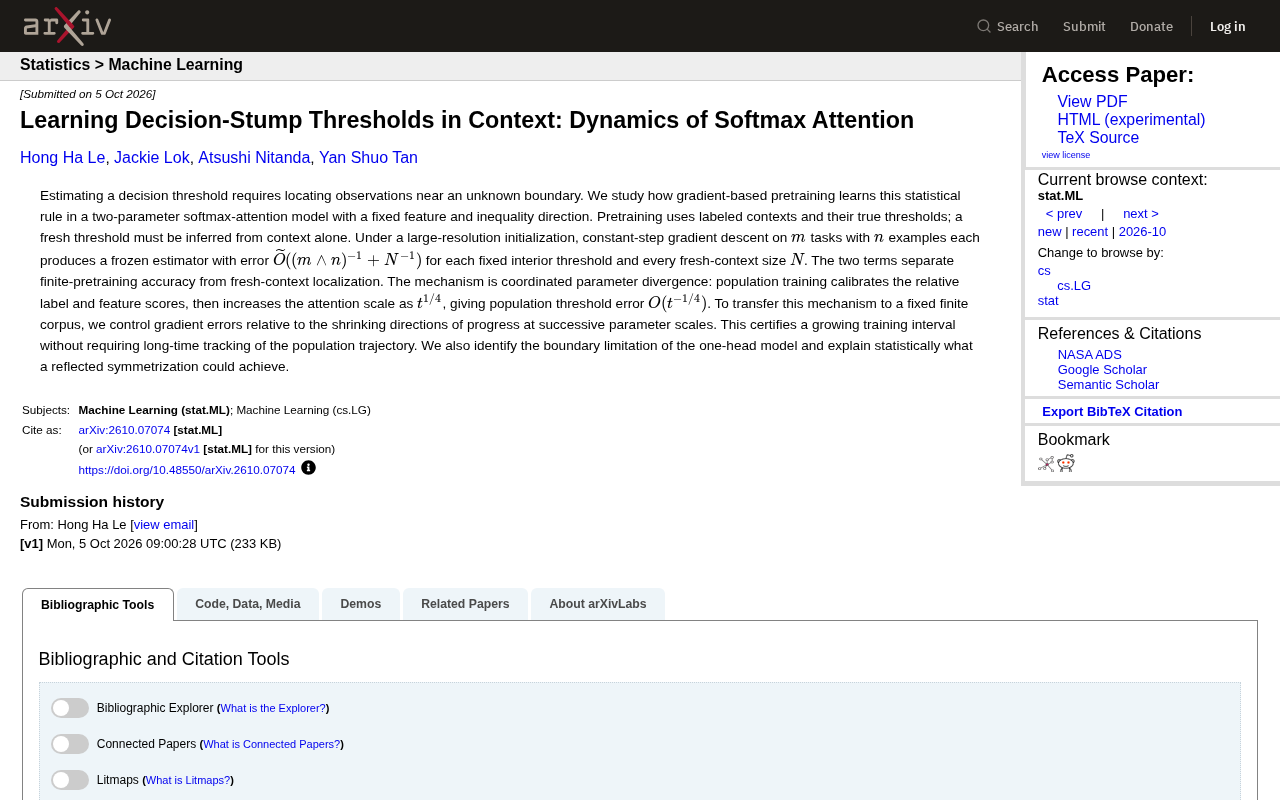
In machine learning, estimating a decision threshold is fundamentally a problem of locating observations near an unknown boundary. This study published on arXiv (paper 2610.07074v1) focuses on a question that appears simple yet carries significant theoretical value: how does gradient-based pretraining enable a model to learn this statistical rule?
The researchers construct a two-parameter softmax attention model with fixed features and inequality direction, using it to analyze the learning process for decision-stump thresholds. This highly simplified setup is not aimed at achieving practical performance, but rather at revealing the internal learning dynamics of attention mechanisms within an analytically tractable framework.
Core Setup: Separating Pretraining from In-Context Inference
The training paradigm of this model is quite illuminating. During pretraining, the model is given labeled contexts along with their true thresholds, while at inference time, a brand-new threshold must be inferred from context alone — closely mirroring the in-context learning (ICL) paradigm seen in modern large language models.
The central finding is: under large-resolution initialization, gradient descent with a constant step size over $m$ tasks (each containing $n$ samples) produces a "frozen estimator" with error $\widetilde O((m\wedge n)^{-1}+N^{-1})$, a result that holds for every fixed internal threshold and for arbitrary new context sizes $N$.
A Natural Two-Term Error Decomposition
The elegance of this error bound lies in its clean separation into two terms, each corresponding to a distinct source:
- The first term $(m\wedge n)^{-1}$ reflects finite pretraining accuracy — the bottleneck determined by the minimum of the number of training tasks and the number of samples per task;
- The second term $N^{-1}$ reflects in-context localization ability — how accurately the threshold can be located given the context size at inference time.
This clean decomposition allows us to separately understand two independent dimensions: "how much statistical rule has been learned" and "how precisely can it localize in a new setting."
In-context learning (ICL) refers to the ability of large language models to complete new tasks at inference time using only a small number of input examples, without updating any parameters. This phenomenon has been widely observed in models such as GPT-3, but its underlying mechanism has long lacked theoretical explanation. One leading hypothesis suggests that during pretraining, models implicitly learn a kind of "learning algorithm" that allows them to perform operations resembling Bayesian inference or gradient descent at inference time. This study operates within that framework, concretizing ICL as the analytically tractable task of "estimating a decision threshold from context," providing a rigorous mathematical entry point into the mechanisms behind ICL.
Core Mechanism: Coordinated Parameter Divergence
The key mechanism revealed by this study is called coordinated parameter divergence. Specifically, the overall training process first calibrates the relative relationship between label scores and feature scores, then grows the attention scale at a rate of $t^{1/4}$, causing the population-level threshold error to converge at a rate of $O(t^{-1/4})$.
This finding offers a theoretical perspective on why attention mechanisms work: the sustained growth of the attention scale is not incidental, but rather the inevitable result of the model progressively "sharpening" its focus on observations near the decision boundary. As training proceeds, the model becomes increasingly capable of concentrating attention precisely on the critical samples near that boundary.
Transferring from Population to Finite Data
A common challenge in theoretical analysis is that elegant population-level results do not always carry over cleanly to finite data settings. The researchers address this by controlling gradient errors — keeping them manageable relative to the "continuously shrinking progress directions" along each parameter scale.
The significance of this technical approach is that it proves an ever-growing training interval is effective without requiring long-term tracking of the population trajectory. In other words, the study provides a method for rigorously characterizing finite-sample training behavior without relying on idealized continuous trajectories.
A decision stump is the simplest form of decision tree: it has a single split node and performs binary classification based on whether a single feature exceeds some threshold. Despite its limited expressive power, the decision stump is widely used as a baseline model in theoretical analysis — from early Boosting theory to this study — precisely because its simplicity allows researchers to strip away complexity and focus on core mechanisms. In this study's context, the threshold itself is an unknown random variable, and the model must infer its location by observing labeled context samples. Statistically, this is equivalent to estimating a quantile or boundary parameter of a distribution, for which a clear theory of optimal estimation exists as a reference benchmark.
Limitations of the Single-Head Model and Symmetrization Insights
The study does not shy away from the model's limitations. The authors explicitly identify constraints of the one-head model at the boundary and explain from a statistical perspective how reflected symmetrization may offer improvement.
This discussion is valuable: it shows that a single attention head has an inherent structural deficiency when handling boundary cases, and that introducing a symmetrization mechanism — essentially supplementing information from the inequality in the opposite direction — has the potential to overcome this limitation. This also provides a micro-level theoretical clue for understanding why multi-head attention is necessary.
Reflected symmetrization is a common variance-reduction technique in statistical estimation: for a given estimator, averaging it with its version reflected about an axis of symmetry can eliminate one-sided bias. In the context of attention mechanisms, a single-head model naturally tends to locate boundaries from one direction (e.g., sorting feature values in ascending order), while exhibiting systematic bias for boundaries in the opposite direction. By introducing symmetrization — that is, simultaneously considering attention heads corresponding to both the forward and reverse inequalities — the model effectively approaches the boundary from both sides at once. This can theoretically reduce the error rate from that of one-sided estimation to the level of symmetric estimation, providing a concrete statistical explanation for why multi-head attention is theoretically necessary.
Significance and Reflections
This work is a quintessential piece of theoretical machine learning research. Rather than pursuing empirical performance on large-scale tasks, it uses a drastically simplified model to gain an analytically tractable understanding of attention learning dynamics.
Its contributions are primarily threefold: first, it decomposes the abstract ability of "in-context learning" into quantifiable error terms; second, it reveals the statistical meaning behind the widely observed phenomenon of attention scale diverging during training; and third, by exposing the limitations of the single-head model, it provides an indirect argument for the reasonableness of more complex architectures.
For researchers interested in the theoretical foundations of Transformers, this kind of micro-level dynamics analysis is an important piece of the puzzle for understanding emergent capabilities in large models. While a vast gap remains between simplified models and real-world large models, it is precisely this type of rigorous theoretical work that gives us a clearer picture of "what attention is actually learning."
It should be noted that this article is based on the paper's abstract. Specific proof details, experimental validation, and broader applicability boundaries should be verified against the full paper.
Related articles

Chain of Thought Isn't Just for AI: How Humans Can Use CoT to Improve Thinking Quality
Chain of Thought isn't just a prompt trick for large models. Starting from a Hacker News discussion, this article analyzes why CoT works for human thinking too, breaks down actionable ways to transfer it, and highlights the key differences between human CoT and machine CoT.
Cloudflare Teams Up with OpenAI: Closi…
Cloudflare Teams Up with OpenAI: Closing the Loop from Vulnerability Discovery to Defense with AI
Cloudflare uses OpenAI Daybreak to investigate security vulnerabilities and generate reviewable remediation plans, while developers use Codex to boost coding efficiency and quality.

Orca Multi-Agent Orchestration in Practice: A Guide to Parallel Collaboration with Claude and Codex
Orca is Stable AI's free open-source agent workbench supporting 34 agents like Claude Code and Codex in parallel. Learn its Git worktree isolation, multi-model orchestration, and mobile management.