How Sparse Attention Papers Sugarcoat Their Results: Four Common Tricks Exposed

A researcher exposes four common tricks used to inflate results in sparse attention papers.
A veteran researcher reveals how sparse attention and KV Cache compression papers systematically inflate experimental results through four common tricks: cherry-picking compression-friendly benchmarks like simple NIAH tasks, asymmetric hyperparameter tuning that favors the proposed method over baselines, using aggregate metrics to mask failures on hard subtasks, and exploiting saturated benchmarks where over-parameterized models naturally tolerate compression. The post urges the community to demand fairer evaluations and compare against simpler alternatives like KV Cache quantization.
Introduction: A Researcher's Self-Reflection
Efficient Attention mechanisms and KV Cache compression are among the hottest directions in large model inference optimization today. KV Cache (Key-Value Cache) is a core optimization technique for Transformer models during autoregressive inference — when generating each new token, the model needs to compute attention scores between the current token and all historical tokens, which requires retaining the Key and Value vectors of every past token. As context windows grow longer, KV Cache memory consumption scales linearly. Take Llama-2 70B as an example: the KV Cache for a 128K context can exceed 100GB of GPU memory. How to dramatically reduce computation and memory overhead without sacrificing model performance has become a shared pursuit of both academia and industry. Current mainstream compression approaches include sparse attention (computing attention for only a subset of token pairs), KV Cache eviction (discarding unimportant KV pairs), KV Cache quantization (representing KV vectors in lower precision), and sharing/merging strategies.
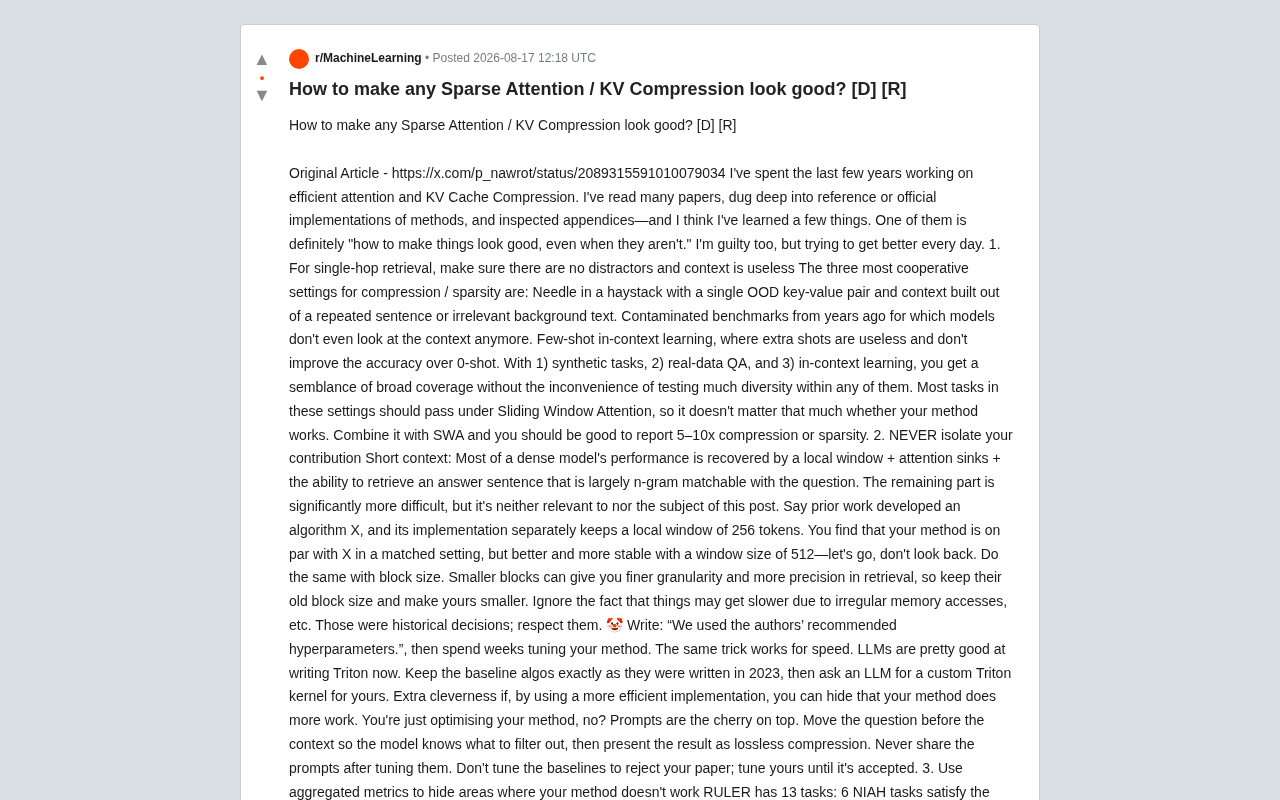
However, Piotr Nawrot, a researcher who has worked deeply in this field for years, recently published a provocative "reflection" post on social media with a title that cuts straight to the point: How to make any Sparse Attention / KV Compression method look good? He openly admitted that he "used to be part of the problem" but is trying to do better. Written in a near self-deprecating tone, the post systematically exposes the pervasive experimental beautification tricks found in papers across this field.
This isn't a simple rant — it's a profound interrogation of the credibility of the entire evaluation ecosystem. For anyone following cutting-edge research, understanding the logic behind these "tricks" matters far more than blindly trusting the pretty "5-10x compression ratio" numbers printed in papers.
Trick #1: Cherry-Pick the Most Compression-Friendly Benchmarks
The author identifies three categories of evaluation scenarios that are most "cooperative" with compression and sparse methods — almost guaranteeing that any method will perform well:
- Single-hop Needle in a Haystack (NIAH): Insert a single out-of-distribution (OOD) key-value pair while the context is padded with repetitive sentences or irrelevant background text. The Needle in a Haystack test was originally proposed by Greg Kamradt in late 2023 to evaluate a model's ability to precisely retrieve specific information within long contexts. Since the filler text is typically repetitive or irrelevant content that differs significantly from the "needle" in terms of semantics and distribution, even simple attention patterns can easily locate the target — the critical KV pairs naturally stand out in attention scores, making it nearly impossible for compression methods to lose them.
- Contaminated benchmarks from years ago: The model has already seen these datasets, and can sometimes answer correctly without even reading the context.
- Few-shot in-context learning: The extra examples are effectively useless — 0-shot and few-shot accuracy show no difference.
These three scenarios correspond to "synthetic tasks," "real-data QA," and "in-context learning" respectively. They appear to cover a broad range, but each category internally lacks genuine diversity in challenge. The author makes a sharp observation: Most of these tasks can be passed with Sliding Window Attention (SWA) alone.
Sliding Window Attention is a method that restricts the attention range so that each token only attends to tokens within a fixed-size window around it, rather than the entire context sequence. The Mistral model family is a representative example, using a window size of 4096 tokens at every layer. SWA's core assumption is that for most natural language tasks, the most recent context contains the most critical information. Since SWA's KV Cache size is constant (equal to the window size), it naturally achieves O(1) memory usage instead of O(n).
In other words, whether your method actually works doesn't matter — just combine it with SWA and you can proudly report 5-10x compression ratios or sparsity levels. This exposes a brutal reality: many seemingly impressive compression results are fundamentally just simple tasks that a local window could handle. If an evaluation task can be passed with SWA alone, then any more complex sparse/compression method's stellar performance on that task is unconvincing — it hasn't demonstrated effectiveness in scenarios that genuinely require long-range dependencies.
Trick #2: Never Evaluate Your Contribution in Isolation
This is the sharpest section of the entire post. The author reveals a series of tactics for gaming experimental setups:
Asymmetric Hyperparameter Tuning
In short-context scenarios, most of a dense model's performance actually comes from "local window + attention sinks + the ability to retrieve answer sentences that have n-gram overlap with the question." Attention Sinks were systematically described by Xiao et al. from MIT in their 2023 StreamingLLM paper: Transformer models allocate massive attention weights to the first few tokens of a sequence (typically tokens 1-4), regardless of their semantic content. This occurs because the softmax normalization mechanism needs a "sink" to dump attention weights when there's no specific token worth attending to, and the tokens at the beginning of the sequence, being visible from all positions, naturally assume this role. This means that simply retaining a small number of KV pairs from the beginning of the sequence plus a local window can maintain the model's basic functionality — the baseline is already strong on its own.
Here comes the trick: suppose prior method X uses a local window of 256 tokens, and you find your method is more stable with a 512 window — just use 512, while keeping the baseline at 256. Apply the same trick to block size: use smaller blocks for your method to get finer retrieval granularity, while keeping the baseline's old block size.
The author uses a biting emoji (🤡) to mock this practice: The paper says "we use the authors' recommended hyperparameters," then spends weeks furiously tuning their own method.
Shenanigans in Speed Comparisons
Nowadays, LLMs can proficiently write Triton kernels. Triton is a programming language and compiler developed by OpenAI for writing efficient GPU kernels, dramatically lowering the barrier to writing CUDA-level high-performance code. Traditionally, writing efficient GPU operators required deep understanding of the CUDA programming model, shared memory management, warp scheduling, and other low-level details. Triton allows developers to write code in near-Python syntax while the compiler automatically handles memory coalescing, thread mapping, and other optimizations. As large language models themselves have gained the ability to write Triton code, researchers can quickly generate optimized GPU implementations for their new methods.
This is where the shenanigans appear: keep the baseline algorithm's original implementation from the paper, but have an LLM craft a custom optimized Triton kernel for your method. An even "smarter" move is to use a more efficient implementation to mask the fact that your method actually performs more computation. The performance difference may stem from implementation quality rather than the algorithm itself, but paper readers can hardly tell the difference.
Hidden Advantages in Prompt Design
Place the question before the context so the model knows in advance what to filter for, then market the results as "lossless compression." After tuning the prompt, never share it publicly. The core logic boils down to one sentence: Don't tune the baseline well enough that it could reject your paper; only tune your own method until it gets accepted.
Trick #3: Use Aggregate Metrics to Hide Failure Modes
The author uses the widely popular RULER benchmark as an example. RULER (Real-world Understanding of Long-context Evaluation and Retrieval) was proposed by NVIDIA's research team in 2024 and comprises 13 synthetic tasks designed to test a model's ability to handle long contexts across multiple dimensions. These tasks fall into four categories: NIAH (Needle in a Haystack, including 6 variants such as single needle, multi-needle, and multi-key-multi-value), Variable Tracking, Common/Frequent Words Extraction, and QA tasks based on SQuAD/HotpotQA.
RULER contains 13 tasks, of which:
- 6 NIAH tasks fit the "cooperative" characteristics described in Trick #1;
- 2 QA tasks use datasets from years ago;
- The VT task also contains large amounts of irrelevant context.
The author specifically clarifies that this is not a criticism of RULER — it remains extremely useful. The point is only to demonstrate how it can be misused.
The trick: only report the aggregated average score. As for the noticeable performance degradation on NIAH-MK3 (Multi-Key with 3 keys, which requires the model to simultaneously locate three different keys in long text and return their corresponding values — the subtask with the highest demand on attention completeness)? Mention it briefly in the "Limitations" section at the end of the paper, just for show. Aggregate metrics inherently dilute failures — a point worth watching for in virtually all multi-task benchmarks. When the easier tasks make up the majority of 13 tasks, the average score can effectively mask significant degradation on the few high-difficulty tasks.
Trick #4: Ride the Free Gains from Saturated Tasks
The author proposes a thought-provoking comparative experiment:
Task A: Brand-new math competition problems released just a week ago, not yet in any training data.
Task B: A benchmark where a new model family (1B, 10B, 100B) all score around 80%.
On Task A, compression hasn't even had a chance to cause damage before the 1B and 10B models score 0; the 100B model starts at 50% and monotonically decreases as compression increases. On Task B, models of all sizes can tolerate substantial compression, and the 100B model tolerates even more than the smaller ones.
The author poses a pointed question: Isn't the large model simply using its surplus parameters and hidden state capacity to absorb the losses caused by compression? And this happens precisely in scenarios where those resources weren't needed to solve hard problems in the first place. Choosing saturated tasks exploits this "capacity redundancy" to create the illusion that compression is robust. This observation touches on a deep issue: a model's natural robustness to information loss under over-parameterization should not be mistaken for the superiority of the compression method itself.
Bonus: Statistically Dubious Moves
Finally, the author lists several common practices that are statistically indefensible:
-
AIME has only 30 samples. You run 4 seeds, your method scores 80, the baseline scores 79 — bold your 80 and claim you beat the baseline. As if statistical significance doesn't exist. AIME (American Invitational Mathematics Examination) has been widely adopted in recent years for evaluating LLM mathematical reasoning capabilities. However, with only 30 problems per year, a single correct answer difference corresponds to roughly 3.3 percentage points, and the variance across 4 random seeds may far exceed the true difference between methods. Even without any changes, simply switching random seeds could produce larger fluctuations. This is a classic "p-hacking" problem: selectively reporting the best results when the sample size is insufficient to support reliable conclusions. Strictly speaking, comparisons on small-sample benchmarks should report confidence intervals or conduct paired statistical tests. If your "efficiency method" also happens to set a new SOTA, that's doubly suspicious.
-
Only plot the quality-efficiency curve against the original implementation, then stop there. Never ask: could a smaller dense model, KV Cache quantization or offloading, or a better system configuration achieve a superior operating point? KV Cache quantization compresses FP16/BF16 Key and Value vectors to INT8, INT4, or even lower precision, directly reducing memory usage by 2-4x with typically minimal impact on quality. Works like KIVI and KVQuant have demonstrated that KV Cache often tolerates quantization better than model weights themselves. KV Cache offloading transfers infrequently accessed KV pairs from GPU memory to CPU memory or SSDs, using intelligent prefetching strategies to hide data transfer latency. If a complex sparse attention method doesn't even outperform simple KV Cache quantization combined with a smaller dense model on the quality-efficiency tradeoff, its practical value becomes questionable. Unfortunately, many papers deliberately avoid such "inconvenient" comparisons. Improving your baseline gets repackaged as "advancing the frontier."
Conclusion: Be Wary of the Truth Behind Pretty Numbers
The value of this post lies not in negating the entire efficient attention research direction, but in reminding every researcher and engineer: the rigor of evaluation methodology is often more important than the novelty of the method itself.
For practitioners, the next time you encounter a paper claiming "10x lossless compression," consider asking a few questions:
- Do the tasks contain genuine distractors? Do they go beyond simple NIAH or saturated benchmarks?
- Is the baseline treated fairly? Are hyperparameters, implementation optimizations, and prompt design applied equally?
- Are failure cases hidden beneath aggregate metrics? How does performance look on the hardest subtasks?
- Has the method been compared against simpler alternatives like quantization or offloading? On the same quality-efficiency tradeoff curve, does the complex method truly outperform simpler approaches?
What truly advances a field has never been pretty numbers — it's real capability that withstands rigorous scrutiny. The author closes with "I'm guilty too, but I'm trying to be better every day." That honesty itself may be exactly the dose of sobriety this field needs most.
Related articles

Python 3.15 New Feature: Is the sentinel Type Better Than None?
Python 3.15 adds the sentinel type, using named unique sentinel objects to replace None and bare object(), resolving confusion among missing values, explicit emptiness, and invalid input while avoiding type hint failures.

Deep Learning's Three Architectures and the Universal Approximation Theorem: A Complete Guide to MLPs, CNNs, and Transformers
Explaining the inductive bias differences among MLP, CNN, and Transformer, the existence meaning of the Universal Approximation Theorem (UAT), and the role of Taylor expansion in approximation analysis, while clearing up common misconceptions.

GitLab Emergency Patch Release: Analysis of Critical Security Fixes
GitLab releases critical patch 19.5.1, sparking 355 points of discussion on Hacker News. This article analyzes the background, upgrade steps for self-hosted instances, and verification points to help DevOps teams respond quickly to security updates.