How the ACT-R Model Predicts Individual and Item Differences in Pragmatic Inference

The ACT-R model explains individual and item differences in atypicality-based pragmatic inferences from a resource-rational perspective.
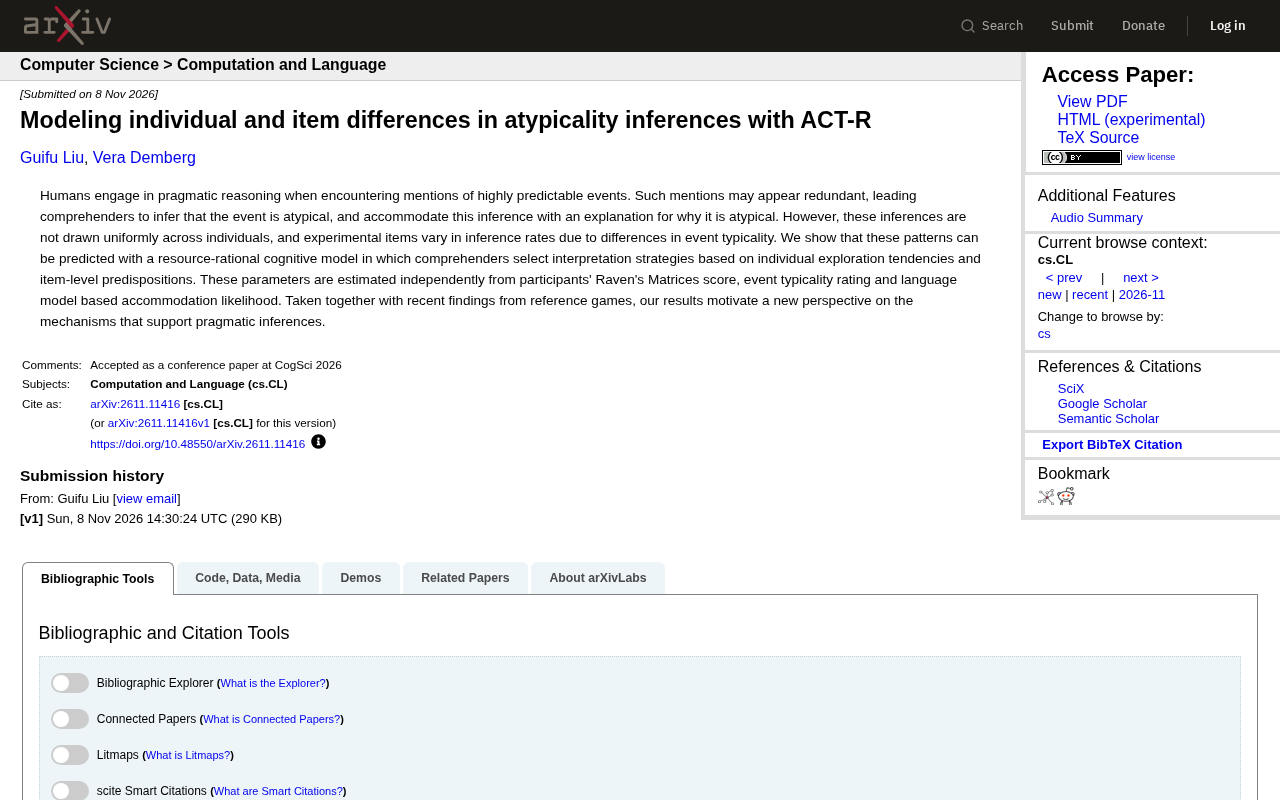
This article presents a new study using the ACT-R cognitive model to investigate atypicality inferences in pragmatic reasoning. When people encounter mentions of highly predictable events, they often infer atypicality and seek explanations, but these inferences vary across individuals and items. The study proposes a resource-rational framework incorporating individual exploration tendencies (estimated from Raven's matrices scores) and item priors (estimated from typicality ratings and language-model affordance probabilities) as separable parameters. The model fits experimental data and converges with reference-game findings, suggesting pragmatic inference is a flexible selection of resource-rational strategies under individual and item constraints.
Atypicality Inferences in Pragmatic Reasoning
When people encounter a mention of a highly predictable event, they often engage in pragmatic inference: such a mention may seem redundant, so the comprehender infers that the event is atypical and searches for an explanation for its atypicality. However, this inference does not occur uniformly across all people, and inference rates also vary across experimental items depending on event typicality. A new study uses the ACT-R cognitive model to explain these individual- and item-level variations from a resource-rational perspective.
Pragmatic inference refers to the process by which listeners, when understanding an utterance, go beyond literal meaning and combine context with speaker intent to derive implied meaning. The classic Gricean theory of conversational implicature holds that when a speaker violates the Quantity maxim (e.g., by providing redundant information), the listener infers that the speaker has a special purpose. Atypicality inference is a concrete manifestation of this mechanism: mentioning a highly predictable event is ostensibly redundant, leading the listener to infer that the event is not the norm and to further seek a reason. This phenomenon connects formal pragmatics and psycholinguistics and is a key experimental paradigm for testing the "redundancy as signal" hypothesis.
Strategy Selection Under the Resource-Rational Framework
The study proposes that comprehenders select interpretive strategies based on individual exploration tendencies and item-level priors. The core of the model lies in quantifying individual differences and item differences as estimable parameters: individual exploration tendencies are independently estimated via Raven's Progressive Matrices scores, while item-level priors come from event typicality ratings and language-model-based affordance probabilities. This separate estimation approach allows the model to capture both dimensions simultaneously: "who is inferring" and "about what."
Resource rationality is a branch of rational choice theory that holds that cognitive agents, under constraints of limited time, working memory, and computational resources, select reasoning strategies that maximize expected utility rather than pursuing unbounded optimal solutions. This framework models cognitive processes as a selection problem within a "strategy space," where each strategy has its costs and benefits. In pragmatic inference, resource rationality means that whether comprehenders make atypicality inferences—and how much cognitive effort they invest—depends on a cost–benefit tradeoff jointly determined by individual exploration tendencies and item characteristics. This perspective provides a unified theoretical foundation for explaining individual and item differences in inference rates.
ACT-R (Adaptive Control of Thought—Rational) is an integrated cognitive architecture proposed by John Anderson for simulating the underlying mechanisms of human cognition. Its core assumption is that cognition consists of modular buffers and production rules, and that behavioral selection follows a utility-learning mechanism: the system dynamically adjusts the utility values of strategies based on historical success. ACT-R is particularly well suited to modeling individual differences because its parameters (e.g., exploration rate, noise, activation decay) can correspond to stable individual traits. In this study, ACT-R is used to formalize resource-rational strategy selection, enabling individual exploration tendencies and item priors to be incorporated as estimable parameters within a single computational model.
Multi-Source Evidence and Model Validation
The model not only fits experimental data on atypicality inferences but also resonates with recent findings from reference games. Similar patterns in reference games suggest that the mechanisms of pragmatic inference may be consistent across tasks. Combining these two lines of evidence, the researchers propose a new perspective on the mechanisms supporting pragmatic inference: inference is not a single fixed process but rather a flexible selection of resource-rational strategies under individual and item constraints.
Reference games are a classic experimental paradigm in psycholinguistics for studying pragmatic inference. In this task, a speaker must choose a descriptive expression for a specific referent, and a listener uses it to identify the target. Because speakers trade off between informativeness and distinguishability, listeners' choice behavior can reflect the degree to which they reason about speaker intent. Reference games have been widely used to test mechanisms such as Gricean reasoning, common ground, and perspective-taking. This study finds that atypicality inferences resonate with inference patterns in reference games, providing convergent evidence for cross-task consistency in the mechanisms of pragmatic inference.
Implications for Pragmatic Inference Research
This work combines cognitive modeling with psycholinguistic experiments, offering a computational-level explanation for understanding variability in pragmatic inference. Through the ACT-R framework, the study demonstrates how a small number of interpretable parameters can connect individual differences, item characteristics, and behavioral outcomes. In the future, this modeling approach may be extended to a broader range of pragmatic phenomena and help reveal the cognitive foundations of strategy selection in language comprehension.
One-line Summary
An ACT-R model explains individual and item differences in atypicality-based pragmatic inferences from a resource-rational perspective.
Paragraph Summary
This article introduces a new study that uses the ACT-R cognitive model to investigate atypicality inferences in pragmatic reasoning. When people encounter a mention of a highly predictable event, they often infer that the event is atypical and seek an explanation, but this inference varies substantially across individuals and experimental items. The study proposes a resource-rational framework that incorporates individual exploration tendencies (estimated from Raven's Progressive Matrices scores) and item priors (estimated from event typicality ratings and language-model-based affordance probabilities) as separable parameters in the model. The model not only fits the experimental data but also converges with reference-game research, indicating that pragmatic inference is a flexible selection of resource-rational strategies under individual and item constraints, providing a unified computational explanation for pragmatic variability.
Related articles

Gemini 4 Neon Released: A Balance Between Frontier Intelligence and Efficient Task Execution
Google DeepMind releases Gemini 4 Neon, focused on frontier intelligence and fast end-to-end task execution. This article breaks down its benchmark performance in coding, enterprise analysis, scientific reasoning, and cybersecurity, its four thinking levels, pricing, and safety alignment data.

Is AI the Culprit Behind Global Outages? The Trust Crisis Behind the NSA and FAA Failures
Fourth major failure in five days hits NSA classified network. Microsoft blames a software bug, FAA denies its new AI system, NSA says routine maintenance. Senator Warner suggests AI accelerates vulnerability discovery, leading to rushed fixes — while 39% of Americans already view AI negatively, exposing a deepening trust crisis.

Robot Developer Builds Custom B-rep Kernel with 3,487 Tests
A robot developer builds a custom B-rep geometry kernel with 3,487 tests, exploring why robotics needs dedicated CAD tools and the barriers to building one.