How the FDA Is Building an AI-Ready Data Foundation on Databricks
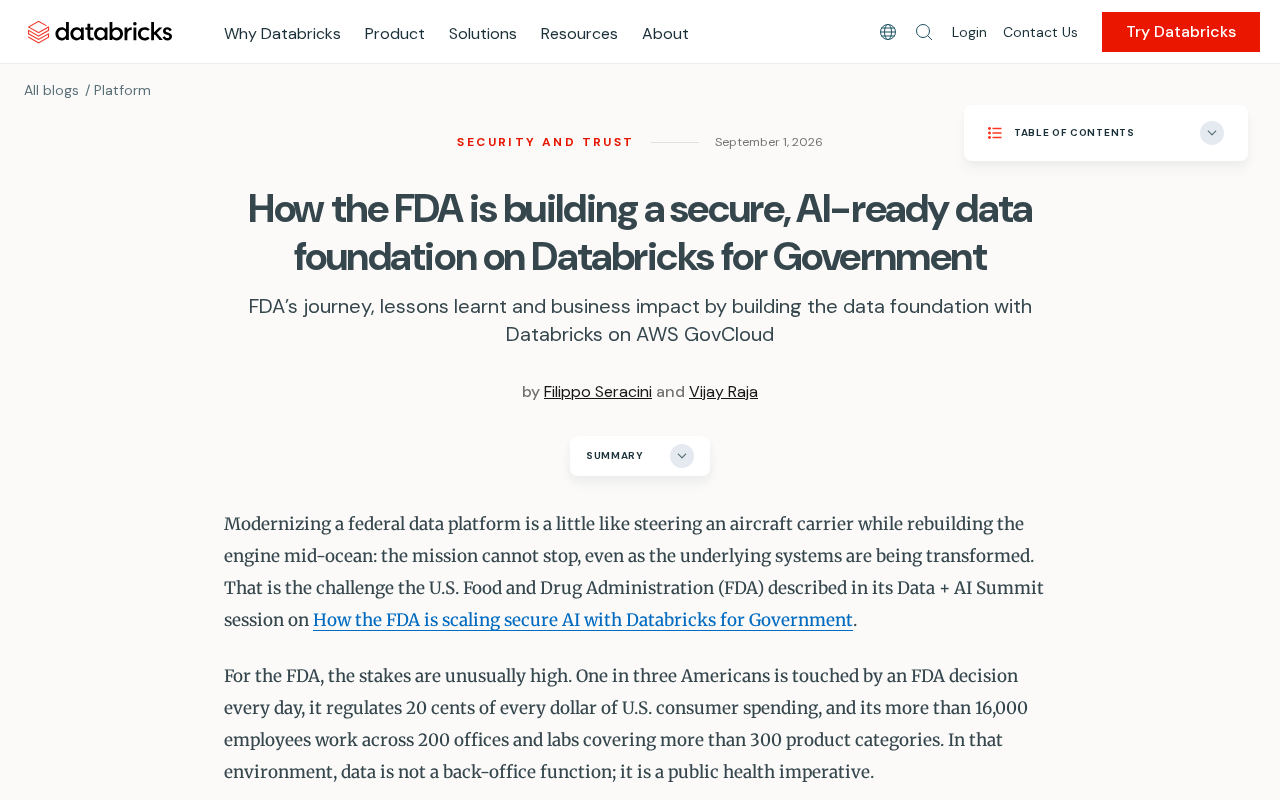
The FDA uses Databricks for Government to build a secure, AI-ready data foundation for drug regulation.
The FDA is modernizing its data infrastructure on Databricks for Government, adopting a unified Lakehouse architecture to break down legacy system data silos while meeting stringent FedRAMP security and compliance requirements. With built-in governance via Unity Catalog and MLOps capabilities through MLflow, the platform enables AI applications in drug safety signal detection, clinical data review, and risk early warning — offering a replicable blueprint for regulated industries.
Introduction: Rebuilding the Engine While at Sea
The U.S. Food and Drug Administration (FDA) is undertaking a monumental data modernization effort. As an official blog post put it, transforming a federal-level data platform is like "rebuilding the engine of an aircraft carrier while it's sailing at sea" — you can't stop the ship, you can't disrupt operations, but you must carry out a thorough overhaul of the underlying infrastructure.
For an agency like the FDA — responsible for drug approvals, food safety, medical device regulation, and more — data reliability, security, and compliance have never been optional; they are lifelines. The FDA's regulatory purview covers approximately 25% of U.S. economic activity. With over 18,000 employees, the agency processes data spanning dozens of domains each year, from adverse drug reaction reports to imported food inspection records. Now, as artificial intelligence matures, the FDA faces a new challenge: how to build an "AI-ready" data infrastructure while upholding federal-level security standards. This is precisely why it chose to deploy on the Databricks for Government platform.
Why Data Modernization Is So Difficult for Federal Agencies
The Data Silo Problem Created by Legacy Systems
Federal government agencies often run legacy systems accumulated over decades. According to multiple reports from the U.S. Government Accountability Office (GAO), the federal government spends over $100 billion annually on IT, with roughly 80% going toward maintaining and operating existing legacy systems rather than investing in modernization. These systems are scattered across different departments, use different data formats, and follow their own storage logic, creating massive "data silos." Some systems may still run on mainframe programs written in COBOL, while others are built on early relational databases — with no unified data model or API interfaces connecting them.
For the FDA, adverse drug reaction reports, clinical trial data, manufacturing facility inspection records, and other information are distributed across numerous independent systems that are difficult to integrate. Take the FDA Adverse Event Reporting System (FAERS) alone: it receives millions of adverse event reports per year, with data formats ranging from structured forms to unstructured physician narrative text — an extraordinarily complex landscape.
For AI to truly deliver value, the prerequisite is that data must be unified, clean, accessible, and governed. Yet the reality is that many agencies haven't even established a unified data view before attempting to introduce AI. This is why the concept of "AI-ready" actually hinges on the "data foundation" — without a solid data base, any AI application built on top is a castle in the air.
The Dual Constraints of Security and Compliance
Unlike commercial companies, federal agency data platforms must meet stringent government security certification requirements. One of the most critical compliance frameworks is FedRAMP (Federal Risk and Authorization Management Program). Established by the U.S. federal government in 2011, FedRAMP is a standardized framework for security assessment, authorization, and continuous monitoring, specifically targeting cloud products and services. Based on the NIST SP 800-53 security control standards, it classifies data sensitivity into three impact levels: Low, Moderate, and High. Achieving FedRAMP High authorization means the platform can handle data involving "severe or catastrophic adverse effects on life safety and economic interests." The certification process is extremely rigorous, typically requiring 12–18 months and involving the assessment and verification of hundreds of security controls, independently audited by a Third-Party Assessment Organization (3PAO). This barrier effectively shuts out a large number of commercial cloud services, making the technology selection pool for federal agencies far narrower than for enterprise users.
This means any technology selection can't just evaluate whether features are powerful — it must also assess whether the solution can operate securely within a controlled government cloud environment and whether it offers robust access controls and auditing capabilities. These constraints multiply the difficulty of "rebuilding the engine while at sea." The FDA must introduce a modern Lakehouse architecture while ensuring that throughout the entire migration, data doesn't leak, permissions don't break down, and audit trails remain complete and traceable.
Core Capabilities Provided by Databricks for Government
A Unified Lakehouse Architecture That Breaks Down Data Silos
The core value of Databricks lies in its Lakehouse architecture, which combines the flexibility of a data lake with the governance capabilities of a data warehouse. This architecture is the product of nearly a decade of evolution in data management. Before it, the industry went through two major phases: the first was the traditional data warehouse era represented by Teradata and Oracle, where data was highly structured and tightly governed but expensive and unable to handle unstructured data; the second was the data lake era represented by the Hadoop ecosystem, which could store massive volumes of heterogeneous data at low cost but lacked transaction support and data quality assurance, often degenerating into a "data swamp." The Lakehouse architecture, through open table format technologies like Delta Lake, introduces data warehouse-level capabilities — ACID transactions, schema enforcement, time travel (data version rollback) — on top of data lake object storage, merging the advantages of both eras.
For the FDA, this means completing the entire workflow — from raw data ingestion, cleansing, and governance to analytics and machine learning modeling — on a single unified platform, without repeatedly shuttling data between multiple disconnected systems. More importantly, the FDA can simultaneously support BI reporting queries and machine learning training on the same copy of data, avoiding the consistency risks and governance blind spots caused by layer upon layer of ETL pipeline data replication in traditional architectures.
This unification directly addresses the "data silo" problem described earlier. When all data converges on a single governed platform, AI models can finally access high-quality, comprehensive data for training and inference.
A Security Foundation Built for Government
Databricks for Government is a version purpose-built for federal agency needs, running in cloud environments that meet government security standards. It includes fine-grained access controls, data lineage tracking, and unified permission governance (such as the Unity Catalog data governance layer), ensuring that every access to sensitive data can be recorded and audited.
Unity Catalog is a unified data governance solution launched by Databricks in 2022, providing centralized metadata management and access control across the entire Lakehouse platform. Its core capabilities include: fine-grained row-level and column-level permission controls (for example, a given analyst can only see de-identified patient data); automated data lineage tracking that records the complete path of data from source to final report or model; and cross-workspace data sharing and discovery. For a regulatory agency like the FDA, data lineage is especially critical — when an AI model issues a drug safety alert, regulators need to trace which raw data the conclusion was based on, what transformation steps it went through, and who accessed it and when. This end-to-end traceability is the cornerstone of regulatory decision credibility and a necessary condition for meeting requirements under laws such as the Federal Information Security Modernization Act (FISMA).
For the FDA, this security layer is vital. It allows the agency to confidently place regulation-related sensitive data on the platform for analysis without worrying about compliance violations. Security is not an afterthought — it's a property built into the architecture from the ground up.
What "AI-Ready" Really Means
A Complete Pipeline from Data Governance to Model Deployment
"AI-ready" is not simply plugging a large model API into a data platform. It represents an integrated set of capabilities: data must be properly governed, features must be reusable, model training and deployment must follow unified workflows, and results must be monitorable and explainable.
The Databricks platform integrates data engineering, machine learning, and analytics capabilities. Its built-in MLflow open-source machine learning lifecycle management framework provides a standardized workflow from experimentation to production for AI deployment. In federal agency contexts, AI model management is far more complex than in commercial settings: training data must be traceable, model versions must be rollback-capable, inference results must be explainable, and the deployment process must have approval records. MLflow's Model Registry feature allows "Staging-Production-Archived" lifecycle management for each model version. Combined with Unity Catalog's permission controls, it ensures that only models that have passed authorized approval can enter production. This MLOps (Machine Learning Operations) practice is particularly important for the FDA — if an AI model used for drug safety signal detection produces false alerts or misses genuine signals due to chaotic version management, the consequences could directly impact public health.
FDA data scientists can complete the entire pipeline — from data preparation to model development to deployment — within the same environment. This integration dramatically reduces the friction cost of AI deployment: data doesn't need to be exported to external environments, and models can be trained directly on well-governed data, fundamentally reducing security risks and compliance concerns.
Potential AI Application Scenarios in Drug Regulation
While building the data foundation itself is foundational engineering, its ultimate goal is to unlock the value of AI in regulatory scenarios. Foreseeable application areas include:
- Adverse Drug Reaction Analysis: The FDA's Adverse Event Reporting System (FAERS) receives approximately 500,000–600,000 adverse event reports per quarter, a large portion of which exists as unstructured free text, including physician descriptions of symptoms and patient medication history narratives. Traditional signal detection methods primarily rely on statistical indicators (such as the Proportional Reporting Ratio, or PRR, and the Bayesian Confidence Propagation Neural Network, or BCPNN), but these methods have limited ability to process text semantics and identify complex drug interaction patterns. With modern NLP (Natural Language Processing) techniques and large language models, the FDA could achieve automated structured extraction from unstructured reports and cross-report semantic correlation analysis, dramatically improving the efficiency and accuracy of signal detection.
- Accelerated Clinical Data Review: Using AI to assist in reviewing large-scale clinical trial submissions, automatically identifying data anomalies and key safety signals, and shortening the approval cycle for clinical trial data.
- Safety Risk Early Warning: Through pattern recognition and time-series analysis, combined with multi-source data (adverse event reports, social media signals, supply chain data, etc.), proactively identifying potential food or drug safety risks.
The prerequisite for all of these applications is consolidating dispersed FAERS data, electronic health record data, clinical trial data, and more onto a single, well-governed data platform. Once these use cases are operationalized, they will directly improve the response speed and precision of public health regulation.
Lessons for Other Agencies and Industries
The FDA's approach offers a referenceable path for other public sector organizations and heavily regulated industries: The first step of AI transformation is not buying models — it's building the foundation.
Specifically, three key lessons are worth noting:
- Incremental progress with business continuity: Data modernization is a gradual process, not a one-shot effort. It must proceed while ensuring business continuity — just like "rebuilding the engine while at sea." The federal government's annual spending of over $80 billion on legacy system maintenance reminds us that technical debt can only be paid down in stages. Attempting to tear everything down and start from scratch usually ends in failure.
- Security and compliance by design: Security and compliance must be factored in from the very beginning of architecture design, not patched in after AI applications go live. The rigor of certification frameworks like FedRAMP means that if compliance requirements aren't considered at the platform design stage, the cost of retrofitting will be prohibitively high — or outright infeasible.
- Choose a unified platform to reduce complexity: Selecting a platform that unifies data engineering, governance, and machine learning can significantly reduce the complexity of downstream AI deployment. Compared to the traditional multi-system combination of "data lake + data warehouse + standalone ML platform," the Lakehouse architecture eliminates data movement steps and governance blind spots — an advantage that is especially pronounced in high-security environments.
For industries facing similarly strict regulations — finance, healthcare, energy, and beyond — the FDA's approach on Databricks for Government holds considerable relevance. For example, the Basel Accord data governance requirements in banking and HIPAA compliance constraints in healthcare share structural similarities with the challenges facing the FDA. The path of "first build a well-governed data foundation, then gradually unlock AI value" is equally applicable.
Conclusion
The story of the FDA building an AI-ready data foundation is ultimately a story about how "the foundation determines the ceiling." In an era where everyone is talking about large models and AI applications, what truly determines whether an organization can effectively use AI is often the less glamorous foundational work — data governance, security architecture, and compliance frameworks.
When this "aircraft carrier" completes its engine rebuild, what the FDA will gain is not just a more modern data platform, but a solid foundation capable of continuously supporting future AI innovation. For the entire public health regulatory system, the value of this effort is profound and far-reaching.
Related articles

Tesla Opens Cybercab Fleet Purchases, Moving Robotaxi Commercialization Toward a Platform Model
Tesla published a Cybercab fleet purchasing interest form, opening Robotaxi fleet buying and operations to third parties — signaling a shift toward a platform model.
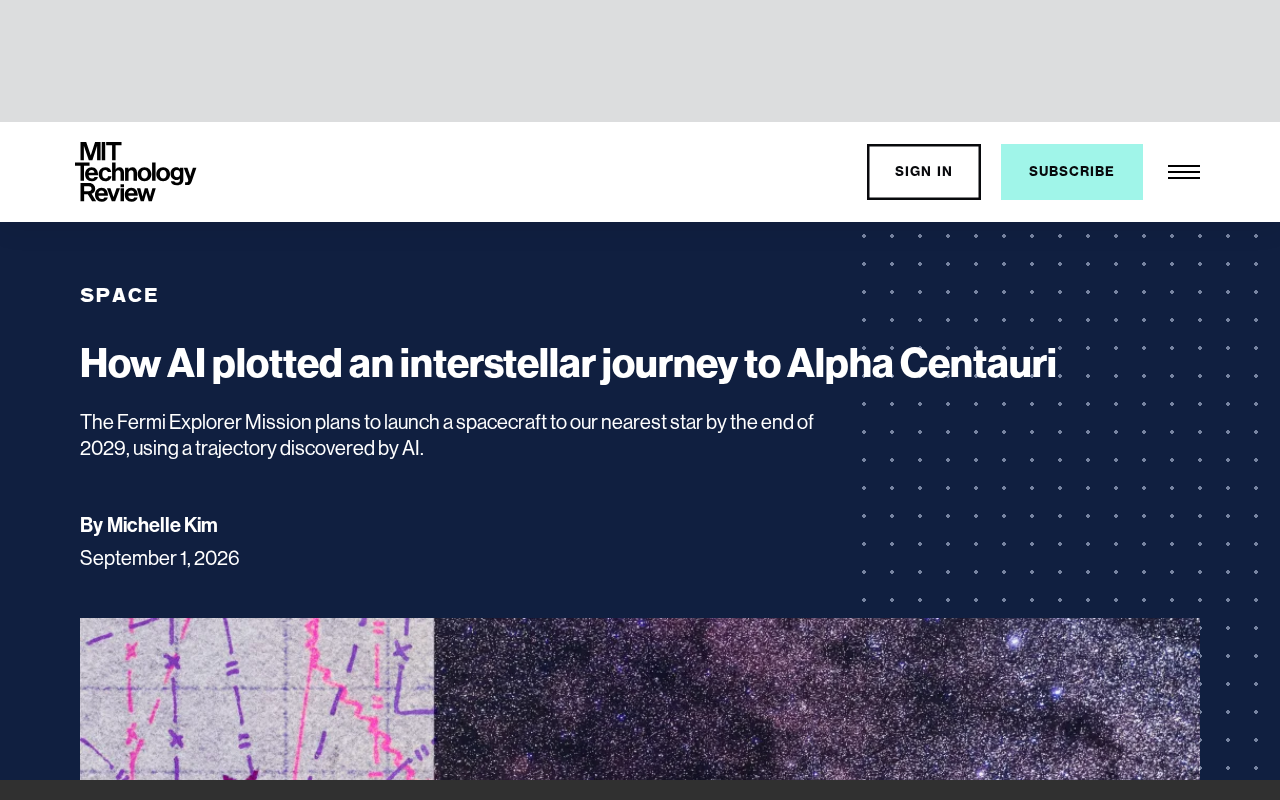
AI Plans an Interstellar Voyage: An 80,000-Year Expedition to Alpha Centauri
The Fermi Explorer Mission plans to launch a spacecraft to Alpha Centauri on an 80,000-year journey. Explore how AI drives trajectory optimization, autonomous navigation, and data prioritization for interstellar exploration.
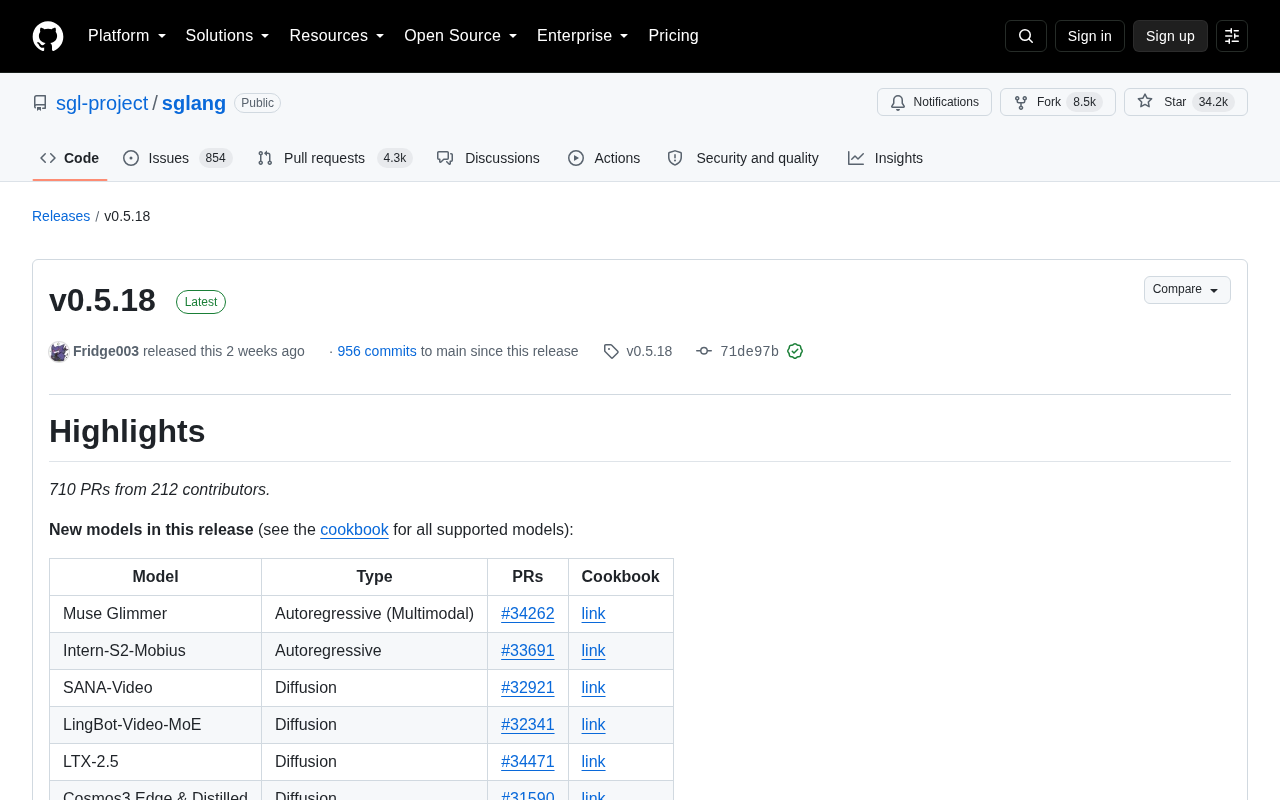
SGLang v0.5.18 Released: Performance Breakthroughs Across 710 PRs
SGLang v0.5.18 brings 710 PRs from 212 contributors, featuring 2.38x startup speedup, tensor parallel optimizations, AMD MXFP4 quantization, and Kimi K3 tuning.