Tesla Opens Cybercab Fleet Purchases, Moving Robotaxi Commercialization Toward a Platform Model
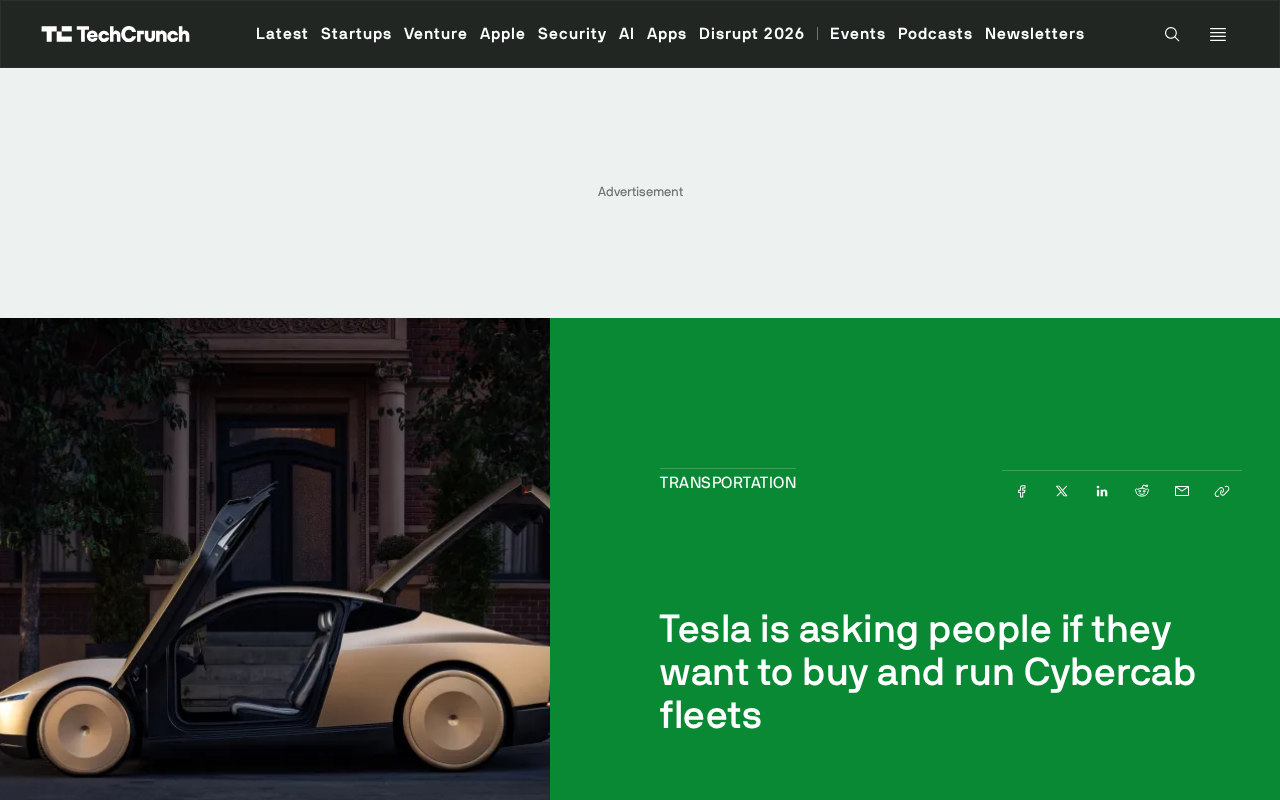
Tesla opens Cybercab fleet purchases to third parties, signaling a platform-based Robotaxi strategy.
Tesla has posted an interest form on its website for purchasing and operating Cybercab fleets, marking a strategic shift from a self-operated Robotaxi model toward a platform-based ecosystem. The move could accelerate fleet scaling by letting external buyers bear vehicle costs while Tesla earns through revenue sharing and software services. However, regulatory hurdles and technology maturity remain key challenges before large-scale deployment.
Tesla Tests the Waters with Cybercab Fleet Ownership Model
Tesla has taken another step forward in the Robotaxi space. According to reports, the company published a form on its website on Thursday to collect information from those interested in purchasing and operating Cybercab fleets. The form is explicitly titled "Cybercab fleet vehicle purchasing," suggesting that Tesla may no longer confine its Robotaxi business to a self-operated model and is instead exploring the involvement of third-party fleet owners in operations.
While this move may seem straightforward, it reveals a significant strategic pivot in Tesla's Robotaxi commercialization roadmap. Previously, the industry widely speculated that Tesla would follow the ride-hailing platform playbook, adopting a fully self-operated fleet model with end-to-end control from manufacturing to operations. Opening up Cybercab fleet purchases to individuals, however, paints a picture much closer to an "asset-light platform" approach.
Cybercab and Musk's "Sharing Economy" Vision
Allowing owners to purchase vehicles and deploy them in a Robotaxi fleet has long been foreshadowed in Musk's public statements over the years. He has repeatedly described a scenario where Tesla owners could connect their idle vehicles to Tesla's autonomous driving network to provide ride services, turning otherwise dormant assets into a continuous revenue stream.
This Cybercab purchase interest form is a concrete step toward realizing that vision. The Cybercab is a vehicle Tesla designed specifically for autonomous taxi scenarios — it has no steering wheel or pedals and was purpose-built for Robotaxi use from the ground up. Enabling individuals or businesses to purchase Cybercab fleets is essentially taking the "owner as operator" concept from idea to execution.
The Business Logic Behind Opening Third-Party Purchases
For Tesla, opening Cybercab fleet purchases to third parties offers at least two key advantages:
- Accelerated capital recovery and production capacity absorption: With external buyers bearing the vehicle purchase costs, Tesla can scale its Robotaxi fleet much faster without shouldering enormous capital expenditures alone.
- Building a platform ecosystem: Tesla could generate long-term revenue through operational revenue sharing, software subscriptions, charging services, and maintenance — repositioning itself from a pure automaker to a mobility network operator.
If this model proves viable, Tesla's expansion in the autonomous taxi market could far outpace what a purely self-operated approach would allow.
Cybercab Commercialization Still Faces Multiple Challenges
While the interest form signals clearer commercial intent, a significant gap remains between collecting interest and achieving large-scale fleet operations.
Regulatory uncertainty is the foremost challenge. A fully driverless Cybercab needs operational permits in each state and city, and policies governing autonomous vehicles vary dramatically across different U.S. regions. Questions such as who bears liability in accidents and how to regulate driverless fleets operated by third-party owners remain largely unresolved.
Technology maturity is another critical bottleneck. Tesla's current Robotaxi service is still in its early stages — limited to certain areas and equipped with safety drivers — and remains some distance from truly large-scale driverless operations. Allowing individual fleet owners to operate Cybercabs places even higher demands on system reliability and remote fleet management capabilities.
A Strategic Signal Worth Watching
Regardless of the eventual pace of deployment, the Cybercab purchase interest form itself is a signal worth paying attention to. It indicates that Tesla is laying the groundwork for Robotaxi scaling well in advance, exploring diversified business models that go beyond self-operated fleets. For investors and industry observers bullish on Tesla's autonomous driving prospects, this is yet another step toward making Musk's vision of "anyone can operate a Robotaxi" a reality.
Conclusion
Tesla's move is still in its early interest-gathering phase, with no details yet disclosed on specific purchase terms, revenue-sharing mechanisms, or eligibility requirements. What is clear, however, is that Tesla is attempting to transform the Cybercab from a concept vehicle into a "productive asset" that individuals and businesses can invest in and operate. If this model proves successful, it could reshape the competitive landscape of the entire Robotaxi industry.
In the coming months, how Tesla responds to interested parties and whether it can secure driverless operation permits in key markets will be crucial indicators of this strategy's viability.
Related articles
The Dude System: How Dual-Detection Multi-Agent AI Catches Inconsistencies Between Papers and Code
Dude is the first dual-detection multi-agent system for paper-code discrepancy detection, using granularity-aligned negotiation and two-stage salience filtering to boost recall and precision by up to 22.8%.
Implicit Instruction Following in Full-Duplex Voice Assistants: DSB-IFEval Benchmark Analysis
In-depth analysis of the DSB-IFEval benchmark reveals full-duplex voice assistants' capability gaps in implicit instruction following, persona reasoning, and conflict resolution. Covers comparative testing of six voice systems and examines behavioral vs. content trade-offs driven by architectural differences.
Personalizing AI Teaching Assistants with Prompt Engineering: A Deep Dive into the Six-Dimension Learner Profile Framework
Explore a prompt engineering framework for AI teaching assistants using six-dimension learner profiles and Bloom's Taxonomy to deliver 96 personalized teaching styles without model retraining.