How to Avoid Ideological Extremism: A Practical Guide to Maintaining Rational Thinking

A practical guide to recognizing and resisting ideological extremism through critical thinking strategies.
This article examines why rational people fall into ideological extremism, exploring mechanisms like motivated reasoning, group polarization, and algorithmic echo chambers. It offers practical strategies including actively engaging high-quality dissent, distinguishing facts from interpretations and values, and cultivating tolerance for uncertainty. It also highlights the special responsibility of tech professionals who design the systems that amplify polarization.
The Challenge of Ideological Polarization in Our Age
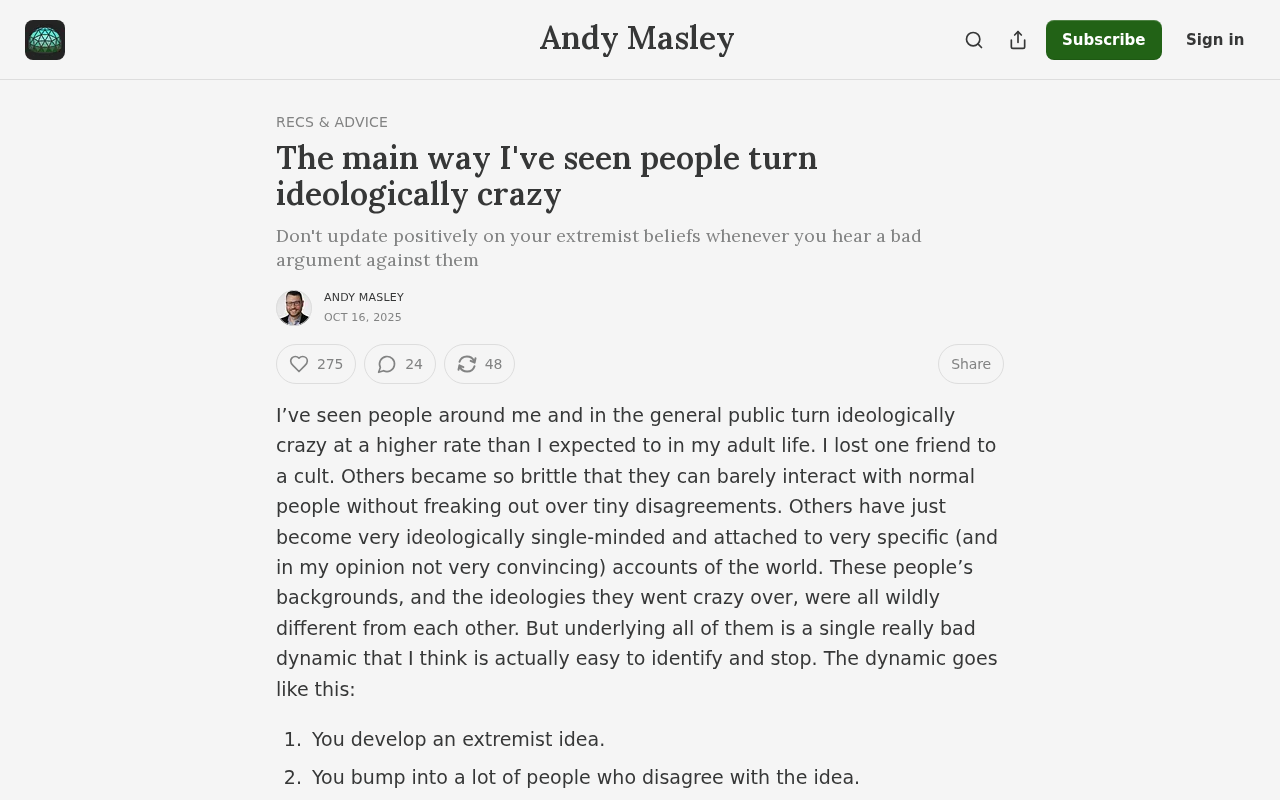
In an era dominated by information overload and algorithmic recommendations, people are more susceptible than ever to falling into ideological echo chambers. An article discussed on Hacker News titled "How not to turn ideologically crazy" touched on a widespread yet underexplored contemporary question: Why do originally rational people gradually slide toward paranoia, extremism, and closed-mindedness?
Though relatively brief, the article sparked lively discussion in the tech community (25 upvotes, 14 comments). Its core concern isn't any specific political stance, but rather a more universal issue of cognitive health—how to maintain independent judgment and mental flexibility in an environment saturated with opposing narratives.
How Ideology Hijacks Your Rationality
From Opinion to Identity: A Dangerous Slippery Slope
What makes ideology dangerous is that it rarely remains merely an "opinion"—it gradually evolves into a core part of one's "identity." When a person internalizes a position as central to their self-concept, any challenge to that position is perceived as an attack on their very personhood. This psychological mechanism makes rational discussion nearly impossible.
Motivated reasoning in psychology clearly describes this phenomenon: people don't examine evidence first and then draw conclusions—they start with a position and selectively seek evidence that supports it. This concept was systematically articulated by cognitive psychologist Ziva Kunda in her classic 1990 paper, where she showed that human reasoning is driven by both accuracy goals and directional goals. When directional goals dominate, people unconsciously engage in selective evidence gathering, biased information interpretation, and differential evaluation of argument credibility. Neuroscience research reveals an even more unsettling truth: when people encounter information that contradicts their existing beliefs, the amygdala (responsible for emotional processing) becomes activated while prefrontal cortex activity (responsible for rational analysis) actually decreases—meaning ideological threats are processed at the neural level as survival threats. This parallels the well-known "confirmation bias," except that in the ideological domain, its destructive power is amplified many times over.
Group Polarization and the Amplification Effect of Echo Chambers
When individuals gather into homogeneous groups, opinions drift toward more extreme positions—this is what social psychology calls group polarization. First discovered by James Stoner in 1961 (then called "risky shift"), it was later systematically studied by legal scholar Cass Sunstein and others. Classic experiments show that when like-minded people discuss an issue together, the group's decision becomes more extreme than the average of individual positions beforehand. Three mechanisms drive this: first, social comparison—people want to be more "correct" than the group average, creating a competition toward extremes; second, the argument pool effect—arguments raised during discussion tend to support the group's existing direction while dissenting views are systematically suppressed; third, identity signaling—expressing more extreme views becomes a way to demonstrate group loyalty.
Social media's echo chamber architecture has amplified this laboratory phenomenon to a global scale. Modern recommendation systems primarily operate on collaborative filtering and deep learning models. Take YouTube's recommendation algorithm as an example: its core optimization objective has long been predicting user watch time, and the model learns that emotionally charged content tends to produce higher watch time and click-through rates. A 2019 experiment by Guillaume Chaslot and other researchers showed that even starting from neutral political content, the autoplay function would guide users toward extreme content within just a few recommendations. Eli Pariser's 2011 concept of the "Filter Bubble" describes precisely this phenomenon: personalization algorithms create a unique information universe where users don't even know what they're missing. Algorithms continuously push content you already agree with, filter out dissent, and ultimately make people believe their position is self-evident truth.
For those who pride themselves on logical thinking, this deserves particular vigilance. Engineers and tech professionals, confident in their reasoning abilities, are often more likely to underestimate their vulnerability to ideological capture in domains outside their expertise.
Practical Strategies for Maintaining Mental Clarity
Strategy One: Actively Seek Out High-Quality Dissent
The most direct way to combat closed-mindedness is to deliberately expose yourself to high-quality arguments that oppose your own position. The key phrase here is "high quality"—this doesn't mean finding the most foolish statements from the opposing camp to mock (i.e., attacking straw men), but genuinely understanding the other side's strongest arguments.
The principle of charity proposed by philosophers is extremely applicable here: before criticizing a viewpoint, first reconstruct it in its most reasonable and strongest form. This principle originates from the analytic philosophy tradition, first systematically proposed by Neil Wilson in 1959 and further developed by Donald Davidson and Willard Van Orman Quine. Its core requirement is: when interpreting others' statements, assume the other party is rational, and among multiple possible interpretations, choose the one that makes their argument strongest and most coherent. Daniel Dennett further operationalized this into "Rapoport's Rules": first, restate the other person's position in your own words so they confirm you understand correctly; then list the points you agree with; next, identify what you've learned from them; only after completing these three steps may you begin your rebuttal. This methodology is nearly counterintuitive in today's polarized environment, yet it represents genuine intellectual honesty. If you can articulate someone's position better than they can, your rebuttal truly has value.
Strategy Two: Distinguish Facts, Interpretations, and Value Judgments
Many ideological conflicts stem from confusing three distinct levels:
- Objective facts: What happened
- Interpretations of facts: Why it happened
- Value-based judgments: What we should do about it
Clearly separating these can significantly reduce unnecessary conflict. Two people may agree on the same facts yet reach entirely different conclusions due to different value priorities. Recognizing this transforms the discussion from "who's lying" to "what do we each value."
Strategy Three: Cultivate Tolerance for Uncertainty
A hallmark of extremist thinking is an excessive craving for certainty. The real world is full of complexity and nuance, while ideology offers simple, clear, black-and-white explanatory frameworks—this "cognitive comfort" is its greatest seduction.
Training yourself to be comfortable with "I'm not sure" and "this issue is complex" is an important discipline of critical thinking. Acknowledging the boundaries of knowledge is not a sign of weakness but a manifestation of intellectual honesty.
The Special Responsibility of Tech Professionals
Ethical Considerations for Algorithm Designers
Discussing ideological extremism in tech communities carries special significance because it is precisely tech professionals who design the recommendation systems, engagement-optimization algorithms, and information distribution mechanisms that drive group polarization.
When a product's core metrics are "time on site" or "engagement rate," the system naturally gravitates toward content that provokes anger, fear, and tribal identification—because these emotions most effectively drive engagement. The commercial root of engagement optimization lies in the attention economy model: when platforms depend on advertising revenue, user attention is the core commodity. Facebook's internal 2018 research (later leaked by whistleblower Frances Haugen) explicitly showed that its algorithm gave disproportionate weight to content triggering "anger" reactions, because anger is the emotion most capable of driving shares and comments among all emotions. Tristan Harris, former Google design ethicist, founded the Center for Humane Technology and described such design as a "race to the bottom of the brain stem"—platforms competing for users' most primal emotional responses. This isn't the malice of individual engineers but a systematic coupling of commercial incentives with human psychological vulnerabilities. Understanding this mechanism means engineers and product designers bear an undeniable responsibility for the health of the information ecosystem.
From Personal Practice to System Design
Avoiding ideological extremism at the personal level is certainly important, but the deeper issue lies in architectural choices at the system level. An information environment that encourages deep thinking, rewards rational dialogue, and protects diverse perspectives won't emerge naturally—it requires intentional design. This is both a technical challenge and a values choice.
Building Your Intellectual Immune System
Maintaining intellectual health, like maintaining physical health, requires continuous, conscious effort. The core takeaways can be summarized as:
- Actively seek out dissent rather than retreating into comfortable echo chambers
- Distinguish facts from judgments to avoid mistaking interpretations for truth
- Tolerate uncertainty and resist the temptation of black-and-white thinking
- Guard against identity-binding—don't let opinions become your personality
In an increasingly polarized era, this kind of "intellectual immune system" may be the most valuable capability for anyone pursuing rationality. For tech professionals who are shaping the future of information, this self-reflection is also the starting point of professional ethics.
Related articles

How Do AI Coding Assistants Write Code? Breaking Down the Inner Workings of Copilot
Deep dive into how AI coding assistants work: from token prediction and context tracking to agentic workflows, revealing how Copilot and Claude Code generate code, plus key limitations developers must know.

Dify in Practice: Enterprise-Grade End-to-End Pipeline Design for Natural Language to SQL
Build a complete NL2SQL solution on Dify with three knowledge bases, multi-model judge mechanism, SQL security validation, and ECharts visualization.

Coze Beginner's Guide: A Complete Tutorial for Building AI Agents with Zero Code
A detailed guide to ByteDance's Coze platform covering core features, China vs. international version differences, and practical use cases. Learn to build AI agents with zero code through drag-and-drop.