Coze Beginner's Guide: A Complete Tutorial for Building AI Agents with Zero Code

A complete beginner's guide to building AI agents on ByteDance's Coze platform with zero coding.
This guide covers ByteDance's Coze platform—a no-code AI development tool that lets anyone build AI agents through drag-and-drop. It explains the differences between China and international versions, the distinction between agents (Bots) and apps, core features like RAG knowledge bases and plugin integrations, and how to choose the right project type for your needs.
ByteDance's Coze is becoming a major gateway for everyday people to get into AI application development. The platform's greatest value lies in this: whether or not you know how to code, you can build your own AI agents through drag-and-drop. This article, based on a systematic Coze tutorial from the Bilibili channel "Hundred Battle Programmers," distills the platform's core concepts, version differences, and practical use cases to help beginners quickly build a comprehensive understanding.
What is Coze
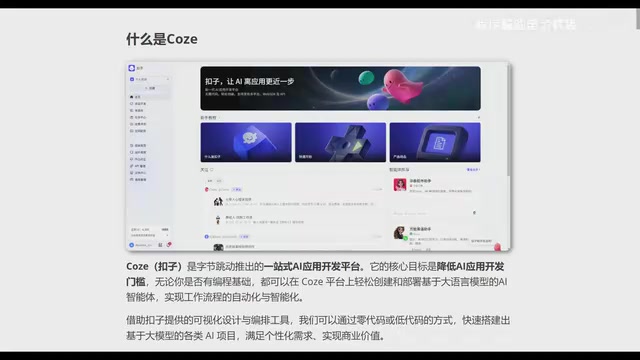
Coze is a one-stop AI application development platform launched by ByteDance, with a very clear core objective: lowering the barrier to AI application development. Traditional AI application development requires solid programming skills, but Coze makes zero-code or low-code development paradigms possible through visual design and orchestration tools.
It's worth expanding on the industry context of low-code/no-code development here. Low-Code and No-Code development are major trends in software engineering in recent years. Traditional software development requires developers to master programming languages, frameworks, databases, and other complete technology stacks, while low-code platforms dramatically lower the development barrier through visual interfaces, pre-built components, and drag-and-drop operations. According to Gartner's predictions, by 2025, 70% of new applications will be built on low-code/no-code platforms. In the AI field, this trend is particularly significant—building an AI application previously required understanding model invocation, prompt engineering, API integration, and other complex steps, while platforms like Coze encapsulate these technical details into visual modules, allowing users to focus solely on business logic.
In other words, the entire development process on Coze is essentially drag-and-drop. Users don't need to write code, and even in the rare scenarios where code is necessary, the platform can automatically generate it through AI. This means non-programmers can also create and deploy AI agents based on large language models on this platform, achieving workflow automation and intelligence.
The tutorial provides a very apt example: suppose you're a customer service representative at a travel company. In the past, writing a personalized itinerary recommendation for each client might take 10 minutes to half an hour. But if you build an itinerary planning agent with Coze, you just need to input the user's parameters like number of days and destination, and the agent can generate a complete itinerary in 10 seconds. This efficiency boost is exactly what makes Coze attractive to everyday professionals.
One important detail: Coze is better suited for developing small, quick AI applications. For programmers, large-scale AI projects still require professional development frameworks (like LangChain, LlamaIndex, etc.), and Coze has obvious limitations in scenarios requiring complex architecture design, high-concurrency processing, and deep customization. Therefore, its true sweet spot lies in lightweight intelligent tools for daily work and life.
Three Core Advantages of Coze
Coze's competitive strengths can be summarized in three areas.
Extremely Low Development Barrier
This is Coze's signature advantage. The platform adopts a visual drag-and-drop and natural language development paradigm—natural language development means that when certain steps do require code, you only need to describe your requirements in Chinese or English, and Coze will automatically generate the corresponding code for you. This allows users without programming backgrounds to quickly build AI applications while maintaining high development efficiency.

Powerful Ecosystem and Integration Capabilities
Coze integrates a rich plugin system that can easily connect to external APIs. For example, if you want to leverage Feishu's collaboration features or integrate Amap's location services, you can conveniently incorporate them into your AI agent. Additionally, the platform supports multiple mainstream large language models and has built-in knowledge base (RAG) functionality, providing retrieval-augmented capabilities for agents.
RAG (Retrieval-Augmented Generation) is a key technology for addressing the knowledge limitations of large language models, and it's worth understanding in depth. The training data of large models has a cutoff date and cannot cover enterprise private knowledge or the latest information. RAG works as follows: when a user asks a question, the system first retrieves relevant document fragments from an external knowledge base, then passes these fragments as context to the large model, allowing the model to generate answers based on retrieved real information. This leverages both the powerful language generation capabilities of large models and ensures the accuracy and timeliness of answers, significantly reducing model "hallucination" (i.e., fabricating information). Coze's built-in knowledge base feature is a concrete implementation of RAG—users can upload PDF documents, web links, Excel spreadsheets, and other materials, and the agent automatically retrieves these materials during conversations to enhance answer quality, making your AI assistant truly "understand" your business.
Enterprise-Level Solutions
Coze also provides team collaboration, permission management, version control, and full-lifecycle services from development, testing, to deployment and monitoring. However, the tutorial honestly points out that Coze's enterprise-level capabilities are still not mature enough, because enterprise projects are often large-scale AI applications, which is precisely Coze's weakness.
Overall, Coze is a platform that toolifies and democratizes cutting-edge AI capabilities. From ByteDance's overall AI strategy perspective, Coze is positioned as the "middle layer" of the AI application ecosystem—connecting downward to various large model capabilities (including its own Doubao model and third-party models), and providing upward tools for developers and regular users to build AI applications. This strategy is similar to Apple's App Store platform model: ByteDance provides infrastructure and development tools, users build various AI applications on top, creating an ecosystem flywheel effect. Since 2024, Coze's user base and number of published agents have grown rapidly, making it one of the most active AI application development platforms in China. Whether you want to explore the possibilities of AI or genuinely hope to improve work efficiency with AI, it provides a solid starting point.
Differences Between Coze China and International Versions
Many users only know about the domestic version of Coze, unaware that an international version also exists. The core differences between the two are reflected in language and models.
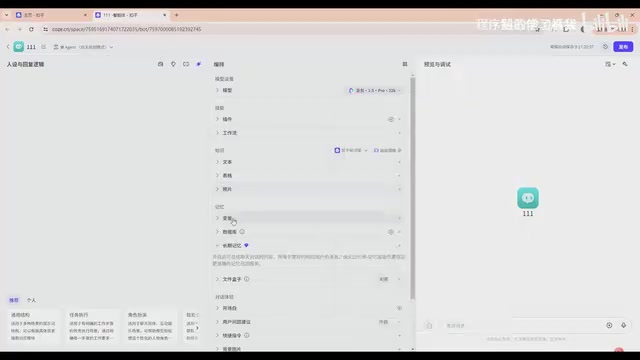
- China Version (coze.cn): Chinese interface, no VPN required, access to domestic models like Doubao, DeepSeekAd, Kimi, and StepFun.
- International Version (coze.com): English interface, VPN required, access to GPT series (including GPT-4o, GPT-5), Gemini series, and DeepSeek series.
From a practical capability standpoint, the international version can produce more powerful agents since it has access to GPT-4o, GPT-5, and other currently top-tier large models. The current global LLM landscape features a two-power competition between the US and China: on the US side, OpenAI's GPT series and Google's Gemini series are in the first tier of comprehensive capabilities, especially leading in complex reasoning, code generation, and multimodal understanding; on the Chinese side, ByteDance's Doubao, DeepSeek, Moonshot's Kimi, and StepFun perform excellently in Chinese language understanding and specific vertical domains, with DeepSeek approaching international top levels in mathematical reasoning tasks. The gap is narrowing rapidly, but a certain disparity still exists on general evaluation benchmarks.
However, for learners in China, the domestic version requires no VPN, has a friendly interface, and domestic models are better optimized for Chinese scenarios, offer data compliance assurance, and typically have lower API costs—making it the more practical choice for getting started. Therefore, systematic Coze learning is recommended to start with the China version.
What Coze Can Do: The Difference Between Agents and Apps
The Coze platform currently supports two main types of AI projects: Agents and Apps. Understanding the difference between the two is key to using Coze effectively.
Agents (Bots)
An agent is a conversation-based AI project, essentially a chat interface. It receives user input through conversation, with the large model automatically calling plugins or workflows to execute specified business processes and generate final responses. Simply put, it's a Q&A format where AI helps you complete tasks.
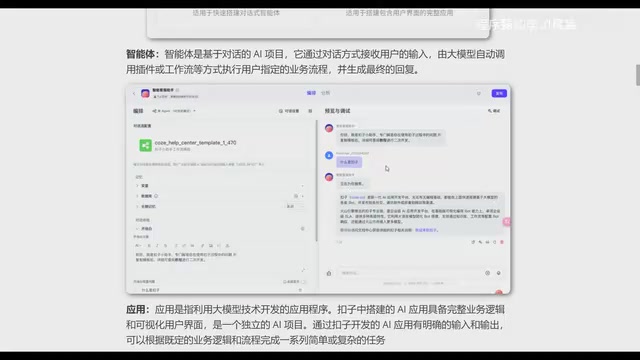
There's an important terminology detail here: on the Coze platform, AI Agents are called Bots. A Bot can perform automated services, intelligent conversations, and various other tasks. It's essentially an AI Agent—just with a different name.
The concept of AI Agent deserves a deeper explanation. AI Agent is one of the hottest concepts in the current AI field, considered the key form factor for large models to achieve real productivity. Unlike traditional conversational AI (like early ChatGPT's simple Q&A), AI Agents possess capabilities for autonomous decision-making, tool calling, and task planning. They can not only generate text responses but also automatically decompose complex tasks based on user intent, call external tools (such as search engines, databases, third-party APIs), execute multi-step operations, and ultimately return results. OpenAI, Google, Anthropic, and other companies are all actively building Agent ecosystems. Bots on the Coze platform are essentially configurable AI Agent frameworks—users define the Agent's role and behavioral boundaries by setting system prompts, grant it the ability to call external tools by attaching plugins, and specify its task execution logic by configuring workflows.
Apps
Apps are complete applications developed using large model technology, with both frontend and backend, capable of building visual user interfaces. An app is an independent AI project with clear inputs and outputs that can complete a series of simple or complex tasks according to established business logic.
The tutorial demonstrates a translation app: users don't need to have a conversation—they just input content, click the translate button, and the app calls the large model in the background to return results. This is fundamentally different from the agent's conversational interaction mode—agents provide an open-ended conversation experience, while apps offer a structured operational flow, closer to traditional software usage. It's worth noting that Coze's app feature is currently still in Beta testing, with functionality and stability still being continuously iterated.
How to Choose: Agent or App
For beginners, you can choose based on the following principles:
- If you want to create a lightweight tool that completes tasks through conversation, an agent (Bot) is usually sufficient. Typical scenarios include: customer service Q&A, content creation assistants, knowledge retrieval, and schedule planning.
- If you need clear inputs and outputs with a visual interface, and want to call large models in the background to handle business logic, then an app is more appropriate. Typical scenarios include: translation tools, data analysis dashboards, form processing, and report generators.
The significance of Coze lies in putting AI development capabilities—which previously belonged exclusively to programmers—into the hands of every ordinary person. As AI reshapes how work is done across all industries today, mastering tools like these for building AI applications may become a fundamental skill for improving work efficiency across all professions in the future—just like learning to use Office software over a decade ago became an essential capability for professionals.
Key Takeaways
Related articles

Amphibious Transforming Drone: Beyond 100x Power Savings, What Are the Real Needs?
Is the amphibious transforming drone just a gimmick? Starting from the 100x power difference of the M4 Morphobot, explore real application scenarios and thesis topic ideas, analyzing boundary conditions where pure drones and pure ground robots both fail.

Warhound Raises $200 Million: Genetically Engineered "War Dogs" Paired with Anduril Gear
Warhound raises $200M, backed by Ben Lamm and Palmer Luckey, to genetically engineer dogs for military and law enforcement use and equip them with Anduril gear. This article analyzes its technology direction, funding logic, and ethical controversy.

Claude API Comes to Google Cloud: IAM Integration and SDK Access Guide
Anthropic hosts the full Claude API on Google Cloud with IAM-controlled permissions and unified billing. This guide covers the Vertex AI and Anthropic-hosted entry points, IAM role configuration, and SDK access.