How to Build Object-Centric Event Logs from Patient Journeys: A New Process Mining Method Explained

A paper proposes a method to systematically generate object-centric event logs from patient journeys, filling a gap in healthcare process mining.
This article introduces a systematic method for creating object-centric event logs (OCEL) from patient journeys. Traditional process mining centers on a single case and struggles to capture multi-entity interactions in healthcare; object-centric process mining (OCPM) links multiple objects through events and better fits healthcare scenarios. The paper outlines challenges such as data heterogeneity, object identification, event definition, and relationship modeling, proposes a generation method, and preliminarily validates it using synthetic patient cohort data from an industry partner.
Patient interactions with the healthcare system and the various states that arise as disease progresses together constitute the "patient journey." This concept is becoming an important research subject in healthcare process mining. Traditional process mining centers on a single case, whereas object-centric process mining (OCPM) can capture complex relationships among multiple entities and is therefore better suited to healthcare scenarios. However, there has previously been no systematic method for generating object-centric event logs (OCEL) from patient journey data. A recent paper fills this gap by proposing a complete scheme for creating OCEL from patient journeys.
A Paradigm Shift in Healthcare Process Mining
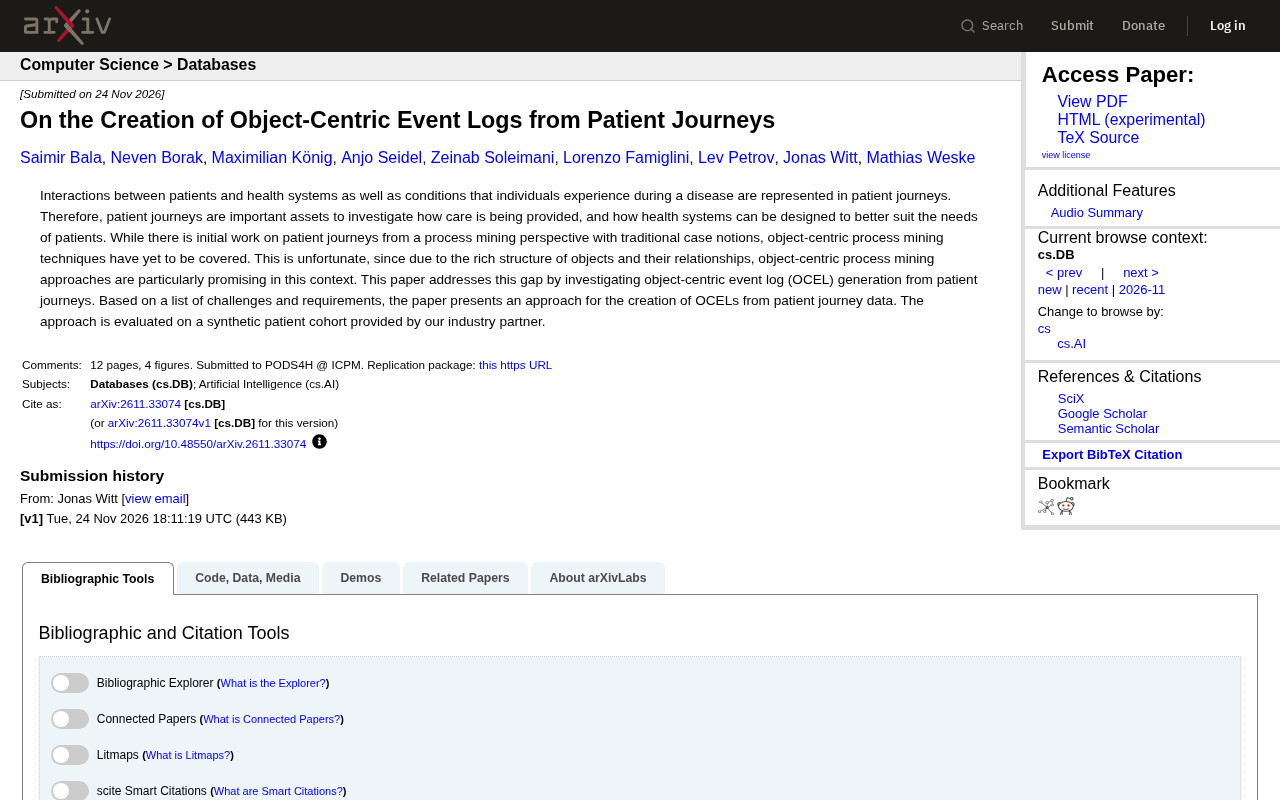
Traditional process mining treats each patient visit as a "case" and analyzes its treatment path. But healthcare processes involve multiple objects—patients, physicians, departments, examinations, medications, and more—and a single-case perspective struggles to characterize the interactions among them. Object-centric process mining treats each entity as an independent object and links multiple objects through events, thereby reconstructing healthcare processes more faithfully. The paper points out that the rich object structure of patient journeys aligns well with the advantages of OCPM, yet no prior research has explored how to generate OCEL from patient journey data.
Object-centric process mining (OCPM) is a new paradigm that has emerged in the process mining field in recent years, whose core idea is to break free from the constraints of the traditional "single case." In traditional process mining, each event must belong to exactly one case (such as a single visit); when multiple entities (patients, physicians, medications) interact, analysts are forced to flatten the data or split it into multiple logs, causing information loss. OCPM instead introduces the object-centric event log (OCEL) data structure, in which each event can be associated with any number of objects and each object can participate in multiple events, thereby natively expressing many-to-many relationships. OCEL is typically stored as event tables, object tables, and relationship tables, and supports process discovery and conformance checking across object types, making it particularly suitable for multi-entity collaborative scenarios such as healthcare, manufacturing, and logistics.
From Patient Journeys to OCEL: Challenges and Requirements
The paper first outlines the main challenges of building OCEL from patient journeys, including data heterogeneity, object identification, event definition, and relationship modeling. Based on these challenges, the authors propose a set of requirements and design a systematic method for generating OCEL. The method specifies the steps for extracting objects, events, and their associations from raw patient journey data, providing a blueprint for subsequent tool implementation. Interestingly, the method emphasizes understanding healthcare domain semantics rather than simple data transformation.
Key Design Points of the Method
- Object identification: Extract key entities from patient journeys (such as patients, diagnoses, treatments, and healthcare personnel) and define their attributes.
- Event definition: Map state changes or interaction behaviors in patient journeys to events and associate them with relevant objects.
- Relationship modeling: Specify the many-to-many relationships among objects and between events and objects to ensure the log conforms to the OCEL standard.
Patient journey in healthcare informatics generally refers to the entire process from symptom onset, consultation, diagnosis, and treatment to recovery or follow-up, encompassing multidimensional information such as clinical states, contact points, treatment decisions, and outcomes. From a data modeling perspective, a patient journey is inherently multi-entity and multi-event: a single hospitalization may involve multiple departments, various examinations, several healthcare professionals, and multiple medications, and the relationships among these entities are complex and dynamic. The key challenges in transforming patient journeys into OCEL are: raw data often exist as relational databases or event streams without unified object identifiers; the definition of healthcare events depends on domain semantics (e.g., whether "starting a medication" and "adjusting the dose" count as different events); and relationships among objects (such as patient–diagnosis–treatment) require explicit modeling to satisfy the OCEL specification. Therefore, generating OCEL is not a simple format conversion but a semantic mapping process driven by domain knowledge.
Synthetic Data Validation and Industry Collaboration
To evaluate the proposed method, the authors conducted experiments using synthetic patient cohort data provided by an industry partner. The results show that the method can generate structurally sound OCEL from patient journey data, supporting subsequent object-centric process analysis. Although the experiments are based on synthetic data, the paper provides a reusable methodological foundation for the healthcare process mining community and points out directions for future validation on real healthcare data.
Implications for Healthcare AI and Process Analysis
The significance of this research lies in connecting the patient journey—an important concept in healthcare—with object-centric process mining technology. As healthcare data grow increasingly complex, traditional case-centric methods may lose critical information, whereas OCEL can preserve the richness of multi-entity interactions, offering a finer-grained perspective for analyzing care pathways and optimizing healthcare system design. For researchers and engineers working in healthcare AI and clinical pathway analysis, this method is worth attention.
Paper title: On the Creation of Object-Centric Event Logs from Patient Journeys Source: rss
(End)
One-line Summary
This paper proposes a method to systematically generate object-centric event logs from patient journeys, filling a gap in healthcare process mining.
Paragraph Summary
This article introduces a systematic method for creating object-centric event logs (OCEL) from patient journeys. Traditional process mining centers on a single case and struggles to capture multi-entity interactions among patients, physicians, and medications in healthcare; object-centric process mining (OCPM) links multiple objects through events and better fits healthcare scenarios. The paper outlines challenges such as data heterogeneity, object identification, event definition, and relationship modeling, proposes a generation method covering object identification, event mapping, and relationship modeling, and conducts preliminary validation using synthetic patient cohort data from an industry partner. The research provides a reusable methodological foundation for healthcare process mining but still requires further validation on real healthcare data.
Related articles

Michael Nielsen Takes Down His Classic Neural Network Textbook, Sparking Community Discussion
Michael Nielsen's classic free textbook Neural Networks and Deep Learning has been taken offline, sparking discussion on Hacker News about the reasons and impact.

Inside the AI Training Data Market: The Trade-off Between Exclusivity and Discounts
G2i founder Gabe Greenberg reveals the dual-track pricing of the AI training data market: labs pay a premium for exclusive data or accept discounts that allow others to buy it.

SessionGraph: Unifying All Coding Agent Sessions in One Interactive Graph
SessionGraph aggregates coding agent sessions into an interactive graph, helping developers review, debug, and manage AI coding workflows across sessions. This article examines its positioning, value, and open questions.