How to Choose a C++ Machine Learning Library: A Comparison Guide for LibTorch vs. TensorFlow
A practical comparison of LibTorch vs. TensorFlow C++ for ML, with alternative library recommendations.
This guide compares the two major C++ machine learning libraries — LibTorch and TensorFlow C++ API — across dimensions like training capability, Windows support, build complexity, and learning curve. LibTorch emerges as the more balanced choice for developers wanting to train models in C++, while TensorFlow C++ suits deployment-only scenarios. The article also covers alternatives like Eigen, mlpack, dlib, and ONNX Runtime, and offers a practical learning path for C++ developers entering ML.
Why Choose C++ for Machine Learning?
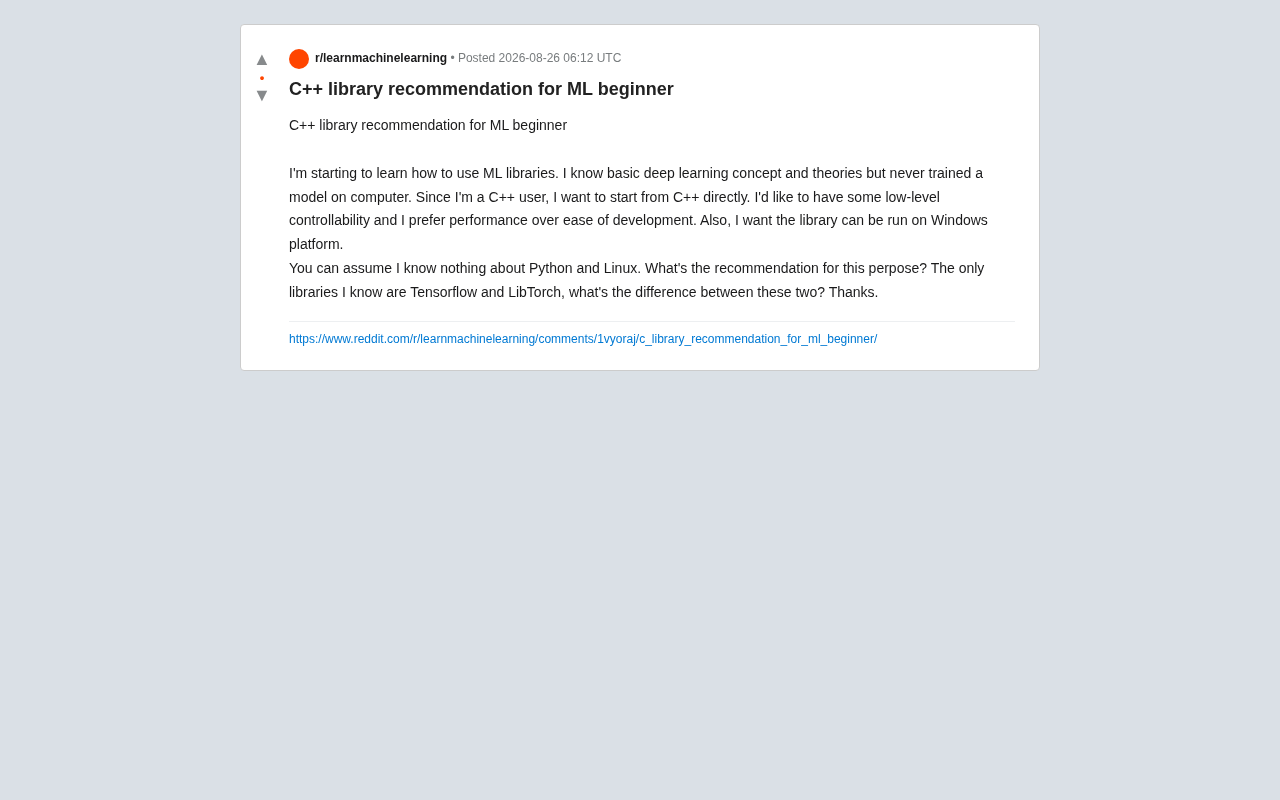
In the world of machine learning (ML), Python is almost the undisputed mainstream language. However, many developers still prefer to develop and deploy models directly in C++ for reasons of performance, low-level control, and compatibility with existing tech stacks. A typical scenario: a developer has already grasped the fundamental concepts and theory of deep learning but has never actually trained a model on a computer. They want to start directly with C++, need to run on Windows, and prioritize performance over development convenience.
These developers are familiar with the C++ ecosystem, require low-level controllability, and are not well-versed in Python or Linux environments. For them, choosing the right C++ machine learning library is critical, as it directly determines the steepness of the learning curve and the maintainability of their projects.
Comparing the Major C++ Machine Learning Libraries
Currently, the C++ ecosystem for machine learning is dominated by two main camps: TensorFlow (C++ API) and LibTorch (PyTorch's C++ frontend).
LibTorch: PyTorch's C++ Frontend
LibTorch is the official C++ distribution provided by PyTorch. It offers tensor operations, automatic differentiation (autograd), and neural network module APIs that are highly consistent with the Python version of PyTorch.
Automatic differentiation is the core technology of modern deep learning frameworks. It differs from numerical differentiation (finite difference methods, which have low precision and high computational cost) and symbolic differentiation (which suffers from expression swell). Automatic differentiation records each operation and its corresponding local derivative rules during the forward computation, building a computation tree. During backpropagation, it applies the chain rule layer by layer from output to input along this tree, computing gradients for all parameters accurately and efficiently. LibTorch's autograd engine inherits PyTorch's design — every tensor object can track the computations it participates in by setting requires_grad=true, and calling backward() automatically completes the entire gradient computation process, eliminating the need for developers to manually derive or implement backpropagation formulas.
For C++ developers, LibTorch has several clear advantages:
- Modern and intuitive API design: LibTorch leverages many modern C++ features, with a code style close to Python PyTorch, resulting in a relatively low learning cost.
- Dynamic computation graphs: Consistent with PyTorch's dynamic graph mechanism, making debugging and experimentation easier. Dynamic computation graphs (Define-by-Run) build the computation graph in real time during each forward pass. Code logic matches execution order, allowing standard breakpoint debugging, conditional branches, and loops, which greatly reduces development and debugging difficulty. This means you can write neural network logic just like regular C++ code and use Visual Studio's debugger to step through and inspect each tensor's values and shape — especially important for developers who have never trained a model before.
- Strong official support: Good documentation and an active community, with pre-compiled binary packages available for Windows, making setup relatively simple.
- Strong low-level controllability: You can directly manipulate tensors and define custom operators to meet performance and low-level control requirements.
For C++ developers who prioritize performance and low-level control, LibTorch is often the more recommended starting point, as it balances performance with a relatively gentle learning curve.
TensorFlow C++ API: Deployment-Oriented
TensorFlow's C++ API is more oriented toward inference deployment rather than training. Its positioning is: models are typically trained on the Python side and then exported to the C++ side for high-performance inference. Key characteristics of TensorFlow C++:
- Limited training support: The C++ training API is not as complete as its Python counterpart and is primarily designed for inference scenarios.
- Complex build process: Compiling TensorFlow C++ from source on Windows is notoriously tedious, often requiring the Bazel build system, which is not beginner-friendly. Bazel is Google's open-source build tool designed to support incremental compilation and cross-language builds for very large codebases. Using Bazel to compile TensorFlow on Windows means developers need to install and configure Bazel, MSYS2, Python, and a series of other dependencies. The entire process is time-consuming (a full build can take several hours) and is prone to failure due to version mismatches. In contrast, LibTorch uses the CMake build system — the most mainstream cross-platform build tool in the C++ ecosystem — which integrates well with IDEs like Visual Studio and CLion. The official team directly provides pre-compiled dynamic and static libraries, and developers only need to add
find_package(Torch)in their CMakeLists.txt to complete integration, significantly lowering the barrier for environment setup. - Static computation graphs: TensorFlow 1.x's static graph mechanism is beneficial for deployment optimization but offers a less intuitive debugging experience compared to dynamic graphs. Static graphs (Define-and-Run) require developers to fully define the computation flow first, compile and optimize it, and then feed in data for execution. This approach enables compiler-level optimizations such as operator fusion and memory reuse, but debugging is difficult because error messages often don't map intuitively to source code. Although TensorFlow 2.x introduced Eager mode to address this, its C++ API still primarily revolves around static graph design.
Therefore, if your goal is to train models from scratch rather than merely deploy existing models, TensorFlow C++ is not an ideal entry point.
Core Differences Between LibTorch and TensorFlow C++
In a nutshell, the difference between the two can be summarized in one sentence: LibTorch is better suited for complete training and experimentation in C++, while TensorFlow C++ is better suited for deploying pre-trained models for inference.
| Dimension | LibTorch | TensorFlow C++ |
|---|---|---|
| Primary focus | Training + Inference | Primarily Inference |
| Computation graph | Dynamic | Static |
| Windows support | Pre-compiled packages, easy setup | Complex build process |
| API friendliness | Modern C++, close to PyTorch | Relatively low-level |
| Learning curve | Gentler | Steeper |
| Build system | CMake (mainstream C++ ecosystem) | Bazel (requires additional learning) |
For a C++ developer who prioritizes performance, needs low-level control, and works on Windows, LibTorch offers a clearly superior overall experience.
Other C++ Machine Learning Libraries Worth Considering
Beyond these two major libraries, the C++ ecosystem offers several lightweight or specialized options worth exploring depending on your specific needs:
- Eigen: A high-performance linear algebra library. While not a dedicated ML framework, if you want to understand neural network matrix operations at a deeper level and hand-code a simple network, Eigen is an excellent tool. Eigen is a header-only C++ template library that achieves lazy evaluation and automatic vectorization through Expression Templates, performing extensive optimizations at compile time with performance comparable to hand-written BLAS code. In the deep learning field, Eigen serves as the underlying computation backend for multiple frameworks — TensorFlow's CPU kernels make extensive use of Eigen. Hand-writing matrix multiplication, activation functions, and backpropagation with Eigen gives you a deep understanding that a fully connected layer is essentially matrix multiplication plus bias followed by a nonlinear function, and how gradients propagate back layer by layer through transposed matrix multiplication. It helps you truly master low-level controllability.
- mlpack: A C++-based machine learning library focused on traditional ML algorithms (such as clustering, regression, dimensionality reduction, etc.), designed with an emphasis on speed and ease of use, suitable for non-deep-learning tasks.
- dlib: A comprehensive C++ toolkit that includes machine learning, image processing, and other modules, with friendly documentation and good cross-platform support.
- ONNX Runtime: If your ultimate goal is high-performance inference across frameworks, ONNX Runtime provides an excellent C++ interface. ONNX (Open Neural Network Exchange) is an open neural network exchange format led by Microsoft and Facebook that defines a standard set of operators and model serialization protocols. Developers can train models in any framework such as PyTorch or TensorFlow, export them as
.onnxfiles, and then use ONNX Runtime for high-performance inference on different hardware (CPU, GPU, NPU). ONNX Runtime's C++ API is streamlined and supports multiple Execution Providers, including CUDA, TensorRT, DirectML, and more. On Windows, combining it with DirectML can fully leverage GPU compute power from various vendors. This pattern of "training with Python frameworks, deploying with ONNX Runtime C++" is a very popular hybrid strategy in the industry today.
A Practical Learning Path for C++ Machine Learning
Considering the typical C++ developer's background — understanding theory but lacking hands-on experience, preferring performance and low-level control, working on Windows — here is a pragmatic learning path:
Step 1: Start with LibTorch. Download the official pre-compiled Windows version of LibTorch, and you can quickly set up your environment with CMake and Visual Studio. Begin with tensor operations and training a simple fully connected network, gradually familiarizing yourself with the API. Specifically, you can start with a classic task like MNIST handwritten digit recognition: create a network with two or three linear layers, define a cross-entropy loss function, use an SGD or Adam optimizer, and complete forward propagation, loss computation, backpropagation, and parameter updates in a training loop. LibTorch's namespaces such as torch::nn::Module and torch::optim provide interfaces that correspond almost one-to-one with Python PyTorch, and the code logic from many Python tutorials can be directly translated to C++.
Step 2: Understand the underlying mechanisms. If you want to truly master the low-level principles of deep learning, try implementing a backpropagation algorithm from scratch using Eigen. While this process is challenging, it will give you a much deeper understanding of automatic differentiation and gradient computation. Specifically, you'll need to manually implement the matrix operations for each layer in the forward pass, then derive and implement the gradient formulas for each layer — for example, for a fully connected layer $y = Wx + b$, the weight gradient is $\frac{\partial L}{\partial W} = \frac{\partial L}{\partial y} \cdot x^T$, and the input gradient is $\frac{\partial L}{\partial x} = W^T \cdot \frac{\partial L}{\partial y}$. After completing this exercise, you'll have a thorough understanding of what LibTorch's autograd system does behind the scenes.
Step 3: Consider the ecosystem reality. It's important to be honest about one thing: although C++ has advantages in performance and deployment, the vast majority of tutorials, paper implementations, and pre-trained models in the machine learning field are centered around the Python ecosystem. For pure model research and rapid experimentation, Python + PyTorch remains the most efficient combination. C++ is better suited for performance-sensitive deployment stages after the training pipeline has matured.
Conclusion: How to Choose the Best C++ Machine Learning Library
For developers who want to enter machine learning directly through C++, LibTorch is currently the most balanced choice — it offers a combination of training capabilities, low-level controllability, performance, and ease of use on the Windows platform. TensorFlow C++ is better suited for pure deployment scenarios. If you want to deeply understand the underlying principles, Eigen is an excellent hands-on tool.
However, it's important to maintain a clear perspective: the C++ path is far less rich in learning resources compared to Python. If your goal is to get started with experiments quickly, consider incorporating Python for core training tasks while reserving C++'s strengths for performance-critical deployment and integration stages. This hybrid strategy often yields the best practical results.
Related articles

Chain of Thought Isn't Just for AI: How Humans Can Use CoT to Improve Thinking Quality
Chain of Thought isn't just a prompt trick for large models. Starting from a Hacker News discussion, this article analyzes why CoT works for human thinking too, breaks down actionable ways to transfer it, and highlights the key differences between human CoT and machine CoT.
Cloudflare Teams Up with OpenAI: Closi…
Cloudflare Teams Up with OpenAI: Closing the Loop from Vulnerability Discovery to Defense with AI
Cloudflare uses OpenAI Daybreak to investigate security vulnerabilities and generate reviewable remediation plans, while developers use Codex to boost coding efficiency and quality.

Orca Multi-Agent Orchestration in Practice: A Guide to Parallel Collaboration with Claude and Codex
Orca is Stable AI's free open-source agent workbench supporting 34 agents like Claude Code and Codex in parallel. Learn its Git worktree isolation, multi-model orchestration, and mobile management.