How to Choose a Multi-Agent Platform? The Confusion and Cure for a 46-Person Startup's Operations Lead

Small and mid-sized startups choosing a multi-agent platform should prioritize maintenance costs and integration, starting with a minimum viable agent.
Starting from the confusion of an operations lead at a 46-person startup, the article analyzes why choosing a multi-agent platform is so hard: platform positioning is sharply fragmented, the boundaries between developer frameworks, low-code tools, and vertical SaaS products are blurred, and maintenance costs are often underestimated. Drawing on Reddit, YouTube, and SSPAI discussions, small and mid-sized companies prefer lightweight integration into existing workflows over building from scratch; build vs. buy each has supporters, depending on technical ability and maintenance willingness. The article proposes four selection questions — who maintains it, integration cost, failure mode, and scalability — and suggests starting with a high-frequency, clearly rule-based minimum viable agent, watching real user reputation, and finding a "good enough" solution that fits the team.
Introduction: When Multi-Agent Platforms Become Operations' New Maze
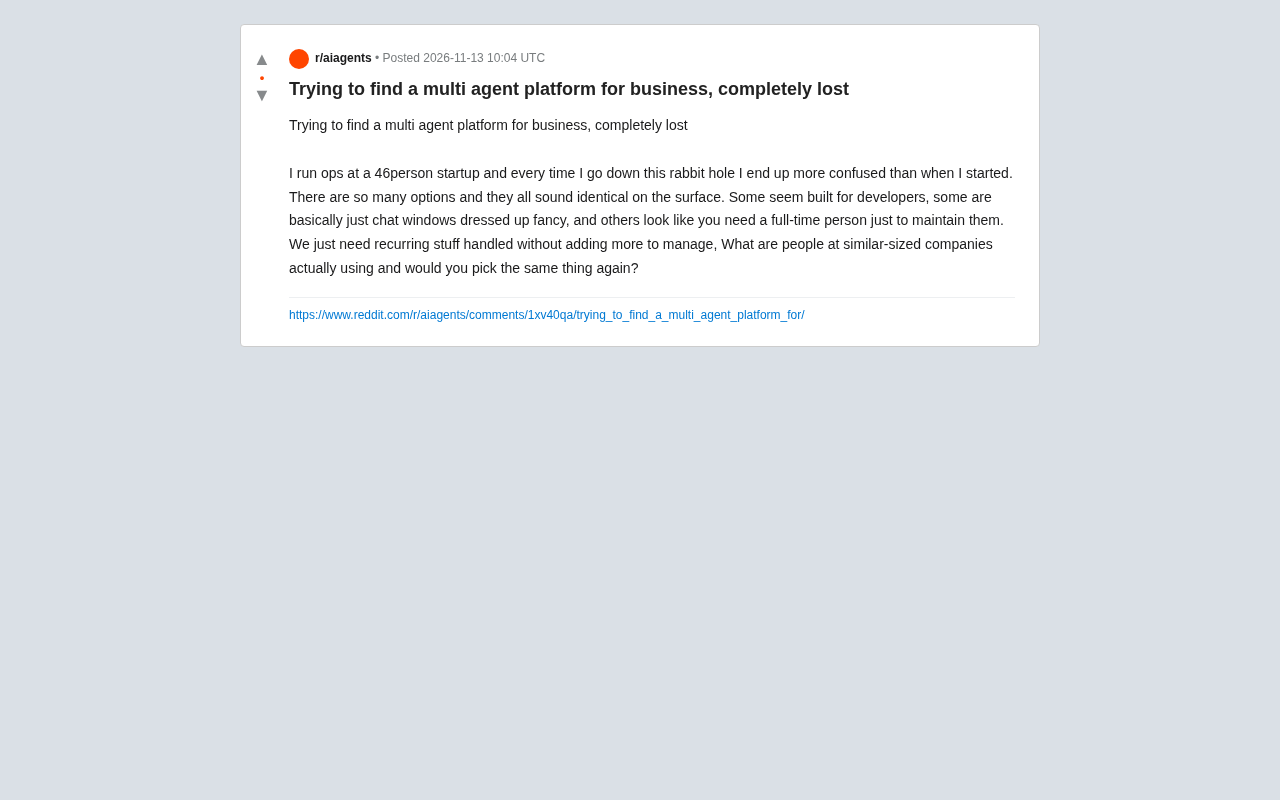
"Every time I research multi-agent platforms, I end up more confused than when I started." So wrote a Reddit user responsible for operations at a 46-person startup. His predicament is fairly representative: the market is crowded with options that all sound superficially similar — some aimed at developers, some little more than "chat windows in fancy packaging," and others that seem to require a dedicated person to maintain. All they really need is to handle repetitive work without adding management overhead.
This is not an isolated case. As the concept of AI agents heats up, all kinds of platforms are flooding the market, but information overload makes selection unusually difficult. Based on that discussion and perspectives from multiple communities, this article sorts out the logic of choosing a multi-agent platform to help companies of similar size find a solution that fits them.
The State of the Market: Why Is Choosing So Hard?
Platform Positioning Is Sharply Fragmented
Today's multi-agent platforms fall roughly into three categories: developer-facing low-level frameworks (such as AutoGen and CrewAI), low-code/no-code automation tools (such as Zapier and Make), and vertical-scenario SaaS products (such as customer service and sales automation). The problem is that many products blur these boundaries in their marketing, making it hard for non-technical operations people to judge the real barrier to entry.
According to user feedback in the Reddit discussion, some platforms "sound like a panacea but in practice require writing code or understanding APIs." This information asymmetry is the main source of confusion.
AutoGen is an open-source multi-agent conversation framework from Microsoft Research. Developers write Python code to define multiple agents that can talk to one another and the rules for their collaboration, making it suitable for building complex multi-role task flows, but it requires strong programming skills. CrewAI is an open-source framework built around the idea of role-playing: each agent is set up as a "team member" with a specific role, goal, and tools, and collaboration is achieved through task assignment. Its level of abstraction is higher than AutoGen's, but it still requires writing code. Both are "developer-first" low-level tools that do not themselves provide a graphical interface or out-of-the-box business templates, and they differ fundamentally from low-code automation platforms and vertical-scenario SaaS products in target users and implementation barriers. Understanding this layering helps operations people judge whether a given product is truly right for them.
Maintenance Costs Are Underestimated
Another analysis, from the Bilibili creator "AI Efficiency Watch," points out that many teams focus only on feature lists when choosing a platform while ignoring the ongoing investment: prompt tuning, data source updates, exception handling, and so on. For a 46-person company with no dedicated AI engineer, this is often a hidden cost.
What Comparable Companies Actually Choose: Cross-Validation from the Community
Consensus: Lightweight Integration First
Drawing on discussions across Reddit, the YouTube channel "AI Startup Watch," and the SSPAI community, one consensus emerges: small and mid-sized companies prefer platforms that can be embedded in existing workflows without extra maintenance. For example, they use Zapier or Make to connect existing SaaS tools, then add agent capabilities through the OpenAI Assistants API or a similar service, rather than building a multi-agent system from scratch.
One user responsible for operations at a similarly sized company shared: "We ended up using Make + GPT-4 to handle customer email classification and initial replies. Once set up, it only needs occasional adjustments and adds no management burden."
The OpenAI Assistants API is an interface provided by OpenAI that lets developers create agent assistants with instructions, knowledge-base retrieval, and tool-calling capabilities without building their own model service, and embed them into existing applications or automation flows via API. Compared with a full agent framework, it reduces the complexity of model calls and state management, and is often used by small and mid-sized teams as a lightweight way to "add intelligence to existing workflows." Zapier and Make are visual automation platforms that connect triggers and actions of different SaaS tools by drag and drop; plugging the Assistants API in as one step enables tasks such as email classification and content generation without much extra code — this is the technical basis for the community's "lightweight integration first" recommendation.
Disagreement: Build vs. Buy
The community is divided on whether to build in-house. Some teams with stronger technical backgrounds argue that open-source frameworks like CrewAI give them full control over the logic and avoid vendor lock-in; others argue that for non-technical teams, low-code platforms, though less flexible, are quick to learn and have a lower total cost of ownership.
According to cases from the YouTube channel "AI Founders Speak," an e-commerce company of about 50 people used CrewAI to build an agent that automatically handles return requests, but it needed a part-time developer to maintain; another education company chose to buy an off-the-shelf customer service bot, trading customization for zero maintenance.
Vendor lock-in refers to the risk that, after deeply binding its business processes to a platform, a company finds it hard to switch to another solution because of difficult data migration, closed interfaces, or high replacement costs. In the agent scenario, lock-in can show up as prompts and knowledge bases that cannot be exported, collaboration logic that can only be orchestrated within a specific platform, or usage-based pricing that drives costs up as scale grows. One advantage of building in-house with open-source frameworks like CrewAI is precisely that the logic and data stay in your own hands, so you can switch the underlying model or deployment environment at any time; buying an off-the-shelf SaaS product saves maintenance, but you need to confirm in advance its data export capability, API openness, and exit costs, so you don't get constrained by a single vendor once the business grows.
A Selection Framework: Four Key Questions
Based on the discussion above, operations people can filter options with the following questions:
- Who maintains it? Does the platform require a dedicated person? If the team has no developers, prioritize services that work out of the box and update automatically.
- How high is the integration cost? Can it connect directly to existing tools (such as Slack, Notion, CRM)? Avoid data silos.
- What is the failure mode? When the agent makes a mistake, is it easy to detect and roll back? Low-code platforms usually provide visual logs.
- How scalable is it? As the business grows, does the platform support more agents or more complex workflows? Avoid locking in too early.
Practical Advice: Start with a Minimum Viable Agent
Rather than searching for the "perfect platform" all at once, first define a high-frequency, clearly rule-based repetitive task (such as meeting-notes compilation or lead cleaning) and test it at minimum cost. Several users in the Reddit discussion suggest starting with a single agent and considering multi-agent collaboration only after validating the results.
Also, pay attention to community reputation rather than marketing materials. Search for real user reviews on platforms like Reddit and G2, and pay special attention to comments about maintenance costs and customer support.
Conclusion: No Panacea, Only Fit
There is no standard answer to choosing a multi-agent platform. For a startup of 46 people, the key is to find a solution that matches the team's technical ability, willingness to maintain, and business scenario. Confusion often comes from trying to find the "best" platform, when what you actually need is a tool that is "good enough" and doesn't add burden.
One-line Summary
Small and mid-sized startups choosing a multi-agent platform should prioritize maintenance costs and integration, starting with a minimum viable agent.
Paragraph Summary
Starting from the confusion of an operations lead at a 46-person startup, the article analyzes the root causes of difficulty in choosing a multi-agent platform: platform positioning is sharply fragmented, the boundaries between developer frameworks, low-code tools, and vertical SaaS products are blurred, and maintenance costs are often underestimated. Drawing on discussions across Reddit, YouTube, SSPAI, and other communities, small and mid-sized companies prefer lightweight integration that embeds into existing workflows rather than building a multi-agent system from scratch; build vs. buy each has its supporters, depending on the team's technical ability and willingness to maintain. On this basis, the article proposes four selection questions — who maintains it, integration cost, failure mode, and scalability — and recommends starting with a high-frequency, clearly rule-based minimum viable agent, paying attention to real user reputation, and ultimately finding a "good enough" solution that matches the team's capabilities.
Related articles

Abnormal Error Rate Spike in Claude Mythos 5.2 and Fable 5.2
Claude Mythos 5.2 and Claude Fable 5.2 show an abnormal spike in request error rates, marked as investigating on the official status page. This article covers the incident overview, practical impact on developers, and recommended responses.

ReAct Runtime Context Trimming: Why Claude Code Acts at 70%
A deep dive into ReAct runtime context trimming: why Claude Code compresses at ~70% usage, why tool calls dominate, why messages must be dropped in pairs, and why codebases don't need RAG.

AI Agent vs LLM: How Cursor and Claude Code Actually Work
An in-depth analysis of the essential difference between AI Agents and LLMs: LLMs generate code suggestions, while Agents modify files and run tests via tool calls. Using a Spring Boot bug fix as an example, it breaks down the workflows, permission control, and verification mechanisms of Cursor and Claude Code.