How to Choose Claude Code Team Pricing: Seats, API, or Enterprise

Claude Code's three pricing models fit different scenarios; choose by usage intensity, headcount stability, and compliance needs, and a hybrid approach is often the cheapest.
The article compares Claude Code's three payment paths: Team Seats charges a fixed monthly fee per head ($25 or $125) with predictable budgeting; Console API bills by token usage, suiting volatile teams but risking runaway bills; Enterprise is a $20/person/month base plus API rates, really selling compliance capabilities like SSO, audit logs, and permission management. Based on a 10-person team, stable and relatively heavy usage makes the low-tier seat plan at $250/month most worry-free, volatile or light usage favors the API, and those without compliance needs needn't choose Enterprise. The three models can also be mixed, and allocating payment methods by role usually gets closer to actual costs than a one-size-fits-all approach; the article also warns against mistaking Enterprise for an "advanced Team Seats."
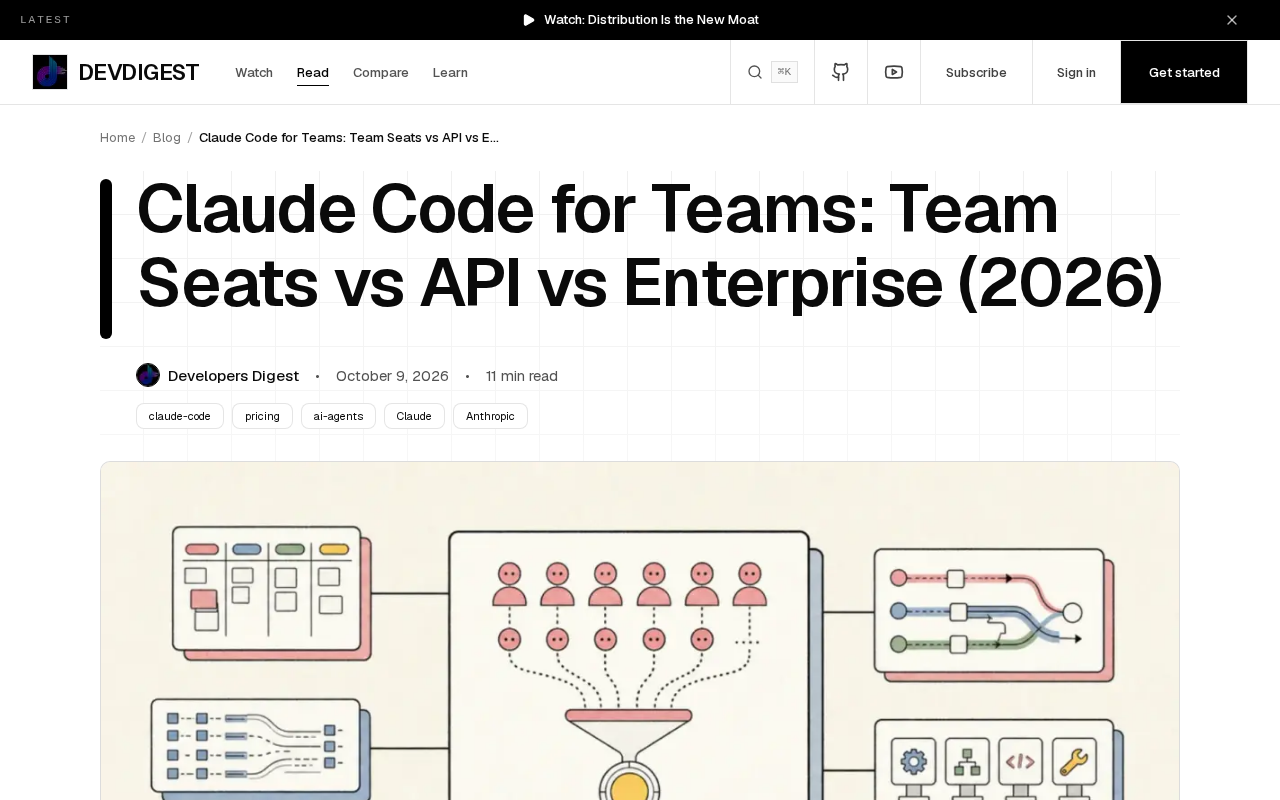
When a team decides to make Claude Code its primary coding tool, the first thing it runs into isn't a technical problem — it's a billing problem. Anthropic currently offers three payment paths: Team Seats, Console API pay-as-you-go, and Enterprise. Each path has a very different cost structure and set of use cases, and picking the wrong one could mean wasting several times the necessary spend.
What the Three Pricing Models Actually Are
Team Seats: Flat Monthly Fee, Per Head
Team Seats is the most intuitive option — each developer pays a flat monthly fee, split into two tiers of $25 and $125. The lower tier provides baseline usage, while the higher tier targets heavy users and unlocks a higher usage ceiling. For teams with stable headcount and even day-to-day usage intensity, the biggest benefit of this model is predictable budgeting: 10 people means 10 monthly fees, and the bill won't spike just because the team is crunching on a project in a given month.
Console API: Pay for What You Use
When you call the API through the Anthropic Console, costs are calculated entirely by token consumption. There's no monthly fee threshold, and the team can precisely control spending on each project. This approach is friendlier to teams with highly variable usage — almost nothing is spent in slow periods, and while the unit price looks high in peak periods, the total is transparent. The trade-off is that someone needs to keep an eye on usage; otherwise a runaway automation script could burn through a month's budget in a few hours.
The basic logic of token billing: LLM API usage is measured in tokens, the smallest unit of text the model processes, roughly equivalent to half an English word or one to two Chinese characters. The cost of a single conversation is determined jointly by input tokens (the prompt you send the model, code context) and output tokens (the content the model generates), and the output unit price is usually higher than the input price. In coding scenarios, context overhead is often underestimated: each Claude Code call may carry the current file, related dependencies, or even snippets of the entire codebase, so the actual token consumption of a single conversation can be far higher than the few instructions you see with your own eyes. Understanding this is what explains why "just a few dozen chats" can still produce a substantial bill, and it's also why teams must build a mental model of usage before adopting an API-based plan.
Enterprise: $20 Base + API Rates
Enterprise pricing sits between the first two: a $20 monthly base fee per user, with overages settled at API rates. It targets organizations that need enterprise-grade features such as SSO, audit logs, and permission management. The $20 base is more like an "entry ticket," and the real cost still depends on actual usage.
What SSO, audit logs, and permission management actually are: SSO (Single Sign-On) means employees log into all tools with a single unified identity (such as a company Google Workspace, Okta, or Azure AD account), with no need to create a separate account for Claude Code, and permissions can be revoked in one action when someone leaves. Audit logs record who called what, when, and what was generated — a hard compliance requirement in regulated industries like finance and healthcare. Permission management controls which projects different members can access, whether they can export data, and whether they can enable certain high-risk features. These three capabilities are inherently missing from Team Seats and Console API — the former bills by seat but has a simple identity system, while the latter is centered on API keys and hard to map to specific individuals. The reason Enterprise pricing is described as "selling management capability rather than compute" is precisely that the value of these features has nothing to do with token usage and everything to do with organizational scale and regulatory pressure.
A Real Bill Comparison for a 10-Person Team
The original article ran the numbers for 10 developers, a size that happens to reflect most small and mid-sized teams.
If everyone is on the low-tier Team Seats plan, 10 people cost a fixed $250 per month, or $3,000 annualized. That figure is usually the lowest of the three options — provided the team's usage doesn't frequently hit the ceiling. Once multiple people regularly exceed the limit, you either upgrade to the $125 tier ($1,250 per month for 10 people) or have to consider the API option.
Console API costs depend entirely on usage. Light use (a few dozen conversations per person per day) may be cheaper than Team Seats; but if you're relying heavily on Claude Code all day for writing code and running refactors, the API bill can easily exceed the seat fee. The core conclusion of the original article is: for teams with predictable and relatively heavy usage, Team Seats offers better value; for teams with volatile or relatively light usage, the API is more cost-effective.
Enterprise's $20/person base plus API usage isn't cheap at the 10-person scale. Its value isn't in saving money but in compliance and control capabilities — if the team has no hard requirements like SSO or auditing, choosing Enterprise is basically spending money for nothing.
The Key Variables in Choosing a Plan
Setting aside specific numbers, which plan to choose depends on three variables:
Usage intensity. How long and how often each person uses Claude Code per day determines which model is more economical. Light users will almost never lose money on the API, while heavy users can cap costs with the seat model.
Headcount stability. For teams whose size changes often, the API has no seat-waste problem; for teams with fixed personnel, the unit-price advantage of the seat model can actually show through.
Compliance requirements. This is Enterprise's only irreplaceable strength. Teams that need unified identity management, operational auditing, and data isolation can't be served by the first two options.
One easily overlooked detail: the three plans aren't mutually exclusive. A team can absolutely give core developers Team Seats and grant API credits to occasional users — in practice, this hybrid model is often cheaper than a one-size-fits-all approach.
How to implement the hybrid model: Combining Team Seats and Console API requires a bit of division-of-labor design at the organizational level. A common approach is to divide by role rather than by headcount: core developers and members who write code as their daily mainstay get seats, locking in their cost ceiling and ensuring a good experience; product managers, designers, and members who occasionally do scripting or data processing get API credits, with budget alerts set per project or per month. Technically, this requires the team to maintain two billing entry points and corresponding usage dashboards, and financially it needs to be able to allocate API spending by person or by project. The essence of how the hybrid model saves money is letting "high-certainty usage" go through fixed pricing and "low-certainty usage" go through flexible pricing — but the cost is increased management complexity. If the team itself has no energy to do usage aggregation, the hybrid approach may instead bring hidden costs.
Common Misconceptions
The most typical mistake is treating Enterprise as a "more advanced Team Seats." In reality, Enterprise's $20 base doesn't include a large amount of usage; it sells management capability, not compute. If a team is only 10 people with no compliance pressure, paying for Enterprise means paying for features you won't use.
Another misconception is underestimating the risk of API overspend. Pay-as-you-go sounds flexible, but without budget alerts and usage monitoring, a single configuration mistake can produce an unexpected bill. When choosing the API option, be sure to set spending limits first.
Conclusion
For a 10-person development team, if usage intensity is stable and relatively heavy, Team Seats is the most worry-free choice; if usage is volatile or generally light, Console API is more flexible and more economical; Enterprise is only worth considering when there are enterprise-grade needs such as SSO and auditing. A hybrid approach is also worth trying — allocating payment models by role is often closer to actual costs than a unified plan.
One-line Summary
Claude Code's three pricing models each fit different scenarios; choose based on usage intensity, headcount stability, and compliance needs, and a hybrid approach is often the cheapest.
Paragraph Summary
The article compares Claude Code's three payment paths: Team Seats charges a flat monthly fee per head ($25 or $125) with predictable budgeting; Console API bills by token usage, suiting highly variable teams but carrying the risk of runaway bills; Enterprise combines a $20/person/month base with API rates, and what it really sells is compliance capabilities such as SSO, audit logs, and permission management. Based on a 10-person team estimate, stable and relatively heavy usage makes the low-tier seat plan at $250/month the most worry-free, volatile or light usage makes the API more flexible, and those without compliance needs don't need Enterprise. The article also notes that the three models can be mixed, and allocating payment methods by role is usually closer to actual costs than a one-size-fits-all approach, while cautioning against mistaking Enterprise for an "advanced version of Team Seats."
Related articles

Chain of Thought Isn't Just for AI: How Humans Can Use CoT to Improve Thinking Quality
Chain of Thought isn't just a prompt trick for large models. Starting from a Hacker News discussion, this article analyzes why CoT works for human thinking too, breaks down actionable ways to transfer it, and highlights the key differences between human CoT and machine CoT.
Cloudflare Teams Up with OpenAI: Closi…
Cloudflare Teams Up with OpenAI: Closing the Loop from Vulnerability Discovery to Defense with AI
Cloudflare uses OpenAI Daybreak to investigate security vulnerabilities and generate reviewable remediation plans, while developers use Codex to boost coding efficiency and quality.

Orca Multi-Agent Orchestration in Practice: A Guide to Parallel Collaboration with Claude and Codex
Orca is Stable AI's free open-source agent workbench supporting 34 agents like Claude Code and Codex in parallel. Learn its Git worktree isolation, multi-model orchestration, and mobile management.