How to Choose Your First Genie Agent for Maximum Impact

How to select your first Genie Agent use case using high-frequency, low-risk scenarios and measurable business metrics.
With Salesforce Genie Agents surpassing one million deployments in 2026, enterprise AI agents are moving from proof-of-concept into scaled adoption. This article distills two core principles for choosing your first agent: prioritize high-frequency, low-risk task scenarios to minimize experimentation costs and build operational experience quickly; and orient selection around measurable business metrics — such as handling time, labor costs, and response speed — so the value of your first agent can be clearly demonstrated to secure broader organizational support.
Introduction: When Agents Become the New Way of Working
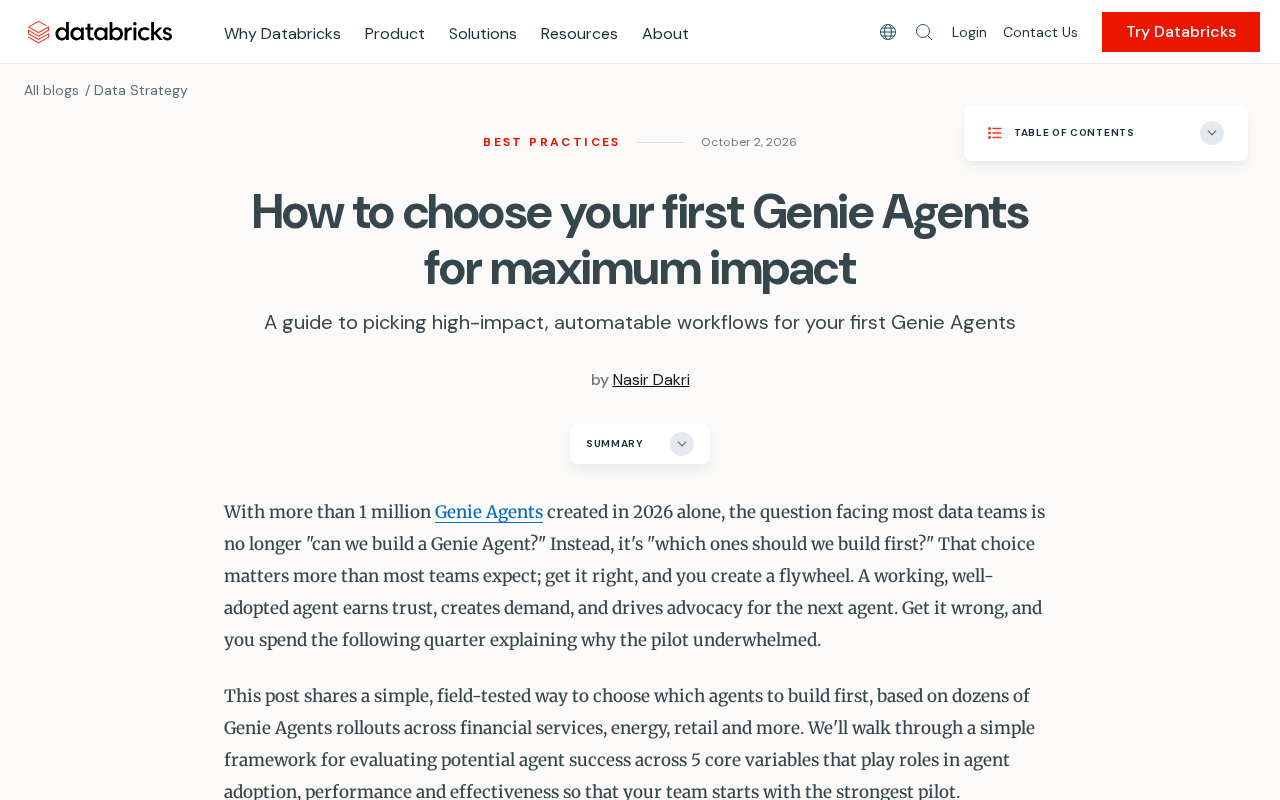
As enterprise AI agents experience explosive growth, figuring out how to deploy your very first intelligent agent from scratch has become a central challenge for many teams. According to the source material, over one million Genie Agents were created in 2026 alone — a number that speaks volumes about how agent technology is transitioning from proof-of-concept into scaled, real-world deployment.
However, the core content provided in the source material is quite sparse. Beyond the title's focus on "how to choose your first Genie Agent for maximum impact" and the creation volume data point, the body text cuts off abruptly at "The question facing..." — leaving no methodology, step-by-step breakdown, or supporting case studies.
Genie Agents are Salesforce's enterprise-grade AI agent product and a core component of its Agentforce ecosystem. Unlike traditional RPA (Robotic Process Automation), Genie Agents can understand natural language instructions, pull data across systems, and autonomously plan execution paths to a meaningful degree — rather than simply following predefined rules. Under the hood, they leverage Salesforce Data Cloud (formerly the Genie data platform) for real-time data integration, giving agents access to unified customer profiles and enabling context-aware automation across sales, service, and marketing use cases. The figure of one million refers to agent instances configured and activated by enterprise customers within the Salesforce ecosystem, spanning everything from customer service bots to internal IT support assistants.
Reading Agent Selection Logic from Limited Information
Despite the incomplete source material, the question of "choosing your first agent for maximum impact" carries broad, universal relevance. When enterprises first introduce AI agents, the choice of that initial use case often determines whether the broader rollout succeeds or stalls.
A sound selection framework typically centers on a few key dimensions: the more repetitive and standardized a task, the more pronounced the efficiency gains an agent can deliver; the clearer the boundaries of a business process, the lower the risk of the agent making consequential errors; and scenarios that can quickly demonstrate return on investment are far more effective at building internal organizational confidence.
Prioritize High-Frequency, Low-Risk Scenarios
For a first deployment, targeting tasks that occur frequently but carry manageable risk is the safest way to minimize the cost of experimentation. Even if the agent occasionally makes mistakes in these scenarios, the impact on core business operations remains reversible — and in the meantime, your team rapidly accumulates operational data and hands-on experience.
In practice, strong entry points include IT service desk ticket classification, HR FAQ handling, and initial draft generation for sales quotes. What these scenarios share is that inputs and outputs are relatively structured, human review is low-cost, and the consequences of errors are limited to a single interaction rather than causing systemic damage. By contrast, scenarios involving compliance approvals, financial settlements, or medical decision-making — despite their potentially higher value — are generally poor candidates for a first agent use case, given how costly cascading errors can be. Racking up early "small wins" helps teams calibrate an agent's capability boundaries in a real environment, building the trust needed to gradually expand into higher-stakes scenarios.
Orient Around Measurable Impact
The key to "maximum impact" lies in the word measurable. If the value of your first agent cannot be quantified through clear metrics — such as processing time, labor costs, or response speed — then making the case for further expansion and budget approval becomes an uphill battle.
When quantifying agent value, useful metric frameworks generally fall into three categories: efficiency metrics (e.g., reduction in average handling time, increase in throughput per unit of time), cost metrics (e.g., labor substitution or time saved converted to dollar figures), and quality metrics (e.g., error rate changes, CSAT shifts). It's strongly recommended to define baseline data before the agent goes live — retroactive attribution is far less convincing without a control group to compare against. For teams already within the Salesforce ecosystem, Einstein Analytics or Tableau dashboards can connect directly to agent execution logs, enabling near-real-time performance tracking without the overhead of building additional data infrastructure.
Closing Note: Source Limitations and Further Recommendations
It's worth being transparent: the original source material for this piece was severely incomplete. The body text cuts off at a critical point, offering neither a detailed breakdown of Genie Agents' specific capabilities nor a complete selection framework or practical deployment steps. While the "one million agents" figure is a meaningful data point, it appears without adequate context.
For readers looking to go deeper on Genie Agent selection strategy, the best next step is to consult Salesforce's official documentation and case study library for actionable deployment guidance. This article, constrained by limited source material, offers only a general analytical framework for agent selection as a reference point.
Related articles

Chain of Thought Isn't Just for AI: How Humans Can Use CoT to Improve Thinking Quality
Chain of Thought isn't just a prompt trick for large models. Starting from a Hacker News discussion, this article analyzes why CoT works for human thinking too, breaks down actionable ways to transfer it, and highlights the key differences between human CoT and machine CoT.
Cloudflare Teams Up with OpenAI: Closi…
Cloudflare Teams Up with OpenAI: Closing the Loop from Vulnerability Discovery to Defense with AI
Cloudflare uses OpenAI Daybreak to investigate security vulnerabilities and generate reviewable remediation plans, while developers use Codex to boost coding efficiency and quality.

Orca Multi-Agent Orchestration in Practice: A Guide to Parallel Collaboration with Claude and Codex
Orca is Stable AI's free open-source agent workbench supporting 34 agents like Claude Code and Codex in parallel. Learn its Git worktree isolation, multi-model orchestration, and mobile management.