How to Deploy an AI Receptionist: A Must-Read Selection and Pitfall Guide for Small Business Owners

AI receptionists can be deployed without developers; selection and script design are the keys to success.
Based on Reddit community discussions, this article systematically breaks down the selection, deployment, and use of AI receptionists. It argues that an AI receptionist should be positioned as a "first filter," with SaaS platforms best for non-technical small businesses. Deployment requires no coding; the focus is on organizing repeated questions, connecting the phone system via call forwarding, and testing in real scenarios. Customer acceptance depends on transparent disclosure and fast human transfer. When call volume is very low, ROI may not justify the cost.
Introduction: When No One Answers the Phone, Business Slips Away
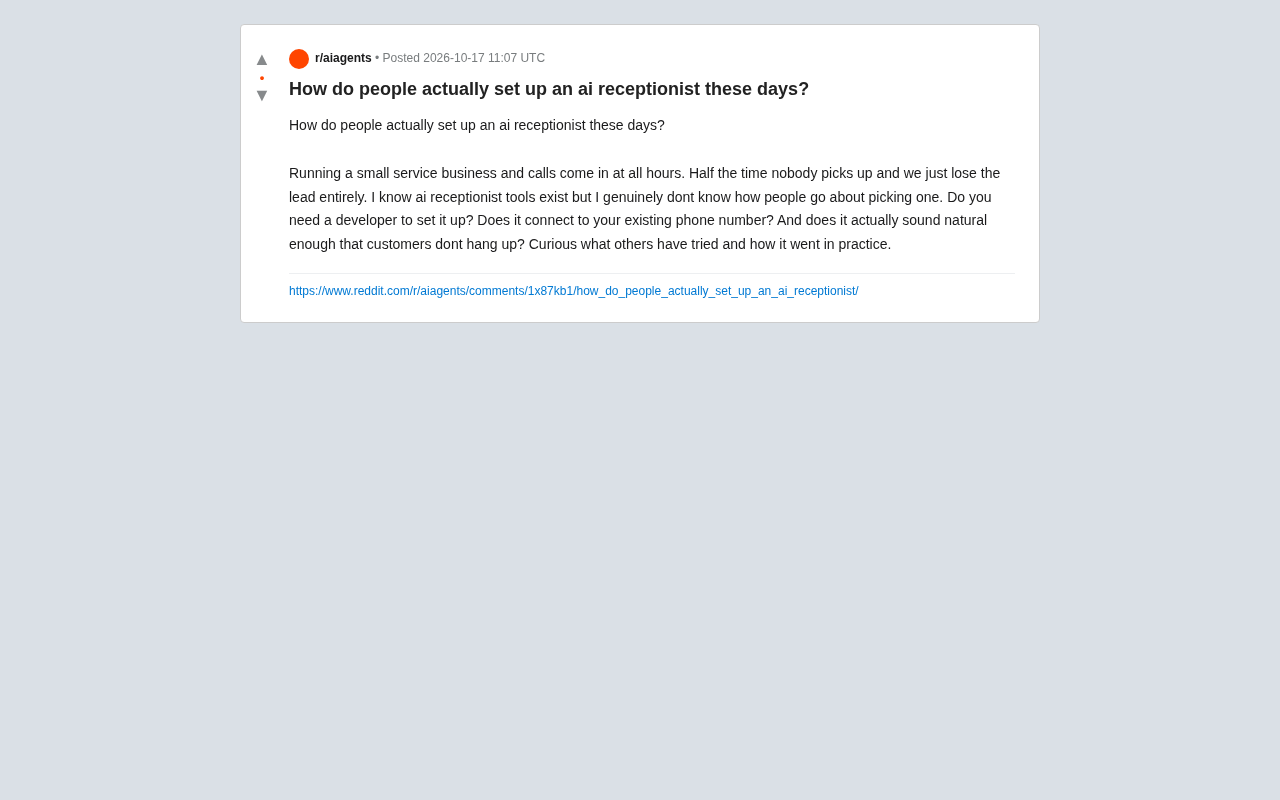
"The phone can ring at any time, but half the time no one picks up, and leads are lost just like that." This complaint from a small business owner on Reddit hits a pain point for many service-oriented businesses. AI receptionist tools have emerged, claiming to answer calls 24/7, hold natural conversations, and even schedule appointments. But the real question is: how should ordinary people actually choose, set up, and use them? Do you need a programmer? Can it work with your existing number? Will customers hang up as soon as they hear it's AI?
Based on real discussions in the Reddit community and industry practice, this article breaks down the full deployment process for AI receptionists to help you avoid the trap of "buying it but not knowing how to use it."
1. What Exactly Is an AI Receptionist? Clarify the Boundaries First
An AI receptionist is not a "universal voice robot." Its core capabilities usually include: automatically answering incoming calls, identifying intent (appointments, pricing inquiries, after-sales), answering common questions, transferring to a human, or taking messages. Unlike traditional IVR keypad menus, modern AI receptionists are based on large language models and speech synthesis and can hold multi-turn natural conversations.
But note that it is not good at handling complex complaints or calls with high emotional needs. The community consensus is that only by positioning the AI receptionist as a "first filter" rather than a "fully authorized agent" can expectations be managed properly.
IVR (Interactive Voice Response) is a common keypad menu technology in traditional phone systems, where users press number keys such as "1" for appointments or "2" for inquiries to select service paths. It runs on preset rules, cannot understand natural language, and has fixed paths that easily trap users in multiple menu layers. Modern AI receptionists, by contrast, are based on large language model (LLM) and text-to-speech (TTS) technology, can understand users' spoken expressions, conduct multi-turn contextual conversations, and dynamically adjust responses based on intent rather than relying on fixed keypad branches. Understanding this difference helps you judge: if your business questions are highly structured (for example, only needing to check business hours), traditional IVR is lower cost; if the scenario involves appointments, pricing inquiries, and other interactions requiring flexible exchange, the advantages of an AI receptionist truly become apparent.
2. Selection: You Don't Need a Developer, But You Need to Understand the Business
2.1 Main Types of Solutions
According to shares from multiple small business owners on Reddit, AI receptionist solutions on the market fall roughly into three categories:
- Integrated SaaS platforms: such as Rosie, AnswerConnect, etc., providing numbers, AI answering, and backend dashboards with monthly subscriptions. The advantage is out-of-the-box use with no development required; the disadvantage is limited customization.
- Programmable voice APIs: such as the Twilio + OpenAI combination, with extremely high flexibility but requiring developer setup. One user put it bluntly: "If you don't have a technical background, don't touch this path."
- Vertical industry tools: with preset scripts and appointment systems for scenarios such as clinics, law firms, and home services, offering the fastest deployment.
Programmable voice APIs refer to telephone network interfaces provided by cloud communication platforms (such as Twilio), combined with AI models (such as OpenAI's voice capabilities) to build your own answering logic. Their core advantage is a high degree of customization—you can control every script line, every transfer condition, and every data record. But the cost is that developers must handle engineering issues such as number configuration, voice flow orchestration, error handling, and concurrency stability. For small businesses without a technical team, this means ongoing maintenance costs and debugging cycles. The community warning "don't touch this path" is aimed precisely at users who lack development resources but want flexibility. If you already have a technical partner or the budget to outsource, this path can deliver the experience best tailored to your business; otherwise, SaaS solutions should be prioritized.
2.2 Key Selection Questions
The selection checklist that appears repeatedly in community discussions is worth referencing:
- Can it keep your existing number? Most SaaS supports number porting or call forwarding, so there is no need to change numbers.
- Does it support appointment system integration? Such as Google Calendar and Calendly, which directly affect conversion.
- How natural is the voice? Request a demo and have non-technical people do a blind listening test.
- What is the billing model? Per minute or per seat—cost differences become significant when call volume is high.
3. Deployment: Three Steps, Most People Go Live Within a Week
3.1 Configure Scripts and the Knowledge Base
No coding is required, but you need to "feed" business information to the AI: business hours, service items, price ranges, and common Q&A. One user suggested: "First list the 10 questions you repeatedly answer every week—that is the starting point for the AI's knowledge base."
3.2 Connect the Phone System
Mainstream SaaS platforms offer two approaches: first, forward calls from your existing number to the AI number; second, directly use a new number provided by the platform. Forwarding is invisible to customers and is the preferred choice recommended by the community.
3.3 Test and Iterate
Before going live, be sure to test with real scenarios: simulate appointment, pricing inquiry, and complaint calls, and check the AI's transfer logic and message records. One user shared: "In the first week, I listened to call recordings every day. After adjusting the scripts, the hang-up rate dropped noticeably."
4. Real Experience: Will Customers Hang Up?
This is the question the original Reddit post cared about most. Community feedback is mixed:
- Positive cases: multiple users said that as long as the opening clearly states "I am an AI assistant and can help you book an appointment or transfer you to a human," customer acceptance is high, especially outside business hours.
- Negative feedback: when the voice is mechanical, response latency exceeds 2 seconds, or accents cannot be handled, the hang-up rate rises. One user pointed out: "Naturalness depends on the underlying TTS model. When selecting, you must listen to actual call recordings, not just promotional videos."
The consensus is: transparent disclosure + fast transfer to a human is the key design for reducing customer annoyance.
TTS (Text-to-Speech) is the technology that converts text into speech in real time, and its naturalness directly determines customer acceptance of an AI receptionist. Early TTS sounded mechanical with obvious choppiness, easily triggering the alertness that "this is a robot"; modern neural TTS models can already simulate intonation, pauses, and emotion, approaching human recordings. But naturalness is affected by network latency, text quality, and model choice—response latency exceeding 2 seconds significantly increases the hang-up rate. When selecting, do not just look at promotional audio provided by vendors; instead, request actual call recordings generated from your own business scripts and have non-technical people give blind listening scores. The choice of underlying TTS model (such as whether it supports multiple languages and accent adaptation) also determines how the AI performs across different customer groups.
5. Cost and ROI: Can Small Businesses Make the Numbers Work?
Subscription fees range from tens to hundreds of dollars per month, depending on call volume and features. Compared with hiring a part-time receptionist, an AI receptionist has clear advantages in after-hours coverage and instant response. But the community cautions: if call volume is extremely low (fewer than 10 calls per week), the return on investment may not be worthwhile, and it is better to transition first with call forwarding plus voicemail.
Conclusion: An AI Receptionist Is a Tool, Not a Stand-In
The underlying logic of the Reddit discussion is clear: AI receptionists are already mature enough that ordinary people can deploy them without developers. The real barrier is not technology but business organization and script design. Only by treating it as an "ever-tireless first responder" rather than an "all-capable customer service agent" can every call become an opportunity rather than a loss.
One-line Summary
AI receptionists can be deployed without developers; selection and script design are the keys to successful implementation.
Paragraph Summary
Based on Reddit community discussions, this article systematically breaks down the full process of selecting, deploying, and using an AI receptionist. It points out that the core capabilities of an AI receptionist are automatic answering, intent recognition, common Q&A, and transfer to a human, and that it should be positioned as a "first filter" rather than a fully authorized agent. In terms of selection, integrated SaaS platforms are most suitable for small businesses without technical backgrounds, programmable APIs are only suitable for those with development resources, and vertical industry tools deploy fastest. Deployment requires no coding; the focus is on organizing repeated questions, connecting the phone system (call forwarding is preferred), and testing and iterating with real scenarios. Customer acceptance depends on transparent disclosure of the AI identity and fast transfer to a human, not on complete anthropomorphism. On cost, ROI is not worthwhile when call volume is extremely low, and it is advisable to transition first with call forwarding plus voicemail.
Related articles

Claude Reportedly Able to Hide Secret Messages in Benign Images
A Reddit post claims Claude Fable 5.1 can hide secret messages in benign images. This article reviews the background, image steganography principles, and potential security risks, and suggests a testing path from rumor to verification.

Federal Government Awards $85 Million; CFS to Develop Fusion-Specific Semiconductors
The federal government awards $85 million to Commonwealth Fusion Systems to develop conductors and power semiconductors for fusion plants. This article analyzes the significance of this funding for the fusion supply chain and commercialization path.

When Should AI Assistants Proactively Suggest? Timing Is Everything
When should AI assistants proactively suggest? Reddit discussion reveals: the same suggestion feels different at different times. This article analyzes the dual nature of proactive suggestions, the boundary of user expectations, and design principles, exploring how to balance automation and user control.