How to Efficiently Conquer Sutton & Barto's Reinforcement Learning Bible

Read Sutton's RL Bible in stages, combine videos and code practice, and avoid grinding on formulas.
This article addresses beginners' difficulties in reading Sutton & Barto's Reinforcement Learning textbook and proposes a staged reading strategy: first build the MDP framework, then delve into classical methods like dynamic programming, Monte Carlo, and TD, and finally tackle deep reinforcement learning. It recommends cross-validating video courses with the book, implementing pseudocode in code, group discussion or writing output, and skipping proofs you temporarily do not understand, while pointing out three major misconceptions: having to read everything in order, only reading without practicing, and ignoring mathematical foundations. The core idea is that the first reading should aim to build a knowledge map, reduce boredom through active output, and ultimately solve practical problems with algorithms.
Why This Book Is Both Loved and Hated
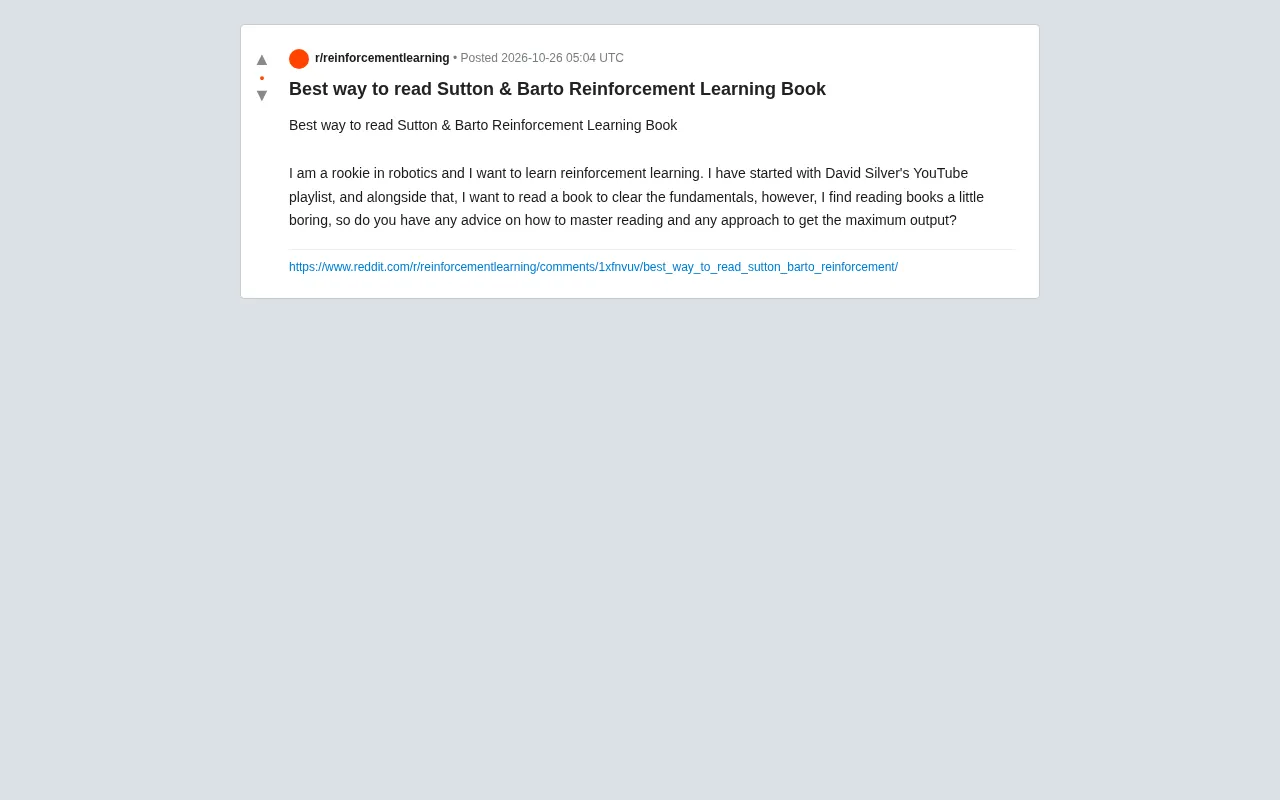
In the field of reinforcement learning (RL), "Reinforcement Learning: An Introduction" by Sutton and Barto is a widely recognized classic textbook, even called the "RL Bible." But for beginners, the reading experience is not friendly—dense mathematical formulas, pseudocode, and theoretical derivations easily make people give up halfway. A Reddit user's plea is typical: he had already started watching David Silver's YouTube course but wanted to consolidate the fundamentals by reading the book, yet found "reading a bit boring" and hoped to find an efficient reading method.
This predicament is not unique. Reinforcement learning involves knowledge from multiple fields such as probability theory, dynamic programming, and function approximation, while Sutton & Barto's book leans toward theoretical rigor and lacks hands-on code examples. Plowing straight through from beginning to end can indeed be disorienting.
Build the Skeleton First, Then Fill in the Flesh
The biggest taboo when reading this book is to grind through chapter by chapter and section by section from the start. A more effective strategy is staged reading:
Stage 1: Build the map (Chapters 1–3). Focus on understanding the core framework of reinforcement learning—agent-environment interaction, rewards, value functions, and Markov decision processes (MDP). There are not many concepts here, but they require repeated pondering. You can pair this with the first few lectures of David Silver's videos to solidify the basics such as MDP and the Bellman equation.
Stage 2: Classical methods (Chapters 4–8). Dynamic programming, Monte Carlo, temporal difference (TD), and eligibility traces. This is the most core part of the whole book; it is recommended to implement simple versions in Python while reading. For example, use numpy to implement TD(0) on a Gridworld—the code is not much, but it can greatly deepen understanding.
Stage 3: Deep reinforcement learning (Chapters 9–13). Function approximation, policy gradients, Actor-Critic, deep Q-networks, etc. This part requires some deep learning background. If you have not encountered neural networks before, it is recommended to first go through basic tutorials on PyTorch or TensorFlow.
Stage 4: Frontiers and extensions (Chapter 14 onward). You can read selectively and choose chapters according to your research direction.
Markov decision process (MDP) is the mathematical framework for reinforcement learning problems, and almost all subsequent algorithms are built on it. An MDP is defined by the five-tuple (\langle S, A, P, R, \gamma \rangle): state set (S), action set (A), state transition probability (P(s'|s,a)), reward function (R(s,a)), and discount factor (\gamma \in [0,1]). Its core assumption is the "Markov property"—the next state depends only on the current state and action, independent of earlier history. The Bellman equation takes advantage of this property to decompose the expectation of long-term return into "immediate reward + discounted value of the next state," thereby transforming the sequential decision problem into an iteratively solvable equation. Understanding MDP and the Bellman equation is a prerequisite for understanding chapters such as dynamic programming, TD learning, and policy gradients.
Four Techniques to Make Reading Less Boring
1. Cross-validate video + book. David Silver's course and Sutton's book overlap highly in knowledge system, but videos are more intuitive. After watching a lecture, immediately flip to the corresponding chapter and skim it quickly, focusing on the mathematical derivations that the video did not explain thoroughly. This rhythm of "video first, book deepens" can reduce frustration.
2. Use code to "translate" formulas. The pseudocode in the book is a treasure, but only reading without writing is equivalent to not learning. After finishing each algorithm (such as SARSA, Q-learning), implement it in a few dozen lines of code and run it in a simple environment (such as FrozenLake). You will find that many details (such as learning rate decay and exploration strategy) are truly understood only when you get hands-on.
3. Read in groups or use output to force input. Reading alone easily makes you sleepy. You can find one or two partners to discuss a chapter each week, or keep writing reading notes and publish them on a blog/Zhihu. In order to explain concepts clearly, you will actively consult materials, draw diagrams, and give examples—this process itself is the best learning.
4. Skip proofs you temporarily do not understand. There are many theorem proofs in the book (such as the policy gradient theorem and convergence proofs); it is normal not to understand them on the first pass. You can first accept the conclusion and continue reading, then come back to tackle the proofs after the overall framework is clear. Do not get stuck in one place for more than two days.
Common Misconceptions and Responses
Misconception 1: You must read every page in order. Sutton & Barto's book is more like a reference book; different chapters can be read independently. For example, you can jump directly from Chapter 6 TD to Chapter 9 function approximation without waiting to fully digest Chapters 7 and 8.
Misconception 2: Only read, do not practice. Reinforcement learning is a highly practical discipline; reading alone easily creates the illusion of "I understand." It is recommended that after learning each algorithm, run it in the classic control environments of OpenAI Gym (now Gymnasium) and observe the learning curve.
Misconception 3: Ignore mathematical foundations. If probability theory and linear algebra are not solid, reading the Bellman expectation equation and policy gradient derivations will be very laborious. Spend a week reviewing conditional expectation, Markov chains, and matrix differentiation; the rest will be much smoother.
Summary
Sutton & Barto's book is worth reading repeatedly, but the goal of the first pass should be to "build a knowledge framework" rather than "understand every formula." By combining video courses, hands-on implementation, and group discussion, turn reading from passive input into active output, and the boredom will be greatly reduced. For beginners with a robotics background, it is recommended to start with Chapters 1–6, thoroughly master classical methods such as value iteration, policy iteration, and TD learning, and then gradually go deeper into deep reinforcement learning. Remember: finishing the book is not the goal; being able to use it to solve practical problems is.
Background Supplement
Eligibility trace is the bridge connecting Monte Carlo and TD learning, and it is also the core concept of Chapters 7 and 8. It uses a "trace" that decays over time to record how recently each state has been visited, thereby continuously interpolating between one-step TD and Monte Carlo (the (\lambda) parameter controls the degree of interpolation). Eligibility traces enable the algorithm to assign credit to multiple recently visited states at each update step, rather than only updating the current state. This can reduce variance while maintaining relatively low computational overhead, and it is the mechanistic basis of algorithms such as TD((\lambda)) and SARSA((\lambda)). If you do not understand its motivation on first reading, you can first remember that "eligibility trace = weighted memory of recent visits" and derive it in depth later.
Function approximation is the key concept that connects tabular reinforcement learning and deep reinforcement learning. When the state space is continuous or huge, it is impossible to store a value for each state individually, so parameterized functions (such as linear models or neural networks) are used to approximate the value function or policy. After Chapter 9 introduces this idea, methods such as Q-learning and policy gradients can be extended to high-dimensional inputs. Function approximation also brings new challenges: function approximation errors can cause algorithms to become unstable or even diverge (the "deadly triad": the risk is highest when function approximation, bootstrapping, and off-policy learning occur simultaneously). Understanding this helps explain why deep reinforcement learning requires stabilization techniques such as experience replay and target networks.
One-line Summary
Read Sutton's RL Bible in stages, combine videos and code practice, and avoid grinding on formulas.
Paragraph Summary
Aimed at beginners' difficulties in reading Sutton & Barto's "Reinforcement Learning" textbook, this article proposes a staged reading strategy: first build the MDP framework, then go deeper into classical methods such as dynamic programming, Monte Carlo, and TD, and finally tackle deep reinforcement learning. The article suggests techniques such as cross-validating video courses with the book, implementing pseudocode in code, group discussion or writing output, and skipping proofs you temporarily do not understand, and points out three major misconceptions: having to read everything in order, only reading without practicing, and ignoring mathematical foundations. The core view is that the first reading should aim to build a knowledge map, reduce boredom through active output, and ultimately be able to use algorithms to solve practical problems.
Related articles

Firebase AI Logic + Gemini Nano 4: A Practical Guide to Android AI Development
How Firebase AI Logic and Gemini Nano 4 help Android developers ship generative AI: App Check and prompt templates ensure security, hybrid routing cuts latency and cost, Spend Caps control budgets, and AI monitoring provides observability.

Microsoft AI Agent Breakthroughs: More Efficient, Better at Code and Weather Forecasting
Microsoft Research Focus Issue 97: ForkPilot cuts agent inference costs, Cabra reveals coding agents' code-understanding gap, Teletune learns workflows from logs, PBC improves extended forecasts, BioEMU-2 opens preview.

Prime Intellect Releases Prime Mega MoE: Trainable Fused MoE Kernel with 3.11x Forward Speedup
Prime Intellect releases Prime Mega MoE, adding backpropagation to DeepSeek's fused Mega MoE kernel for trainability. Up to 3.11x forward speedup and 34% faster Qwen3 MoE training steps in prime-rl.