How to Evaluate AI Agents: A Full-Chain Assessment from Tool Calls to Task Completion

AI Agent evaluation must evolve from single-step accuracy to a layered framework covering tool calls and end-to-end task completion.
Traditional LLM evaluation focuses on single-turn Q&A accuracy, but AI Agents must execute dozens of sequential tool calls in dynamic environments — strong performance at individual steps doesn't guarantee the full task chain succeeds. This article proposes a two-layer evaluation framework: the tool call layer assesses tool selection accuracy, parameter validity, and failure recovery; the task completion layer verifies goal achievement in a reproducible live environment while factoring in efficiency metrics like step count, latency, and token usage. Combining both layers creates a comprehensive picture of Agent capability, and integrating the framework into regression testing prevents silent performance degradation after each model or prompt update.
When you deploy an AI Agent to production, the real question isn't whether it can answer a single query — it's whether it can execute a complete workflow spanning dozens of sequential tool calls in a real-world environment. This is fundamentally different from traditional model evaluation: high accuracy on individual steps doesn't guarantee the entire task chain will hold together.
Why AI Agent Evaluation Demands a New Methodology
Traditional LLM evaluation centers on single-turn Q&A accuracy: give the model a question, get an answer, compare it to a reference. But AI Agents operate through autonomous decision-making and continuous action. They must understand a goal, plan steps, invoke external tools, and adapt their strategy based on returned results — all within a dynamically changing environment — until the task is complete.
In this mode, any deviation at a single step can be amplified by every step that follows. An Agent might select the right tool on step one, yet crash the entire task chain on step five due to a malformed parameter. The evaluation focus must therefore shift from "is the answer correct?" to "was the task actually completed?"
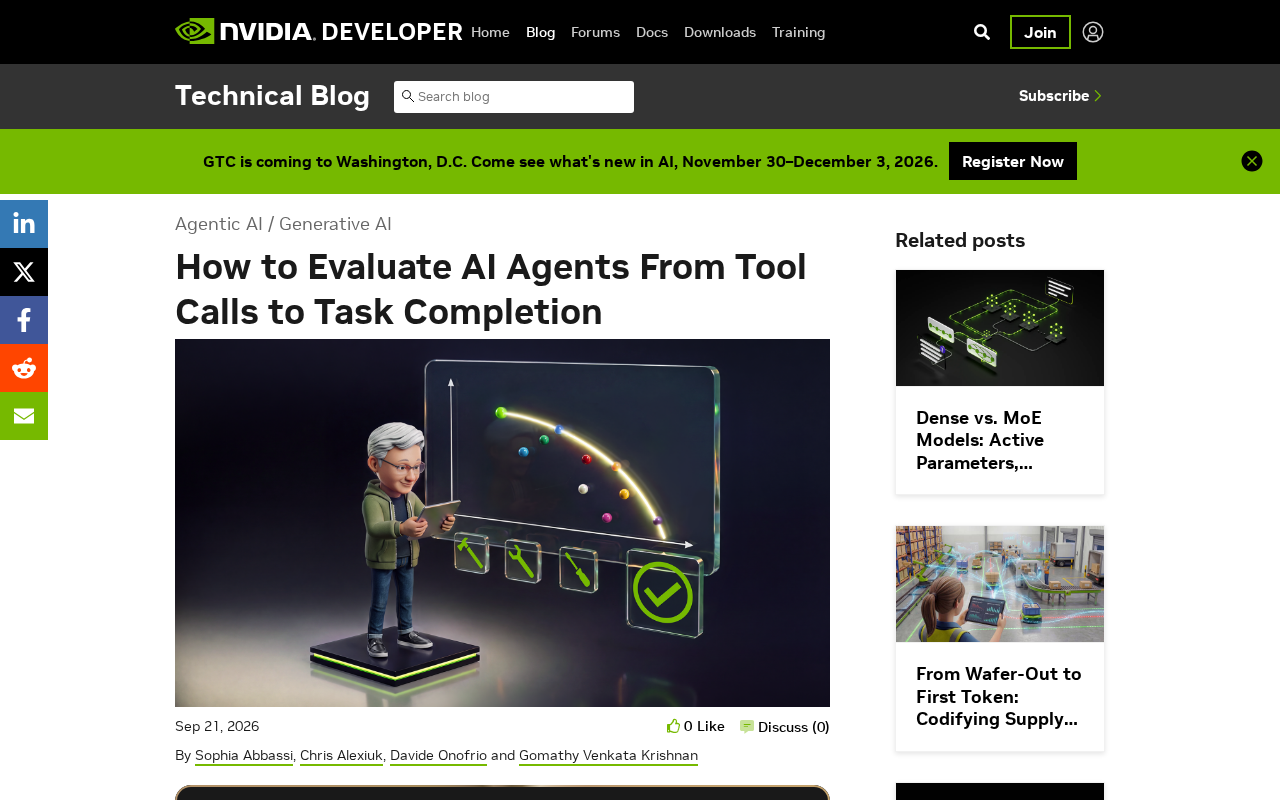
The Tool Call Layer: The First Line of Evaluation
Tool calls (Tool Calls) are the primary way an Agent interacts with the outside world. At this layer, evaluation needs to cover several dimensions: whether the Agent selected the correct tool, whether it passed correctly formatted and semantically valid parameters, and whether it can properly parse the results returned by each tool.
Tool call evaluation tends to be the most quantifiable part. You can measure tool selection accuracy, parameter fill correctness, and recovery capability after a failed call. A mature Agent, upon encountering a call failure, should be able to identify the error, adjust its strategy, and retry — rather than giving up entirely or falling into a meaningless loop.
It's worth noting that correct individual tool calls do not equal task success. An Agent's every call might be technically valid while its overall planning direction is completely wrong. This is what gives rise to the need for higher-level evaluation.
Tool calls are technically implemented via the Function Calling capability of large language models: instead of generating a text response directly, the model outputs a structured JSON payload specifying which function to call and what arguments to pass. The runtime framework then executes the call and feeds the result back into the model's context. Major frameworks such as LangChain, AutoGen, and the OpenAI Assistants API all provide abstractions around this mechanism. Because tool calling is fundamentally a loop of "model generates JSON → program executes → result injected into context," any formatting deviation or semantic error at any stage breaks the entire chain — which is precisely why parameter fill accuracy is so critical in evaluation.
The Task Completion Layer: The Standard That Truly Measures Value
Task completion (Task Completion) is the ultimate goal of Agent evaluation. It measures whether the Agent has ultimately achieved the user's intended objective within a real or simulated environment. This requires a live environment that reflects real business scenarios, where the Agent executes a full sequence of operations.
At this layer, beyond checking whether the final outcome meets the target, you should also assess process efficiency and robustness. Two Agents may both complete a task — but one does it in 5 steps while the other takes 20 steps with repeated retries. Their real-world usability differs enormously. Metrics like step count, latency, token consumption, and retry frequency together form a comprehensive picture of Agent performance.
The dynamic nature of the environment introduces additional evaluation challenges. The state of a live environment changes with each operation the Agent performs, which means evaluation can't simply compare against a static reference answer. You need reproducible, replayable test environments to ensure evaluation results are consistent and trustworthy.
Building a live environment is the greatest engineering challenge at this evaluation layer. Two common approaches exist: sandbox simulation, where you set up a mirror environment that behaves identically to the production system but with isolated data — so every Agent action has real side effects without touching live data — and state snapshots with replay, where the environment is reset to a predefined initial state before each test case, ensuring comparability across runs. The latter is especially important: if the Agent modifies a database record on the first run, the starting point for the second run is already different, and the evaluation conclusions lose meaning. Reproducibility therefore becomes the primary constraint when designing evaluation infrastructure.
Practical Recommendations for Building a Reliable Evaluation System
Combining the tool call layer with the task completion layer yields a tiered evaluation framework. The tool call layer provides fine-grained diagnostic information to pinpoint exactly where things go wrong; the task completion layer provides an end-to-end pass/fail judgment that reflects the Agent's real business value.
In engineering practice, it's advisable to build a test suite covering representative scenarios, where each test case includes a clearly defined initial state, target state, and success criteria. By repeatedly running the Agent in a controlled environment and collecting performance data across both layers, you can build a multi-dimensional profile of the Agent's capabilities.
For continuously evolving Agent systems, this evaluation framework should also be integrated into regression testing workflows. Every time a model or prompt is updated, you can quickly verify whether performance on existing tasks has regressed — avoiding the "fix one scenario, break three others" trap.
The importance of regression testing in Agent systems far exceeds its role in traditional software. An Agent's behavior is jointly determined by model weights, prompts, tool definitions, and invocation logic — any small change to any of these can cause cascading effects across steps, and these effects often don't surface in the scenario closest to the change but quietly degrade in edge cases instead. A common industry practice is to maintain a golden test suite for each known high-value scenario, run it automatically before every change is merged, and use the delta in task completion rate and tool call accuracy as a release gate: if a key metric drops beyond a defined threshold, the deployment pipeline is blocked.
Summary
Evaluating AI Agents is a continuous process from the microscopic to the macroscopic: the tool call layer ensures correctness at each individual action; the task completion layer validates achievement of the overall goal. Only by combining both layers can you truly answer the core question: "Is this Agent ready for production?" As Agents take on increasingly complex tasks in production environments, building a scientifically sound, reproducible evaluation system is becoming one of the core competencies that sets teams apart.
Related articles

Chain of Thought Isn't Just for AI: How Humans Can Use CoT to Improve Thinking Quality
Chain of Thought isn't just a prompt trick for large models. Starting from a Hacker News discussion, this article analyzes why CoT works for human thinking too, breaks down actionable ways to transfer it, and highlights the key differences between human CoT and machine CoT.
Cloudflare Teams Up with OpenAI: Closi…
Cloudflare Teams Up with OpenAI: Closing the Loop from Vulnerability Discovery to Defense with AI
Cloudflare uses OpenAI Daybreak to investigate security vulnerabilities and generate reviewable remediation plans, while developers use Codex to boost coding efficiency and quality.

Orca Multi-Agent Orchestration in Practice: A Guide to Parallel Collaboration with Claude and Codex
Orca is Stable AI's free open-source agent workbench supporting 34 agents like Claude Code and Codex in parallel. Learn its Git worktree isolation, multi-model orchestration, and mobile management.