How to Experience San Francisco Like a Local During COLM

Jason Wei shares a local SF guide for COLM attendees, urging them not to judge the city by its venue neighborhood.
Prominent AI researcher Jason Wei posted advice on Twitter for COLM conference attendees, noting that the venue sits in one of San Francisco's rougher neighborhoods and can easily leave visitors with a misleading impression of the city. Wei admitted the same experience once soured him on San Francisco, which prompted him to write and share a guide on experiencing the city like a local. The piece argues that the gap between conference venue locations and a city's true character is a frequently overlooked issue in the tech community — and that an insider's perspective is far more useful for frequent Bay Area travelers than standard tourist guides.
A Tweet That Sparked a San Francisco Exploration Guide
Beyond the conference halls, attendees' experiences of a host city can vary wildly. Jason Wei, a prominent AI researcher, posted a tweet offering practical city-experience advice for researchers heading to San Francisco for COLM — and it struck a chord.
Behind what seemed like a casual tweet lies a reality often overlooked by the tech community: there's a subtle but significant gap between where academic conferences are held and what a city actually has to offer. Wei was candid about it — the neighborhood where COLM takes place is far from San Francisco's best, and attendees who stick close to the venue may walk away with an unfairly negative impression of the city.
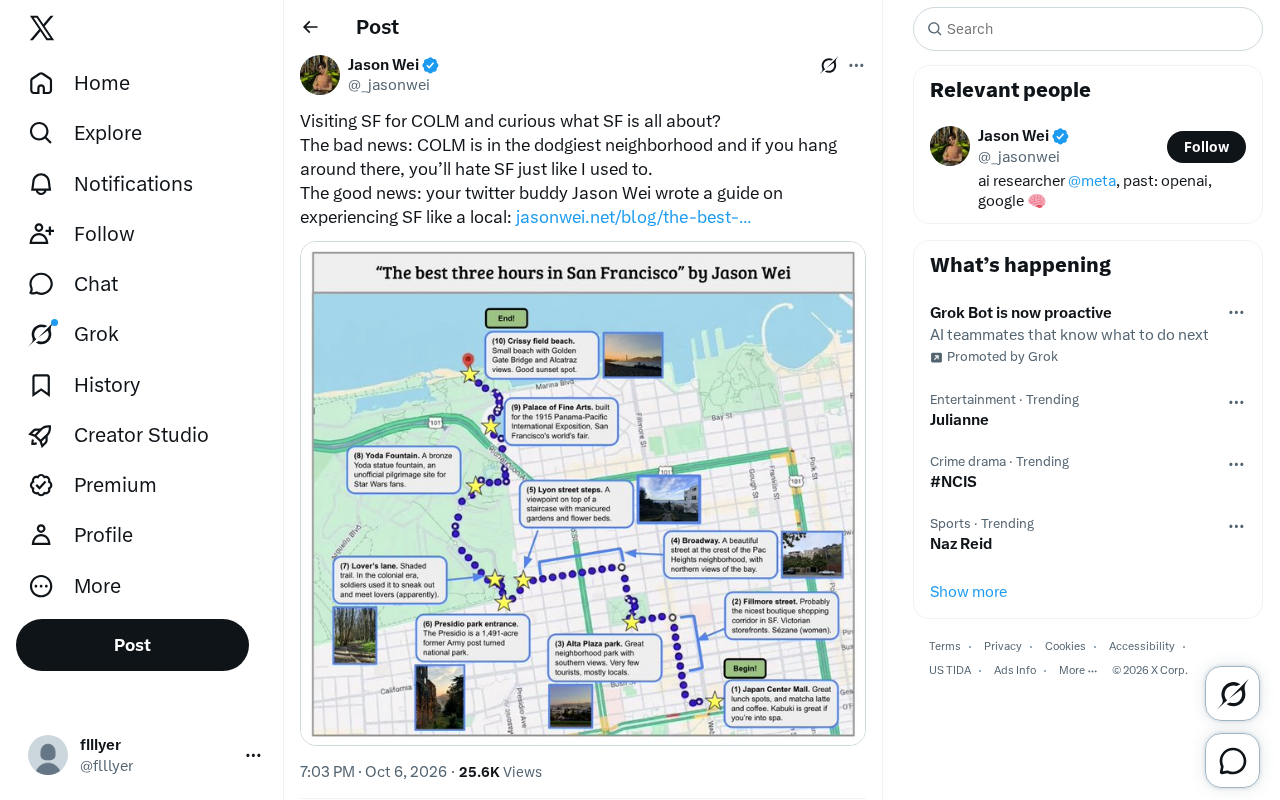
The Reality Gap Around the Venue
The "dodgiest neighborhood" Wei refers to in his tweet touches on a long-standing urban governance issue in San Francisco. Certain downtown areas have drawn sustained attention for their public safety and sanitation challenges — and these areas happen to be exactly where large convention centers tend to sit.
For first-time visitors, this disconnect can be jarring. They may arrive expecting to feel the tech energy and cosmopolitan charm that San Francisco is known for, only to encounter street scenes that don't match those expectations near the conference center. Wei admits he "used to hate San Francisco" because of this very experience — which makes his advice all the more credible. A local's perspective can help visitors avoid forming a skewed impression of the city.
COLM (Conference on Language Modeling) is an academic conference focused on language model research, typically held at a convention center in San Francisco's SoMa (South of Market) district. Historically an industrial zone, SoMa has become a hub for tech companies in recent years — but it also struggles with persistent issues around drug use and homelessness, creating a stark contrast between gleaming tech offices and street-level hardship. These urban challenges became especially pronounced in the post-pandemic period, drawing repeated media and political attention and making them an unavoidable part of how outsiders perceive the city.
The Value of a Local Perspective
In his tweet, Wei shared a guide he wrote on "how to experience San Francisco like a local." The value of this kind of content is that it breaks free from the standardized framework of typical travel guides, offering genuine insight shaped by years of actually living in the city.
For the tech community, this kind of sharing carries special weight. A large number of AI researchers and engineers travel frequently to the Bay Area for work or conferences, yet relatively few truly know the city. A local guide from someone inside the community speaks far more directly to that group's interests and needs than generic tourist recommendations.
From a broader perspective, the overall conference experience is receiving more attention than ever. Conferences aren't just venues for paper presentations — they're opportunities for networking, cultural immersion, and personal discovery. How attendees make the most of a city beyond the packed schedule is increasingly becoming part of conference culture itself.
Jason Wei is a research scientist at Google DeepMind, best known for his work on reasoning capabilities in large language models — particularly for introducing Chain-of-Thought Prompting, a method that has had a profound influence on current LLM research. Having lived and worked in the San Francisco Bay Area for years, he carries significant name recognition and social media influence within the AI research community. That's precisely why a city guide written from his own lived experience travels so much further among fellow researchers than anything a typical travel blogger might recommend.
Takeaways for Conference Attendees
Short as it was, Wei's tweet carries several practical points worth keeping in mind. The neighborhood around a conference venue doesn't represent the whole city — visitors shouldn't let a localized impression shape their overall judgment of San Francisco. Actively seeking out advice from locals can meaningfully improve the quality of the city experience.
For researchers planning to attend COLM or other conferences held in San Francisco, this is a nudge to plan ahead: carve out time beyond the conference schedule to explore the city, and rely on trustworthy local sources to truly appreciate the many sides of this tech capital.
Related articles

Chain of Thought Isn't Just for AI: How Humans Can Use CoT to Improve Thinking Quality
Chain of Thought isn't just a prompt trick for large models. Starting from a Hacker News discussion, this article analyzes why CoT works for human thinking too, breaks down actionable ways to transfer it, and highlights the key differences between human CoT and machine CoT.
Cloudflare Teams Up with OpenAI: Closi…
Cloudflare Teams Up with OpenAI: Closing the Loop from Vulnerability Discovery to Defense with AI
Cloudflare uses OpenAI Daybreak to investigate security vulnerabilities and generate reviewable remediation plans, while developers use Codex to boost coding efficiency and quality.

Orca Multi-Agent Orchestration in Practice: A Guide to Parallel Collaboration with Claude and Codex
Orca is Stable AI's free open-source agent workbench supporting 34 agents like Claude Code and Codex in parallel. Learn its Git worktree isolation, multi-model orchestration, and mobile management.