How to Handle Identity Authentication Questions in Enterprise Security Questionnaires
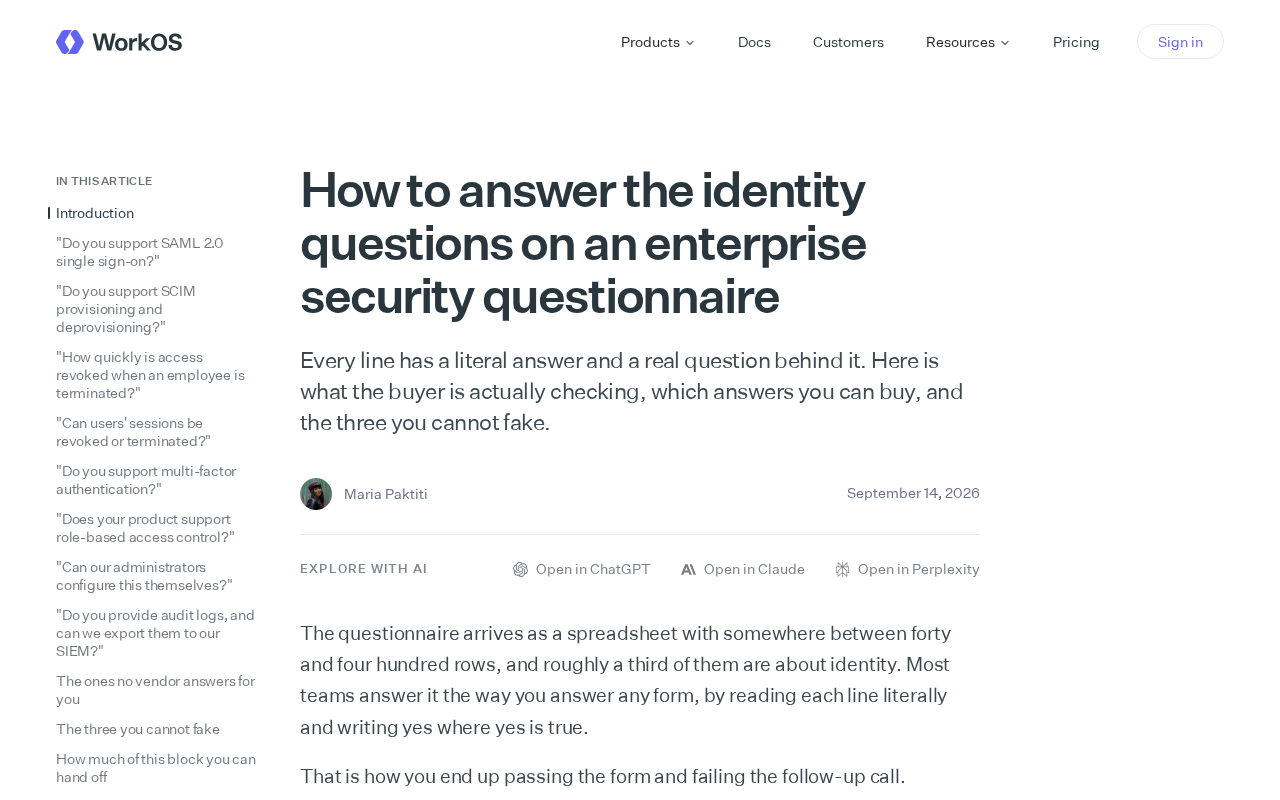
Security questionnaires are risk assessments — features can be bought, but security culture and architectural honesty cannot.
Enterprise security questionnaires are an unavoidable trust hurdle in B2B sales. Buyers appear to be checking feature lists, but are actually assessing the risk of handing over identity and access control to a vendor. A practical framework emerges: functional needs like SSO and MFA, and process requirements like access control policies, can be quickly addressed through IDaaS integrations or compliance certifications — these are "answers you can buy." But genuine security culture and engineering practices, a verifiable incident history, and architectural honesty built in from day one are things no budget can purchase. Understanding this dividing line is what allows vendors to handle deep scrutiny with confidence rather than crumbling when pressed for details.
Enterprise security questionnaires are an unavoidable hurdle in the B2B sales process. Behind every identity authentication question lies what the buyer actually wants to confirm — on the surface they're asking about technical details, but in reality they're evaluating whether you can be trusted to host their data and manage access permissions.
This article builds on a core insight: every line in a security questionnaire has a literal answer, and also a hidden real question. Understanding this distinction is the key to passing reviews efficiently.
What Buyers Are Actually Checking
When a procurement team or security department sends over a security questionnaire that can run hundreds of rows long, they're not just checking off a feature list — they're conducting a risk assessment. The core question they care about is usually: if we hand over user identity and access control to your product, will it introduce unacceptable risk?
Take the identity authentication section as an example. Common items like "Does it support SSO single sign-on," "Does it support SCIM user provisioning," and "Is multi-factor authentication enforced" are literally asking about feature availability. But what buyers really want to know is: can your product integrate seamlessly with their existing identity infrastructure (such as Okta or Azure AD), can permissions be automatically revoked when employees leave, and if credentials are compromised, how large is the attack surface?
Recognizing the real intent behind the question is what allows you to give answers that put reviewers at ease, rather than mechanically checking boxes.
Answers You Can "Buy"
A practical classification framework emerges here: many requirements in security questionnaires can essentially be satisfied by purchasing off-the-shelf solutions.
Solving Problems Through Third-Party Integrations
The vast majority of identity-related feature requirements — SSO, MFA, directory sync, audit logs — have mature commercial components or Identity-as-a-Service (IDaaS) platforms that can be directly integrated. For startups or small teams, integrating certified third-party capabilities is often preferable to building an identity system from scratch. This approach lets you provide affirmative answers quickly on the questionnaire while also leveraging your vendors' compliance credentials (such as SOC 2 or ISO 27001) to bolster your own standing.
Using Compliance Certifications to Cover Process Questions
A large portion of questionnaires covers process and governance questions, such as "Do you have an access control policy document" or "Do you conduct regular access reviews." These can also be addressed quickly by adopting standardized compliance frameworks, purchasing compliance management tools, or bringing in consultants to establish them. In other words, these kinds of "answers" can be obtained with budget and time.
Three Answers That Cannot Be Faked
The core conclusion is this: there are three things that cannot be bought or faked. This is where security questionnaires truly separate vendors.
From the general logic of enterprise security assessments, the things that cannot be faked typically come down to these areas:
-
Genuine security culture and engineering practices: Whether a team truly applies the principle of least privilege in day-to-day development, and whether they have real-world incident response experience, cannot be concealed by a document. Experienced reviewers will probe for details and demand evidence to find out.
-
Verifiable track record: Whether security incidents have occurred in the past, and how they were disclosed and handled, are objective facts that cannot be rewritten on a questionnaire.
-
Architectural honesty: Whether a product's identity model was designed from the ground up with isolation, auditing, and minimal exposure in mind is structural — it cannot be patched in after the fact or faked.
The answers to these three categories depend on long-term investment, not last-minute preparation. This also explains why truly mature vendors can handle deep scrutiny with confidence, while teams that only work the surface will crack under follow-up questions.
Practical Takeaways for Vendors
Once you understand this framework, the strategy for handling security questionnaires becomes clear: buy what can be bought, and do it early — use proven solutions to cover functional and process-related requirements, saving time and building trust. For the things that cannot be bought, long-term investment is required: security must be built into team culture and product architecture from the start.
Treating a security questionnaire as an opportunity to demonstrate trustworthiness, rather than a burden to passively endure, is the right posture for passing enterprise-level reviews and winning major customers.
Related articles
Xi Jinping Proposes Open Source AI Cooperation Zone Among BRICS Nations
Xi Jinping proposed an open source AI cooperation zone at the BRICS summit. Analyzing the strategic intent, open source rationale, and global AI governance implications.
Swift-Qwen3.8-27B: 58% Fewer Thinking Tokens, Nearly 2x Faster Inference
UkisAI open-sources Swift-Qwen3.8-27B, cutting thinking tokens by 58% and boosting inference speed 1.95x via overthinking token penalties and on-policy distillation — with under 1% accuracy loss.

Netflix Partners with Sega: Crazy Taxi Movie and New Sonic Animated Series on the Way
Netflix announces three Sega game adaptations: a Crazy Taxi movie, a new Sonic animated series with edge, and a live-action film based on RGG Studio's Stranger Than Heaven.