How to Intercept Customer Service Issues Before They Escalate?

Customer service issues surface late due to a lack of real-time signals; the discovery mechanism needs to move forward to in-process.
Starting from a Reddit practitioner's question, the article points out that customer service teams generally rely on post-hoc reviews and rising complaint volume to discover issues, leading to inconsistent agent messaging, low first contact resolution, and repeat customer calls. The root cause is the lack of real-time signals and limited traditional sampling coverage. The author proposes three feasible paths: real-time conversation monitoring and keyword triggering, repeat call and secondary contact analysis, and cross-agent answer consistency comparison, with the core idea of moving quality inspection from "post-hoc sampling" to "in-process prompting." It also emphasizes that tools discover anomalies while humans judge follow-up, and warns against misconceptions such as treating early warning as monitoring, pursuing full coverage, and neglecting knowledge base synchronization. The conclusion is that real-time interception capabilities are not yet widespread, and most teams are still at the manual review stage.
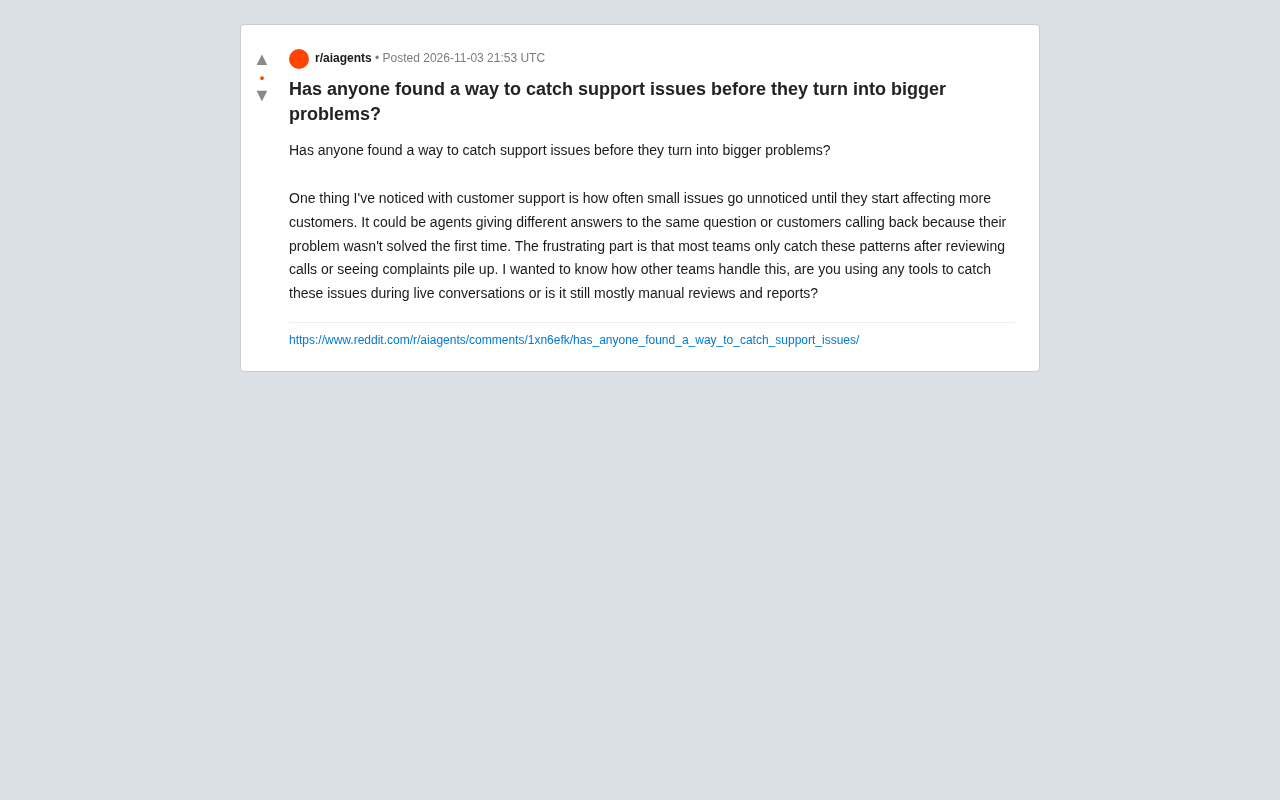
Customer service teams often face a dilemma: small issues go unnoticed early on, only to be discovered after a large number of customers are affected. A question raised by a practitioner on Reddit struck a chord—customer service staff give different answers to the same question, or customers call repeatedly because their issue wasn't resolved, and these patterns are often only noticed during retrospective reviews or after complaints pile up.
Why Small Issues Are Always Seen Only After They Grow
The Reddit user pointed out a common phenomenon: most teams rely on reviewing call records after the fact or waiting for complaint volume to rise, rather than identifying anomalies during conversations. This lag leads to two typical consequences: first, inconsistent customer service messaging—the same question gets different answers from different agents, fragmenting the customer experience; second, low first contact resolution, forcing customers to call back and issues escalating in a loop.
The root of the problem isn't that teams aren't trying hard, but that they lack real-time signals. Traditional quality inspection sampling has limited coverage, and by the time reports come out, the damage is already done.
First Contact Resolution (FCR) is one of the core metrics in the customer service industry, referring to the proportion of customers whose issues are completely resolved on their first contact. A low FCR means customers need to call back two or more times, which not only raises service costs but is also a direct signal that issues aren't being identified in time. In industry research, every few percentage point increase in FCR is often accompanied by simultaneous improvements in customer satisfaction and agent efficiency, so it is often used as a proxy metric for measuring whether "issues are truly resolved during the conversation."
Quality inspection sampling coverage refers to the proportion of all service volume that the quality management team actually listens to or samples. Limited by manpower, most teams' sampling rates are usually only in the single digits percentage-wise, and mostly involve post-hoc sampling. This means the vast majority of conversations are never reviewed, and anomalous patterns easily accumulate in sampling blind spots until they evolve into complaints or public opinion events before being seen.
Feasible Paths for Real-Time Issue Capture
The original poster wanted to know whether any teams capture such issues during real-time conversations, or whether they still rely mainly on manual reviews and reports. From the discussion direction, feasible paths roughly fall into three layers:
Real-time conversation monitoring and keyword triggering. Set keywords and semantic rules in calls or online chats, and give instant reminders when agents give answers inconsistent with the knowledge base. This intervenes earlier than post-hoc sampling.
Repeat call and secondary contact analysis. Track repeat contacts from the same customer within a short period, mark them as "unresolved" signals, and force the team to trace back to the first conversation.
Cross-agent answer consistency comparison. Aggregate multiple agents' response texts for the same type of question to identify points of divergence—this is more efficient than listening to recordings one by one.
These approaches all point to one idea: move quality inspection from "post-hoc sampling" forward to "in-process prompting."
The difference between semantic rules and keyword triggering is worth explaining: keyword matching relies on literal hits, which is simple to implement but easily misses synonymous expressions and colloquial variants; semantic rules use intent recognition or text similarity models to determine whether an agent's response deviates from the standard answer. The latter has broader coverage but places higher demands on model quality and knowledge base maintenance. In practice, a common approach is to use keywords as a low-cost fallback first, then layer semantic comparison on top for high-frequency questions.
Cross-agent answer consistency comparison essentially clusters multiple responses to the same question and identifies minority responses that deviate from the mainstream. Its prerequisite is that question classification is accurate enough; otherwise, responses to different questions mixed together will produce a large number of false divergences.
The Boundary Between Tools and Humans
There is an implicit consensus in the original discussion: relying entirely on manual review cannot scale, but pure tools are not necessarily reliable either. Real-time monitoring generates a large number of false positives, and keyword rules struggle to cover semantic variants. A more realistic approach is for tools to be responsible for discovering anomalous signals, and for humans to be responsible for judging whether a signal is worth following up.
For teams with limited resources, they can start with a single metric—the repeat call rate—which is low-cost and has a clear signal. After validating its effectiveness, they can then layer on conversation consistency analysis.
False Positive Rate is key to whether a real-time warning system can be accepted by the team. If seven or eight out of ten alerts are false positives, agents will quickly learn to ignore the alerts, and the system becomes useless. Therefore, real-time monitoring tools usually need confidence thresholds and tiered alert mechanisms: high-confidence signals pop up immediately, while low-confidence signals are only recorded for later review, thereby balancing recall rate and interruption cost.
Common Misconceptions
First, equating early warning with monitoring agents. If real-time prompts are used as a basis for punishment, they will trigger resistance and actually conceal problems. Second, pursuing full coverage. Full monitoring is costly, and focusing on high-frequency issues and repeat calls is more pragmatic. Third, neglecting knowledge base synchronization. Many inconsistencies in messaging stem from the knowledge base itself being outdated—the tool flags divergences but there is no standard answer to rely on.
Conclusion
The core of early interception of customer service issues is not buying more expensive tools, but moving the discovery mechanism from "post-hoc reports" forward to "in-process signals." Repeat calls, answer divergence, and keyword triggering are all low-cost starting points. The answer the original poster wanted is: some teams are doing this, but most are still at the manual review stage, and real-time interception capabilities are not yet widespread.
One-line Summary
Customer service issues surface late due to a lack of real-time signals; the discovery mechanism needs to move forward to in-process.
Paragraph Summary
Starting from a Reddit practitioner's question, the article points out that customer service teams generally rely on post-hoc reviews and rising complaint volume to discover issues, leading to consequences such as inconsistent agent messaging, low first contact resolution, and repeat customer calls. The root cause is the lack of real-time signals, and traditional sampling coverage is limited. The author proposes three feasible paths: real-time conversation monitoring and keyword triggering, repeat call and secondary contact analysis, and cross-agent answer consistency comparison, with the core idea of moving quality inspection from "post-hoc sampling" to "in-process prompting." It also emphasizes that tools are responsible for discovering anomalies and humans for judging follow-up, and warns against misconceptions such as treating early warning as monitoring, pursuing full coverage, and neglecting knowledge base synchronization. The conclusion is that real-time interception capabilities are not yet widespread, and most teams are still at the manual review stage.
Related articles

AI Tools Quietly Altering Settings: Postman Silently Installs Plugin, Codex Sharing Option Auto-Resets
AI Daily reports: Postman silently installs a Mac plugin and self-approves startup hooks, logged as auto-existing upgrade; Hacker News developers say Codex data-sharing opt-out flips back. Plus Simon Willison's raw float weight experiment with QEN 3.8-27B.

AI Learns to Rewrite AI: MIT's "Weightspace Programming" Redraws the Path to Recursive Self-Improvement
MIT team proposes weightspace programming: GPT-6 Astra reads and edits AI model weights directly. Math scores jump several-fold, hand-written networks beat trained models. Eight experiments analyzed, plus Anthropic's same-day warning and the real boundaries of recursive self-improvement.

Running Qwen 3.8 on a Laptop to Read Raw Weights: 46 Minutes Per Answer
Simon Willison reproduced weight space programming with Qwen 3.8 27B on a laptop: a 17GB model file, 46 minutes per answer, 43,506 reasoning tokens, Pong over an hour, Freeway failed. Suited for interpretability researchers.