How to Make Single-Channel EEG Sleep Staging Explainable: A Comparison of Five XAI Methods

A systematic comparison of five XAI methods for single-channel EEG sleep staging finds Integrated Gradients most robust.
Based on the SleepXAI framework, this study systematically compares the attribution faithfulness of five explainability methods for single-channel EEG sleep staging. Using AASM-defined EEG bands as a clinical reference signal, it quantifies consistency between attributions and band features via Spearman rank correlation, validating on Sleep-EDF and DREAMT (the latter divided into four OSA severity groups by AHI). Integrated Gradients achieves the highest average attribution faithfulness across all five Sleep-EDF sleep stages and all DREAMT AHI groups, showing consistency across datasets, stages, and populations. The study stresses that attribution method choice should be part of system design, not an afterthought.
Automated sleep staging models already achieve impressive accuracy on benchmarks, but clinical adoption remains stuck on an old problem: doctors don't know why the model made a given judgment. A recent study pushes the SleepXAI framework a step further, systematically comparing the attribution faithfulness of five explainability (XAI) methods for single-channel EEG sleep staging, and delivers a noteworthy conclusion—Integrated Gradients (IG) performs most consistently in most scenarios.
Why Single-Channel EEG + Explainability Is a Clinical Necessity
Full polysomnography (PSG) requires simultaneous acquisition of EEG, EOG, EMG, and other signals, involving complex equipment and a heavy wearing burden, making it hard to deploy at home or in primary-care settings. Single-channel EEG substantially lowers the deployment barrier and is better suited for real-world clinical rollout.
The problem is that if the staging results produced by deep learning models lack explainability, clinicians have no basis for trust. This is precisely the gap the study attempts to fill: turning explainability from an "add-on" into a core, quantifiably evaluated metric.
Five XAI Methods, One Clinical Yardstick
Based on the SleepXAI sleep staging framework, the study compares five different XAI attribution methods side by side. The key innovation lies in the evaluation approach: rather than judging whether heatmaps "look good," it uses Spearman rank correlation to measure the faithfulness between attribution results and the AASM-defined EEG frequency bands.
The AASM (American Academy of Sleep Medicine) frequency band divisions are the clinical gold standard for sleep scoring. Using them as a reference signal is equivalent to setting a clinically grounded yardstick for attribution methods. The more closely attribution results align with band features, the more the model's "attention" resembles the scoring logic of human experts.
AASM frequency band divisions refer to the standardized definitions of EEG frequency bands in the American Academy of Sleep Medicine (AASM) sleep scoring manual, typically including slow waves (0.5–4 Hz), theta (4–8 Hz), alpha (8–13 Hz), sigma/sleep spindles (11–16 Hz), and beta (13–30 Hz). These bands correspond directly to characteristic activity in different sleep stages—for example, N3 is dominated by slow waves, while N2 is marked by sleep spindles and K-complexes. For this reason, correlating model attribution results with AASM band features is equivalent to testing whether the model "attends to" the band information that clinical experts rely on during scoring—which is the basis for the study's use of band faithfulness as an evaluation yardstick.
Attribution faithfulness measures whether explanation results genuinely reflect the model's decision basis, rather than merely generating plausible-looking visualizations. Common evaluation approaches include: deleting or retaining the input features with the highest attribution scores and observing changes in model output, fitting the model's local behavior using attribution results, or performing correlation analysis between attribution distributions and domain-prior features. This study adopts the latter, using Spearman rank correlation to quantify the rank-order consistency between attributions and AASM band features, thereby converting "whether an explanation is credible" into a comparable numerical metric.
Datasets and Experimental Design
The experiments cover two datasets: the Sleep-EDF benchmark dataset and the DREAMT dataset. On DREAMT, the study further divides subjects into four OSA severity groups based on the apnea-hypopnea index (AHI) to test the robustness of the methods across populations with different disease severity.
The SleepXAI model achieves strong classification performance on both datasets, providing a reliable foundation for subsequent attribution comparisons—after all, discussing explainability for a model that can't even classify well is of limited value.
Why IG Wins: Consistency Across Sleep Stages and AHI Groups
Under the Spearman rank correlation metric, Integrated Gradients (IG) achieves the highest average attribution faithfulness across all five sleep stages in Sleep-EDF, and also leads other evaluated methods across all AHI groups in DREAMT.
This consistency across datasets, stages, and populations is more convincing than a best result in a single scenario. It indicates that a relatively stable correspondence exists between IG's attribution logic and AASM band features, rather than being a chance phenomenon on one particular dataset.
Integrated Gradients (IG) was proposed by Sundararajan et al. in 2017 and belongs to the family of gradient-based attribution methods. Its core idea is: starting from some baseline input (e.g., an all-zero signal), integrate the gradient of the model output with respect to the input along a straight-line path, thereby distributing the prediction result across input features. Compared with simply taking gradients or saliency maps, IG satisfies two axioms—"sensitivity" and "implementation invariance"—making attribution results insensitive to internal implementation details of the model and theoretically more stable. On time-series signals like EEG, IG can produce a per-sample contribution distribution, making it easy to align and compare with band features—which may be the reason for its more consistent performance across stages and populations.
Implications for Clinical Deployment
The core message of this study is: the choice of attribution method is itself part of system design, not an afterthought. A reliable and clinically interpretable automated sleep staging system needs to factor XAI methods into consideration at the model selection stage.
For engineering teams, this means explainability evaluation should have quantitative standards, rather than relying solely on qualitative judgments from visualization heatmaps; for the clinical side, attribution results aligned with AASM bands are easier to translate into scoring evidence that doctors can understand. The lightweight deployment advantage of single-channel EEG, combined with explanation outputs validated for faithfulness, is a prerequisite for such systems to move into real clinical settings.
One-line Summary
A systematic comparison of five XAI methods' attribution faithfulness for single-channel EEG sleep staging finds Integrated Gradients to be the most robust.
Paragraph Summary
Based on the SleepXAI framework, this study systematically compares the attribution faithfulness of five explainability methods for single-channel EEG sleep staging. Using AASM-defined EEG frequency bands as a clinical reference signal, it quantifies the consistency between attribution results and band features via Spearman rank correlation, validating on both Sleep-EDF and DREAMT datasets—the latter further dividing subjects into four OSA severity groups by AHI. Results show that Integrated Gradients achieves the highest average attribution faithfulness across all five sleep stages in Sleep-EDF and across all AHI groups in DREAMT, demonstrating consistency across datasets, stages, and populations. The study emphasizes that the choice of attribution method should be part of system design, not an afterthought.
Related articles
Gemini 4 Neon Hands-On: Value King or Confident Catastrophe?
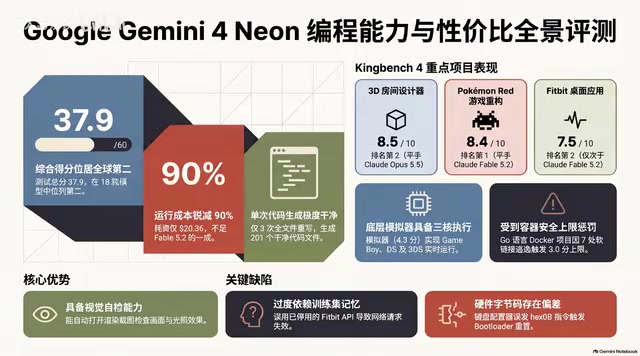
Gemini 4 Neon review: 1M-token context, four thinking levels, 201 files in one KingBench4 pass at one-tenth Fable 5.2's cost—but it hallucinates fake data, leaves 7 symlink escapes, and bricks keyboards.

Google Gemini 4 Neon Hands-On: 6 3D Works That Impress and Fail
Hands-on with Google Gemini 4 Neon on a 3060 laptop: 6 3D works tested. Sunshower Fishing Harbor and mechanical keyboard impress; soft-body physics and faces fall short.

Gemini 4 Neo Web Novel Writing Test: Faint AI Flavor, Textured Dialogue
Bilibili creator's first-look review of Gemini 4 Neo for Chinese web novel writing: testing a Three Kingdoms transmigration opening with faint AI flavor, emotionally textured dialogue, and strong crisis building, plus comparison of 4A/4H/4C models and full workflow demos.