How to Subscribe to Claude in China Without Getting Banned: Registration, Payment, and API Guide

A practical guide for China-based users on subscribing to Claude safely and avoiding account bans.
This article breaks down how users in China can register and subscribe to Claude while minimizing ban risks. It covers choosing the right email, handling phone verification with physical SIM cards, using legitimate payment channels, applying for refunds after a ban, and why switching to the official Claude API is the most sustainable long-term solution for heavy users running automated or coding workflows.
Article Content
Recent rumors about Anthropic rolling out stricter facial verification and account ban mechanisms have left many heavy users in China on edge — especially those who've built their entire workflow around Claude Code and Agent-based pipelines. Once your account gets banned, you quickly realize just how rusty your "old-school coding" skills have become.
This article is based on the hands-on, real-money testing experience of a Bilibili content creator. It systematically covers how to relatively safely subscribe to a Claude account in China, how to apply for a refund after getting banned, and a smarter long-term approach using the official API to sidestep ban risks altogether.
Disclaimer: This article is for informational and risk-awareness purposes only. Third-party subscription proxies, virtual number services, and similar tools all carry compliance and account security risks. Readers should evaluate these risks independently before taking any action.
Why Claude Bans Accounts: What the Platform Is Really Watching For
To understand how to avoid getting banned, you first need to understand Anthropic's risk control logic. The platform typically evaluates a combination of signals — IP address, payment method, phone number, device fingerprint, and behavioral patterns — to determine whether an account is "high-risk."
As one of the most closely watched AI safety companies today, Anthropic's risk control system draws on multi-dimensional anti-fraud techniques borrowed from fintech and large SaaS platforms. Device Fingerprinting is a key component — a technology originally developed for financial fraud detection that collects dozens of signals including browser version, operating system, screen resolution, font list, Canvas rendering characteristics, WebGL rendering differences, and AudioContext signatures. Even when a user switches IPs, the platform can identify the same device across sessions with over 99% accuracy, with no reliance on cookies whatsoever.
Deep Dive: The Physics Behind Canvas Fingerprinting Device fingerprinting technology was originally developed by the financial industry to identify the same device across fraudulent transactions. Modern fingerprinting systems build a hash from dozens of signals passively exposed by the browser. Canvas fingerprinting is particularly unique — different GPU models and graphics drivers produce subtly different pixel-level outputs when rendering the same HTML5 Canvas graphic, due to differences in floating-point precision, anti-aliasing algorithms, and font rendering engines. Even two laptops of the exact same model can produce different Canvas hash values if their driver versions differ. This allows device fingerprinting to identify a device with extremely high accuracy from a single page load, without any persistent storage. A common countermeasure is using a privacy-focused browser (such as Mullvad Browser or Firefox configured with RFP), which standardizes or injects random noise into Canvas output to obfuscate fingerprint characteristics.
WebRTC leaks are another common "self-exposure" scenario. WebRTC (Web Real-Time Communication), open-sourced by Google in 2011, uses the ICE (Interactive Connectivity Establishment) protocol to collect all available network candidate addresses — including local LAN IPs and public IPs — when establishing peer-to-peer connections. This process completely bypasses the browser's proxy settings, meaning that even when using a VPN, a website's JavaScript code can still retrieve the device's real IP via the RTCPeerConnection API. When this contradicts the proxy's exit IP, risk control systems flag it as anomalous immediately.
According to the creator's analysis, Anthropic's core motivation for banning accounts is to identify two types of behavior:
- Running large-scale, non-standard automated tasks: Using a personal Pro/Max account for high-frequency calls that trigger abnormal traffic patterns;
- Account sharing or region spoofing: Selling personal accounts, sharing them among multiple users, or frequently switching regions and IPs.
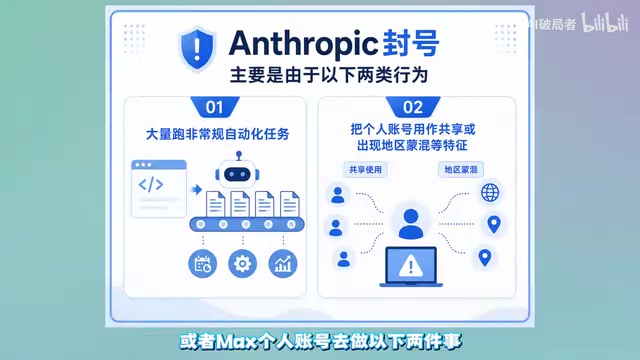
This means every detail during registration and usage — email type, network cleanliness, payment channel — gets factored into a risk score. If any single element "dirties" your account, it can significantly increase the likelihood of a ban.
How to Register Claude in China: Start with the Basics
Email Selection and Network Quality
The first step in registering a Claude account is choosing the right email. Testing shows that Chinese services like QQ Mail and NetEase Mail will display a "cannot register" error. Use Gmail or a Microsoft email account instead.
Your network environment matters just as much. When network "cleanliness" is insufficient, Claude will trigger phone number verification. Before registering, use a tool to check your network status (e.g., a WebRTC leak test) and resolve any issues before proceeding. For WebRTC leaks specifically, Firefox users can go to about:config and set media.peerconnection.enabled to false to disable WebRTC entirely; Chrome users can install extensions like WebRTC Leak Prevent to block leaks and prevent your real IP from being accidentally exposed in a proxy environment.
Phone Verification: Physical SIM vs. Virtual Number
Once phone verification is triggered, virtual number services on the market generally fall into two categories:
- Virtual numbers (VoIP numbers): These are cheap and transmitted over internet protocols, with easily identifiable number ranges (e.g., US +1 Google Voice ranges). Anthropic's SMS verification system can determine in real time whether an incoming number is VoIP via a carrier lookup interface called HLR Lookup (Home Location Register Lookup).
Deep Dive: The Telecom Mechanics of HLR Lookup The HLR (Home Location Register) is a core database in GSM/LTE networks that stores each SIM card's home carrier, IMSI (International Mobile Subscriber Identity), and current registered location area code. HLR Lookup API services (such as Twilio Lookup, NumVerify, and hlr-lookups.com) allow any developer to query a phone number's carrier type in real time at very low cost (around $0.005 per query), typically returning results within 100ms. Platforms use this mechanism to identify VoIP number ranges from Google Voice, Twilio, TextNow, and others with high precision, and can also determine whether a number is currently "active" (i.e., whether the SIM card is in service). This is the fundamental reason why success rates for virtual number registrations continue to fall, while demand for purchasing physical SIM cards from abroad keeps rising.
On top of that, vendors typically resell the same number to multiple users repeatedly, which easily "dirties" the account.
- Physical numbers: These are tied to real SIM cards and carrier contracts, cannot be sold to multiple people simultaneously, have a far higher chance of passing HLR checks than virtual numbers, and are relatively stable, clean, and secure. The same device can receive verification codes multiple times.
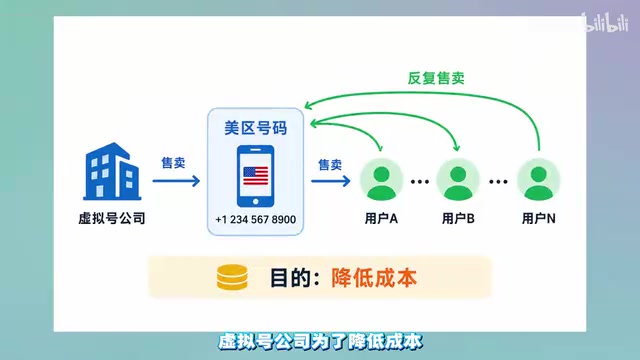
Here's a useful trick worth knowing: register a WhatsApp account with a rented physical number. Even after the rental period expires, you can still receive verification codes for free through WhatsApp — which comes in handy if you ever need to recover your account or switch devices. Of course, the compliance and stability of virtual number services remain uncertain, so evaluate carefully.
Claude Subscription Payment Channels: How to Pay Safely
Payment is the most critical step for avoiding a ban. Because the platform scrutinizes payment signals closely, bulk-purchased gift cards or suspicious phone numbers will only lower your account's trust score. Always use a legitimate overseas payment channel.
According to the creator, third-party platforms (such as WildAI, which they mentioned) are among the few channels in China that currently support Claude Max subscriptions via proxy, and they accept WeChat Pay.
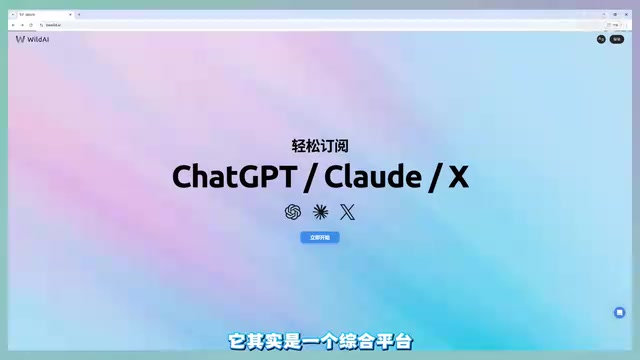
The general process is as follows:
- Go to the platform's official website, click Subscribe Now, and enter an invite code for a small discount;
- Check your network environment — the platform will pop up a detection window and suggest fixes (e.g., guiding you to install a Chrome extension to address WebRTC issues);
- Choose a service plan — select Pro or Max based on your needs;
- Log into your Claude account and upload your Cookie, then wait for verification to complete;
- Complete payment via WeChat Pay.
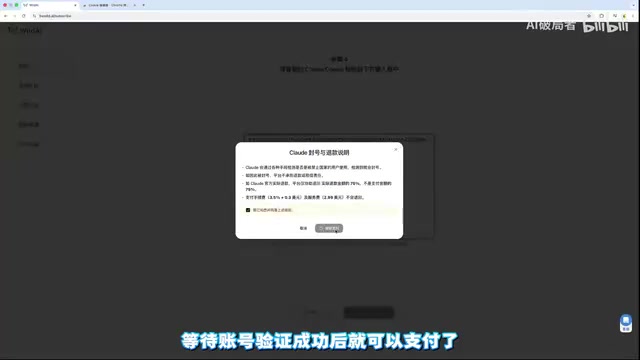
Security Risks of Uploading Your Cookie: Third-party proxy subscription platforms typically require users to upload a Session Cookie (session token). This is the common technical approach for proxy-operated account subscriptions.
Deep Dive: The Security Boundaries of Session Cookies A Session Cookie is fundamentally an encrypted session token issued by a server. Its security design relies on several layers of protection: HTTPS transport encryption to prevent man-in-the-middle interception, the HttpOnly flag to block JavaScript from reading the token, the SameSite attribute to defend against Cross-Site Request Forgery (CSRF) attacks, and a server-side session state database. Claude uses an Opaque Token model, where the token itself carries no decodable user information — its validity is determined entirely by the server-side database record. It's important to note that many platforms set long cache TTLs (Time To Live) on tokens for performance reasons, and changing your account password does not automatically invalidate all previously issued sessions — unless the platform has implemented an explicit "log out all devices" feature that synchronously deletes the corresponding tokens server-side. This means that after a Cookie is obtained by a third party, there is a risk window of hours or even days during which the server holding that Cookie can perform operations with full account-holder privileges.
Before uploading your Cookie, be sure to evaluate the platform's technical isolation measures and privacy policy, and weigh the risk of account information exposure yourself.
The advantage of this approach is that if your account gets banned, Claude's official refund will be returned via the original payment path. Given the current elevated ban rate, choosing a refund-supported channel is a better deal than simply chasing the lowest price.
How to Apply for an Official Refund After Getting Banned
The creator unfortunately experienced a ban themselves, but successfully obtained an official refund by sending an email. Key lessons:
- Attach complete documentation: account email, subscription details, payment screenshot, and a screenshot of the ban notification;
- Honestly describe your actual use case: never mention "relay services / shared accounts / VPN," and don't fabricate your location;
- Keep your information consistent: if a human reviewer finds contradictory information, the chances of account recovery drop dramatically.
Being honest and providing complete documentation are the keys to a successful refund.
Using the Official Claude API to Avoid Bans: The More Sustainable Long-Term Solution
The most important insight here is this: many behaviors that are considered high-risk on a personal Pro/Max account are completely acceptable on the official API.
This difference stems from a fundamental distinction in Anthropic's product design. Personal subscriptions (Pro/Max) are designed for interactive conversations by individual users, and the Terms of Service explicitly prohibit automated bulk calls, account sharing, and commercial resale. API (Application Programming Interface) calls, on the other hand, are programmatic interfaces designed for developers and enterprises, using a typical SaaS B2B pay-per-use model — billed by token consumption.
Deep Dive: The Economics of Token-Based Billing A token is the basic unit by which large language models segment input text, generated by statistical learning algorithms such as BPE (Byte Pair Encoding) or SentencePiece. In English, roughly 4 characters correspond to 1 token (e.g., "hello" is 1 token, "anthropic" is 3 tokens). In Chinese, due to the higher information density of each character, typically 1–2 Chinese characters correspond to 1 token. Using current Claude API pricing as a reference,
claude-3-5-sonnetcosts approximately $3 per million input tokens and $15 per million output tokens; the more powerfulclaude-opus-4is priced higher accordingly. For heavy coding use cases, a single conversation with a full code context can consume thousands to tens of thousands of tokens — for example, sending a 500-line Python file as context to the model could consume around 4,000–6,000 tokens on the input side alone. For high-frequency use cases, it's advisable to estimate your monthly costs in advance using Anthropic's official token calculator to avoid unexpected charges.
A token is the basic processing unit for text in large language models — roughly equivalent to 0.75 English words or 1.5 Chinese characters. The official Claude API supports multiple model families including claude-3-5-sonnet and claude-opus-4. Developers can integrate these into any workflow via standard REST interfaces — this is the underlying call method used by tools like Claude Code and Cursor. Anthropic explicitly supports automated tasks, high-frequency calls, and multi-IP scenarios on the API, fundamentally eliminating the ban risk associated with heavy personal account usage, and this is a compliant use case that Anthropic actively encourages as part of its business model.
In concrete terms, large-scale automated tasks and frequent IP changes — behaviors that trigger risk controls on a personal subscription account — are perfectly normal usage patterns on a pay-per-use API. Therefore:
Connecting a subscribed Claude API Key to the Claude desktop app or an Agent tool lets you run coding tasks without worry, while sidestepping the ban risk that comes with personal accounts.
For heavy coding users, this is the more sustainable long-term path. The third-party platform mentioned above also offers a proxy subscription service for the official API, with a process similar to personal account subscriptions — just submit your Cookie and you're set.
Summary: Three Principles for Safely Using Claude in China
Facing increasingly tight account controls, the approach can be summarized in three points:
- Register cleanly: Gmail/Microsoft email + high-quality network (block WebRTC leaks) + physical SIM verification;
- Pay legitimately: Use a proper overseas payment channel that supports refunds;
- Use compliantly: For heavy automation and coding tasks, prefer the official API over a personal subscription account.
It's worth emphasizing that all third-party proxy subscription and virtual number services carry compliance and security risks, and Anthropic's ban rules can change at any time. The methods described in this article are based solely on one creator's personal testing experience and do not constitute any operational advice. For users who genuinely rely on Claude to boost productivity, taking the official compliant route and using the API on a pay-per-use basis is always the most sustainable choice.
Key Takeaways
Related articles

ChatGPT Space Launches: Team Collaboration and New Pages Features Explained
ChatGPT Space is OpenAI's new team collaboration feature with Pages, real-time collaboration, and Slack/Google Drive sync. We break down its privacy design, multi-platform integration, and the full workflow from conversation to document.

Migrating Apache Spark UDFs to GPU Acceleration with AI Agents
NVIDIA developer blog explains how AI Agents rewrite Apache Spark UDFs for GPU acceleration, covering migration criteria, agent rewriting and verification workflows, plus pitfalls like result consistency and CPU-GPU transfer overhead.

Zed Editor v0.40.4-rc2 Released: Usage Credits Now Available Without Upgrading
Zed editor releases v0.40.4-rc2, allowing users to use usage credits for AI features without upgrading to a paid plan, lowering the trial barrier.