How to Take the Next Safe Step in Application Modernization: A Practical Guide to GitHub Copilot Agent Skills
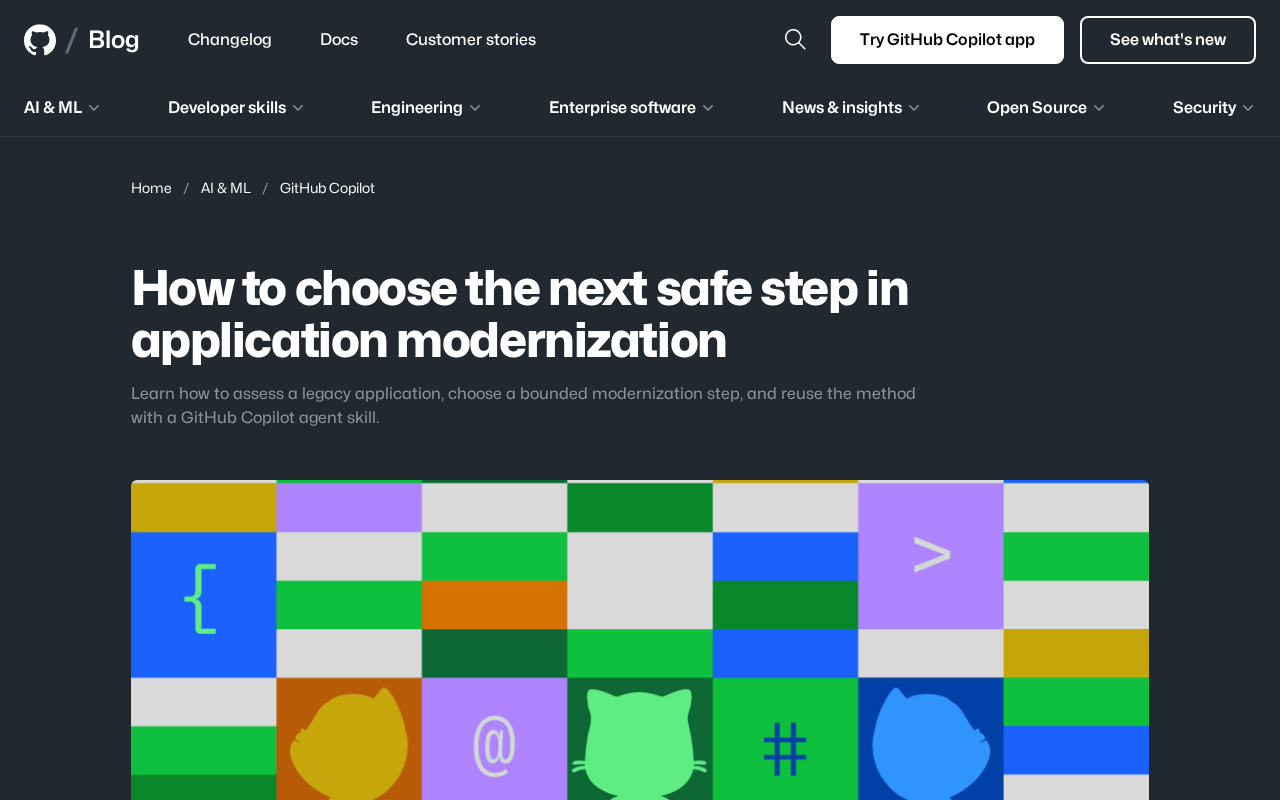
Legacy modernization should first assess, then choose bounded steps, and codify the method with a Copilot skill.
Addressing the common dilemma of "not knowing which piece to change first" in legacy system modernization, the article proposes a three-step framework: first assess the legacy application to identify entry points with clear dependencies and controllable impact; second select a bounded modernization step that is definable, verifiable, and easy to roll back; and finally distill the assessment and step-selection method into a GitHub Copilot agent skill so it's reusable and doesn't depend on individual experience. The framework's real value is turning modernization decisions into a reproducible process.
The Dilemma of Legacy System Modernization: Why the "Safe First Step" Is the Hardest to Find
Application modernization is a topic almost every technical team can't avoid, but when it comes to actually getting started, the most common state isn't "not knowing how to change things" — it's "not knowing which piece to change first." Legacy applications tend to be interconnected: a seemingly local refactor can trigger a cascading collapse of dependencies; the temptation of a one-shot big refactor is strong, and so is the risk.
A recent article on the GitHub Blog offers a pragmatic approach: don't try to swallow the whole elephant at once. Instead, first assess the legacy application, select a bounded modernization step, and then distill this approach into a reusable process — specifically, by using GitHub Copilot's agent skill to carry and reuse this assessment methodology. The value of this idea isn't in any particular tool, but in breaking "modernization" down from a one-time massive project into repeatable small-step decisions.
Step One: Assess the Legacy Application Rather Than Rushing In
The starting point emphasized in the article is "assess a legacy application" — assessment comes before modification. This step is often skipped, with teams relying on intuition to decide that a certain module is "the worst, so fix it first," but intuition and the actual risk distribution frequently don't align.
The core purpose of assessment is to identify which parts are suitable as entry points for modernization: relatively clear dependencies, controllable impact scope, and verifiable benefits after the change. The output of the assessment isn't a grand refactoring blueprint, but a risk-and-benefit distribution map used to support trade-offs in the next step.
It should be noted that the original article only provides directional description for this phase and doesn't expand on a specific list of assessment dimensions. This also means teams need to supplement assessment criteria based on their own tech stack rather than copying a generic template.
When assessing legacy systems, dependency analysis is usually an unavoidable foundational step. Common approaches include static code analysis (scanning imports, call relationships, configuration file references) and runtime tracing (observing actual call chains through logs or APM tools); only by combining both can you distinguish between "code-level coupling" and "actual runtime coupling." Another valuable dimension is change impact analysis: counting how many other modules directly or indirectly depend on a given module — the more times a module is depended upon, the higher the change risk. Additionally, test coverage is a key assessment metric — if the target module has almost no automated tests, even with clear dependencies, the verification cost after modification will rise significantly. Together, these dimensions form the factual basis for judging whether a safe entry point exists.
Step Two: Select a Bounded Modernization Step
"Bounded modernization step" is the most critical concept in the entire article. Bounded means the scope of this step can be clearly defined: which files, which interfaces, and which callers are involved can be mapped out in advance; and once the change is complete, the verification method is also clear.
This contrasts sharply with vague goals like "refactor the entire authentication module first." A bounded step isn't necessarily the most technically sophisticated one, but it's the easiest to converge, the easiest to roll back, and the easiest for the team to build confidence with. The rhythm of modernization comes precisely from this kind of convergent small-step progression.
Why "Bounded" Takes Priority Over "Valuable"
In legacy systems, value judgments are often subjective and highly debated, while boundary judgments are relatively objective. Choosing steps with clear boundaries first shifts the discussion from "is this step worth doing" to "can this step be completed safely," reducing decision-making costs. After completing several bounded steps, the team's understanding of the system will deepen significantly, and by then they'll have greater confidence when tackling high-value, high-risk parts.
In legacy systems, "boundaries" are often related to architectural layering and modularization. Ideal boundaries usually appear at existing interface contracts — such as an exposed API, a clear service boundary, or a component decoupled through dependency injection. If the system itself is a "big ball of mud" architecture, boundaries may not be obvious; in that case, consider doing minimal decoupling work first — for example, adding an interface layer or adapter layer to a module — and then using that as the boundary for subsequent modernization. Another practical way to determine boundaries is the "rollback boundary": if something goes wrong with this change, can it be restored by reverting a small number of commits or turning off a feature flag without involving other modules? The clearer the rollback boundary, the safer the step.
Step Three: Codify the Approach with a Copilot Agent Skill
The third element highlighted in the article's title is reuse: turning this "assess — select step" approach into a GitHub Copilot agent skill. The significance of an agent skill is distilling the team's judgment experience into a callable capability, so that the next time they face another legacy application, they don't have to reason it out from scratch.
From an engineering perspective, this is equivalent to transforming the modernization methodology from "principles in a document" into "an executable assisted process." When assessing a new application, the team can directly invoke this skill to get a structured analytical starting point rather than relying on a senior engineer's memory. The original article doesn't dwell much on the specific implementation details of the skill, only stating that this approach can be reused; in practice, teams need to design the scope and output format their skill covers themselves.
An agent skill is a way in GitHub Copilot to organize prompts, context, and tool calls into a reusable capability. Unlike ordinary conversational prompts, skills typically include explicit trigger conditions, input conventions, and output structures, enabling the same type of task to receive a consistent analytical framework. In legacy system assessment scenarios, a skill can encapsulate steps such as "list the direct and transitive dependencies of the target module," "identify interface callers," and "flag files lacking test coverage," and require the model to output results in a fixed structure. The practical benefit of this is reducing dependence on prompt-writing skill and ensuring that different team members get comparable analytical conclusions when invoking the same skill.
What This Approach Really Solves
Looking at the three steps together, the article is actually responding to an organizational-level problem: modernization decisions shouldn't rely on heroic individual judgment but should become a reproducible process. Assessment provides the factual basis, bounded steps control risk, and the agent skill ensures the methodology doesn't get lost when personnel change.
For teams maintaining legacy systems, the practicality of this framework outweighs its technical depth — it doesn't promise to make modernization easy, but it gives an actionable path for answering the question of "what should we do next."
Frequently Asked Questions
What scale of system is this approach suitable for? The article is aimed at legacy application modernization scenarios, and the core logic is small-step progression, so it's more valuable for systems with complex dependencies and high change risk.
Is GitHub Copilot mandatory? The assessment and step-selection methods are universal; the Copilot agent skill is just one means of carrying and reusing this approach, and teams can also codify the process in other ways.
Won't bounded steps make overall progress too slow? The article's thinking is to trade controllable small steps for certainty; the specific pace depends on the team's risk tolerance, and the original article doesn't provide quantitative progress expectations.
Related articles
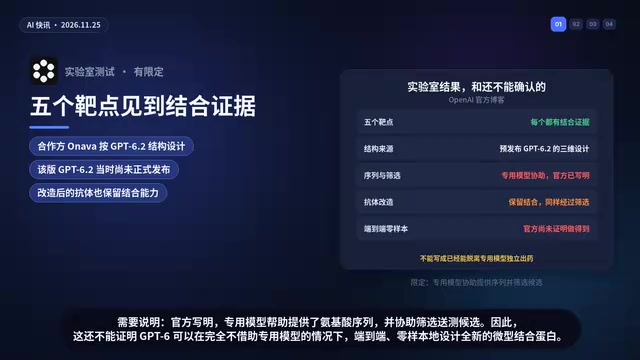
GPT-6 Designs Proteins, Claude Creations Become Apps with One Click, DeepMind Releases New Benchmark
OpenAI says GPT-6 can design protein 3D structures, Anthropic lets Claude creations install as desktop apps, DeepMind's HIP benchmark tests stability on simple questions, Google Workspace opens agent MCP interfaces.
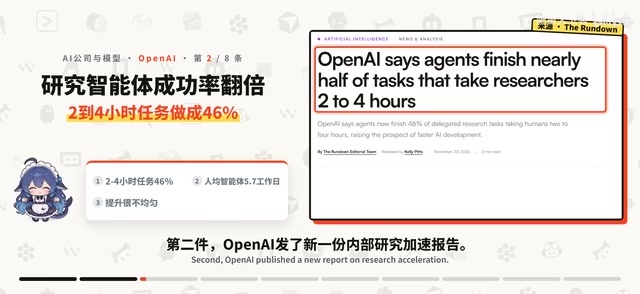
OpenAI Weekly Roundup: GPT-6.2 Rolls Out to ChatGPT, GPT-6 Designs Proteins
OpenAI's week: GPT-6.2 rolls out to ChatGPT, GPT-6 claims independent protein design, agent research share surges, perplexity proposed as a shared metric, and internal safety concerns surface.

Is the Crypto Industry About to "Turn Blue"? The Truth Behind Tech and Politics' Shifting Allegiances
Vergecast discusses whether the crypto industry will shift from the right to the Democrats, revealing the pragmatic nature of tech's politics and the costs of a crypto pivot.