How Top Companies Get Real Value from AI: Moving from Experimentation to Mature Governance

KPMG survey: top AI companies win on governance architecture, not models — model routing, data sovereignty, and AI harness layers are the real differentiators.
KPMG's Q3 AI Pulse survey of 2,100+ executives across 20 countries reveals a striking capability gap between mature organizations that have established AI ROI and those still experimenting — with differences of over 50 percentage points on agent adoption, cybersecurity, data sovereignty, and governance layers. The core finding: AI competition has shifted from models to the management layer above them, including model routing, cross-functional governance, and AI economics management. Meanwhile, use cases are migrating from efficiency toward revenue opportunities, token usage is rising while unit costs fall due to vendor competition, and average planned AI investment has grown from $186M to $210M since early this year.
What Sets the Best AI Companies Apart
The companies that genuinely extract value from AI operate very differently from most. They're building model routers, developing organizational and data sovereignty strategies, and strengthening their AI governance layers. The purpose and value of their AI usage is also quietly shifting. More importantly, these leaders are establishing a replicable template for others to follow.
This edition of the AI Daily Brief focuses on KPMG's Q3 AI Pulse survey, which covered more than 2,100 executives across 20 countries. One of KPMG's key innovations was segmenting data by where companies are in their AI journey — comparing organizations still in the "experimentation" phase with those that have "established ROI." The gap between the two groups is essentially a roadmap for where enterprise AI is heading in the months ahead.

The Enormous Divide Between Mature and Experimental Organizations
The gaps revealed by the data are striking. Among organizations that have established ROI, 48% report significant employee adoption of AI agents — compared to just 15% at experimental-stage organizations. The show's host repeatedly emphasized that agents are becoming a mainstream reality in enterprise settings.
The divergence in cybersecurity is even more dramatic. 58% of mature organizations are deploying AI-assisted cyber defenses, versus only 8% of experimental organizations — a full 50-percentage-point gap. As agents proliferate, this kind of defensive capability is becoming close to a necessity.
On the "AI harness layer" metric, 86% of mature organizations have established formal interfaces governing how employees interact with AI. Even 31% of experimental organizations have something in place, but a 55-point gap still remains.
The contrast in data sovereignty strategy is equally stark: 53% of mature organizations have an enterprise-level sovereignty strategy, compared to just 8% of experimental ones. This directly addresses recent debates about whether to hand data over to model labs versus building more complex architectures to manage that risk.
AI Agents are AI systems capable of autonomously planning, invoking tools, and executing multi-step tasks — fundamentally different from traditional large language models that only handle single-turn Q&A. A typical agent can receive an open-ended instruction like "compile a competitive analysis report," autonomously break it into subtasks, call search tools, read and write files, invoke a code execution environment, and deliver results — all without step-by-step human guidance. Because agents can act autonomously, deploying them at enterprise scale places far higher demands on cybersecurity, data access controls, and operational auditing than ordinary AI tools — which explains why mature organizations invest 50 percentage points more in cyber defenses than their experimental counterparts.
Governance Is the Real Differentiator
KPMG's summary of the current shift: we are entering a phase where what matters most is no longer the model itself, but the governance layer built on top of AI — ensuring all AI actions operate within the organization's boundaries and context.
Concrete manifestations include: 53% of organizations placing accountability for AI-assisted decision-making at the C-suite level; cost and efficiency considerations increasingly penetrating governance, with 23% of organizations having built model routing capabilities to flexibly switch between models and control costs.
A pattern that runs throughout the data: the more mature the organization, the more it favors formal cross-functional or enterprise-wide unified approaches across every dimension — from experimentation and strategic planning to scaling, driving adoption, and establishing ROI. Scattered pilots are giving way to systematic governance.
Model Router is a middleware mechanism that automatically routes requests to the most appropriate AI model based on task type, cost, latency, or quality requirements. For example, a simple text classification task might be routed to a small, low-cost model, while a complex reasoning task is routed to a large flagship model. The core value of this architecture lies in "decoupling" — enterprises are no longer locked into a single vendor and can simultaneously connect GPT-4o, Claude, Gemini, and even their own fine-tuned models, dynamically optimizing for performance versus cost. As enterprise AI usage scales up, model routing is graduating from an engineering detail to a strategic capability: it's a cost control tool, a bargaining chip with vendors, and the foundational infrastructure that makes multi-model architectures possible.
AI Use Cases Are Shifting from "Efficiency" to "Opportunity"
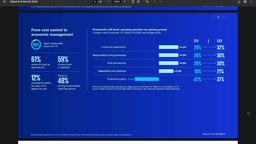
Notable is the migration in use cases. Productivity remains a key goal, but the share of organizations listing it as the primary objective has dropped from 42% at the start of the year to 37%. Taking its place is what KPMG calls a rise in "operational priorities": human-AI collaboration is up 4 percentage points; responsible AI governance, technical trustworthiness, and security are each up around 4 points; and adaptability and resilience are up 3 points.
In the long-running debate between efficiency-oriented AI and opportunity-oriented AI, the data offers a clear signal: one in four organizations is developing multi-agent systems, and one in five is orchestrating multiple agents. Revenue-oriented agent strategies have risen steadily since the start of the year, while purely efficiency-oriented strategies are declining — most organizations now pursue both, no longer treating them as a zero-sum tradeoff.
From Cost Control to "AI Economics Management"
As use cases mature, cost management is also evolving. KPMG frames this shift as moving from "cost control" to "AI economics management": cost visibility has become widespread; the next step is linking costs to value.
The specific numbers: 43% of experimental organizations already have AI cost monitoring dashboards, a figure that jumps to 77% among mature organizations; 50% of experimental companies include cost review in AI approval workflows, versus 73% for mature companies; and usage or token budget controls sit at 31% for experimental organizations versus 46% for mature ones.
The host offered a pointed perspective here: over-restricting token budgets during the experimentation phase can severely constrain the space for exploration. The ability to capture AI's value often matters far more than the token costs saved.
Token is the basic unit of measurement for how large language models process text — roughly 1,000 tokens equals about 750 English words. Both the input (prompt) sent to the model and the output it generates consume tokens, and cloud-based API services are typically billed by token usage. For enterprises, token budget management directly affects AI operating costs: too restrictive and complex tasks can't be completed; too loose and costs spiral out of control. The core of "AI economics management" is building a value attribution model on top of token-level cost visibility — that is, determining what measurable business value is generated for every dollar spent on tokens.
Efficiency Gains Don't Equal Spending Cuts
One easily misread signal: Ramp's latest AI Index shows token spending is down 5.2% month-over-month, but token usage is actually up — companies are expanding their AI usage while lowering per-unit costs. Ramp's economists note this decline is almost entirely driven by competition between OpenAI and Anthropic, rather than open-source models (which still account for less than 5% of enterprise spending).
Aligning with this trend, the enterprise-focused features OpenAI unveiled at Dev Day carry strategic intent: companies can use their committed spend credits to purchase other open-source models sold through OpenAI. Enterprises get the multi-model flexibility they increasingly crave, while OpenAI keeps the spend within its own ecosystem.
For those worried that cost consciousness might dampen overall investment: KPMG found that average planned AI investment over the next 12 months rose from $186 million at the start of the year to $210 million in Q3. The host believes we may have barely scratched the surface of what we'll ultimately spend on intelligence.
Questions That Weren't Even on the Radar a Year Ago
Looking back at last year's survey, KPMG was still asking basic questions like "how many organizations have experimented with agents." Today, model routing, data sovereignty, multi-model architecture, and AI economics management have all become critical management decisions.
This evolution — from curious experimentation to systematic governance — is an extremely positive signal for the industry as a whole. Top companies aren't winning on the strength of any single tool, but through an entire suite of governance-layer capabilities. That is precisely the replicable template they're leaving for every other enterprise to follow.
Related articles

Workbuddy for Absolute Beginners: How a Desktop AI Agent Fits Into Real Workflows
A beginner's guide to the Workbuddy desktop AI agent: installation, claiming credits, file management, and building automated workflows—compared with CodeX for fit and cost, helping professionals shift from AI question-askers to AI managers.

OpenAI's New Agent Stack: Computer Use, Decisions API, and Ultra-Fast Workflows
OpenAI Dev Day unveiled a new agent stack: Computer Use outperforms humans, Decisions API delivers ultra-low-latency classification via Luna, Agents API opens the same Computer Use capabilities, and GPT-6.1 Sol costs only one-seventh of Astra. Core updates, benchmark data, and developer insights.

Liang Wenfeng Open-Sources DeepInfo Inference Framework, Takes On U.S. Ban
DeepSeek open-sources its DeepInfo inference framework after its models, featuring GPU/CPU cross-pipelining, small-model prediction with large-model verification, and full Huawei Ascend and NVIDIA chip support—facing the U.S. federal ban head-on. This article analyzes its significance for AI deployment and open-source strategy.