How Wearable Sensors Are Making Horse Racing Safer: Using 'Gait Fingerprints' to Detect Injuries Early

Wearable sensors build gait fingerprint baselines for racehorses to flag micro-fractures before catastrophic injury occurs.
Racehorses can't voice discomfort, and the gait changes that signal serious injury are often imperceptibly subtle. Wearable sensor technology aims to close this perceptual gap by building a healthy-state 'gait fingerprint' baseline for each horse — alerting teams when real-time data deviates, directing attention to at-risk individuals. The core value lies in addressing racehorse safety's most critical problem: catastrophic fractures typically stem from accumulated micro-fractures, and intervening at that early stage can break the fatal chain. The technology doesn't replace veterinary judgment; it acts as an early warning sentinel that extends human perception through continuous quantified data, growing more precise with every training session.
Racehorses can't tell their trainers "my ankle hurts" the way human athletes can. The subtle changes that foreshadow serious injury are often too fine for even experienced veterinarians to catch with the naked eye in time. That's exactly the problem driving wearable technology into equestrian and horse racing — using sensors to continuously track movement data, shifting the approach from "wait until the injury is obvious" to "intervene when the first small anomalies appear."
Changes Too Subtle for the Human Eye
One veterinarian admitted in an interview that while she regularly visits training tracks to observe horses in motion, "some problems are really very subtle." This is the core motivation for introducing wearables: the technology has the potential to identify abnormalities before the human eye ever notices them.
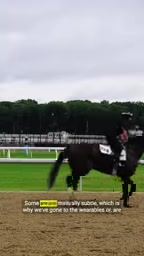
Unlike human athletes, horses don't actively express discomfort — training teams must rely on observation and experience. When a horse's gait shifts due to a minor injury, the change can be so small that no one can detect it visually. The value of wearable devices lies in transforming that subjective, experience-dependent judgment into quantifiable, continuously monitored data.
How the 'Gait Fingerprint' Works
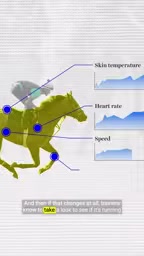
At the heart of this technology is the concept of building a "running fingerprint" for each horse — essentially a profile of its normal gait characteristics when healthy. Manufacturers like Garmin and StrideSafe produce the wearable sensors that collect this data.

Once a horse's gait deviates from its own personal baseline, the system alerts the training team: this horse is moving differently, possibly due to a minor injury, and warrants further examination. In other words, the device doesn't make a diagnosis — it acts as an "early warning sentinel," directing human attention toward individuals that genuinely need a closer look.
The cumulative effect of data is equally important: the more frequently a horse wears the device, the more refined its gait fingerprint becomes, and the better the technology gets at detecting deviations. This is a classic "more data, better model" logic, directly aligned with how consumer-grade wearable health monitoring works.
The technical backbone of gait analysis typically relies on inertial measurement units (IMUs), which integrate accelerometers, gyroscopes, and magnetometers onto a single small chip capable of recording acceleration and angular velocity changes in three-dimensional space hundreds of times per second. Sensors for horses are generally mounted at the fetlock (the joint just above the hoof) or on the back beneath the saddle — two locations most sensitive to gait changes. The system consolidates dozens of dimensions per stride — timing, impact force, left-right symmetry, and more — into a multidimensional feature vector. That vector is the "gait fingerprint." When newly collected data deviates from the historical baseline beyond a statistical threshold, the algorithm triggers an alert. This principle closely mirrors industrial vibration monitoring — factories use the same logic to detect early bearing wear in rotating machinery, except the subject has shifted from steel components to a living musculoskeletal system.
From Micro-Fractures to Preventing Catastrophic Injuries
This technology matters most because it addresses one of the gravest issues in racehorse safety — catastrophic fractures. Research shows that many fatal fractures don't happen suddenly; they accumulate from tiny micro-fractures over time.
The veterinarian in the interview emphasized that the goal is to "detect problems at a much earlier stage, before reaching the fatal tipping point." Intervening while micro-fractures are still minor — before they progress into serious injury — not only saves lives but improves prognosis, giving horses a better chance of returning to competitive form or extending their careers.

This means wearable technology delivers value on two levels: at the extreme end, it has the potential to reduce on-track fatalities; in day-to-day practice, it helps training teams prevent more serious injuries, balancing animal welfare with competitive performance.
A micro-fracture is a microscopic crack that forms inside bone when repeated stress exceeds the local load-bearing capacity. These are extremely difficult to detect early through imaging — standard X-rays are nearly useless, and while MRI or nuclear scintigraphy are more sensitive, they are costly and require sedating the horse. The most common sites of catastrophic fracture in racehorses are the distal third metacarpal (commonly called the "cannon bone") and the proximal sesamoid — locations that absorb ground impact forces several times the horse's body weight at full gallop. As micro-fractures accumulate, bone fatigue strength declines, and the structure ultimately fails completely under the high-load conditions of training or racing. Because bone stiffness begins to change locally during the micro-fracture stage, a horse's gait symmetry often shows small, quantifiable imbalances that are invisible to the naked eye — precisely the intervention window that gait sensors are theoretically designed to capture.
What the Technology Logic Reveals
Zooming out, wearable devices for racehorses represent the extension of "predictive health monitoring" into non-human domains. The technical paradigm closely mirrors human sports science and industrial predictive maintenance: establish an individual baseline, use continuous data streams to detect deviations, and hand anomalous signals to experts for judgment.
This "human-machine collaboration" model is worth noting — the device doesn't replace veterinary expertise; it expands the boundaries of human perception, allowing teams to focus limited attention on the horses most likely to have a problem. As wearing frequency and data accumulation increase, the system's detection accuracy should improve continuously, creating a positive feedback loop.
Of course, this technology is still largely in the "gradually being introduced" phase. Its accuracy, adoption rate, and applicability across individual horses all require further real-world validation. But the direction is clear: in a domain like horse racing — where animal welfare intersects with enormous commercial stakes — identifying a risk days or even weeks earlier could be the difference between life and death, between recovery and retirement.
Related articles

Workbuddy for Absolute Beginners: How a Desktop AI Agent Fits Into Real Workflows
A beginner's guide to the Workbuddy desktop AI agent: installation, claiming credits, file management, and building automated workflows—compared with CodeX for fit and cost, helping professionals shift from AI question-askers to AI managers.

OpenAI's New Agent Stack: Computer Use, Decisions API, and Ultra-Fast Workflows
OpenAI Dev Day unveiled a new agent stack: Computer Use outperforms humans, Decisions API delivers ultra-low-latency classification via Luna, Agents API opens the same Computer Use capabilities, and GPT-6.1 Sol costs only one-seventh of Astra. Core updates, benchmark data, and developer insights.

Liang Wenfeng Open-Sources DeepInfo Inference Framework, Takes On U.S. Ban
DeepSeek open-sources its DeepInfo inference framework after its models, featuring GPU/CPU cross-pipelining, small-model prediction with large-model verification, and full Huawei Ascend and NVIDIA chip support—facing the U.S. federal ban head-on. This article analyzes its significance for AI deployment and open-source strategy.