Howseen AI: Track Your Brand's Visibility in AI Recommendations and Optimize Proactively

Howseen AI monitors brand visibility across major AI platforms and auto-generates optimized content to close the loop.
As conversational AI like ChatGPT and Gemini becomes a new channel for product recommendations, whether brands get mentioned in AI responses is the new marketing battleground. Howseen AI is a GEO (Generative Engine Optimization) tool covering ChatGPT, Gemini, Perplexity, and Google AI Overviews. It monitors brand recommendations, pinpoints specific visibility blind spots, and automatically generates SEO- and GEO-optimized content to publish to your blog — turning diagnosis and action into a single automated pipeline. Its biggest differentiator is going beyond score reports, though challenges around AI platform opacity, unverifiable optimization outcomes, and content quality control remain.
As consumer purchase journeys shift from search engines to conversational AI, a new question has emerged: when users ask ChatGPT, Gemini, or Perplexity "which tool should I buy," does your brand get mentioned? Howseen AI, which debuted at #6 on Product Hunt, is a monitoring and optimization tool built precisely for this scenario.
From Search Optimization to "Generative Engine Optimization"
Traditional SEO revolves around search engine rankings. But as large language models become a new gateway for information, a concept known as GEO (Generative Engine Optimization) is gaining attention. Howseen AI targets this emerging space — it no longer just cares about where you rank in Google search results, but focuses on whether AI recommends your brand or your competitors when generating answers.
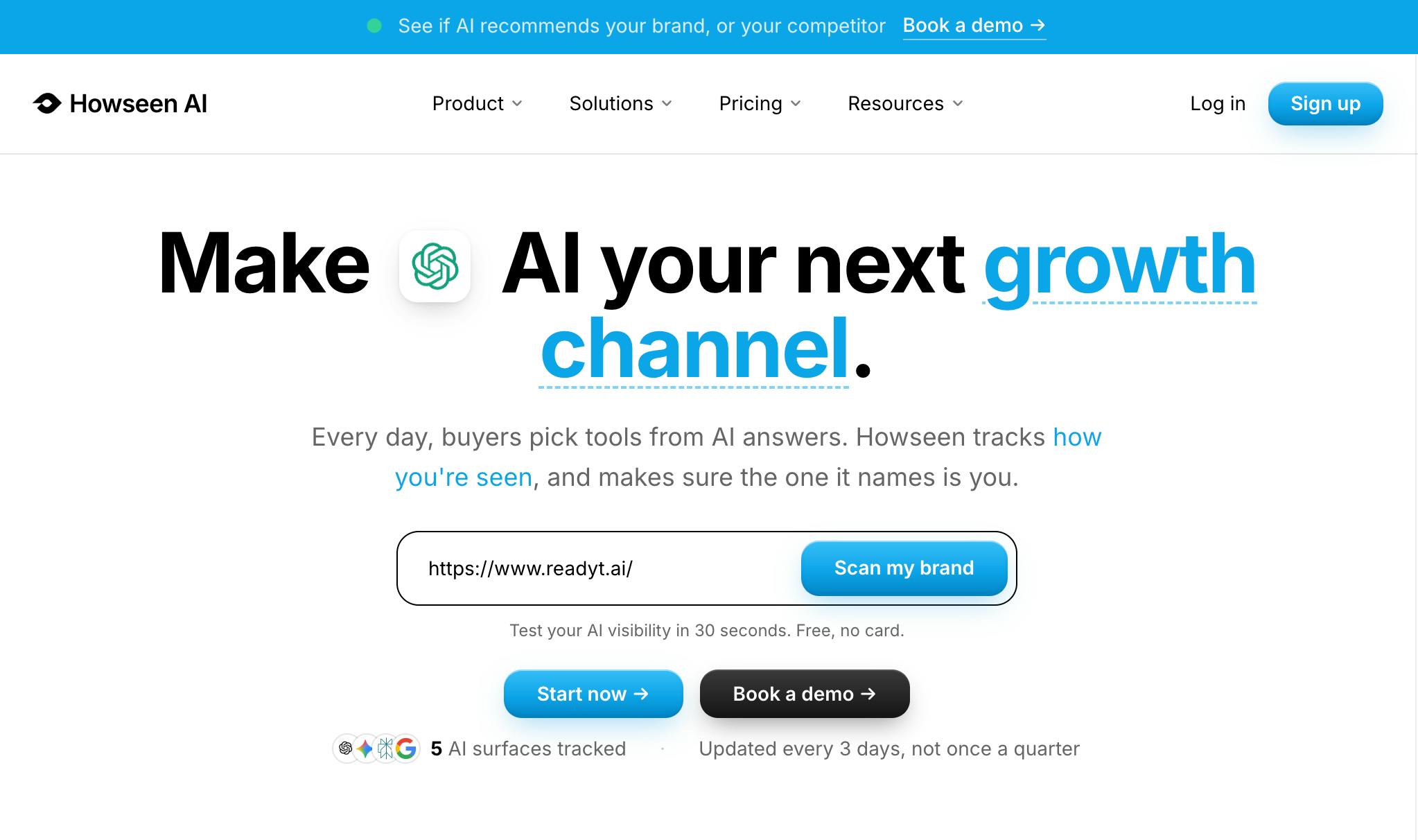
The product's core logic is grounded in a real behavioral shift: more and more B2B and B2C buyers are directly asking AI "which tool is best for me." This means brand exposure is no longer fully controlled by your own website or ads — it's shaped by a model's training data and real-time retrieval results. If a brand is "invisible" in these answers, it's effectively absent from the new decision-making chain.
The concept of GEO was first proposed by researchers at Princeton University and other institutions in 2023. The central question was: what content characteristics make large language models more likely to cite a particular source when generating responses? Research found that citing authoritative data, increasing information density, and using clear, quotable sentence structures all improve the probability of being referenced by AI. Unlike traditional SEO, which relies on quantifiable signals like backlinks and keyword density, GEO optimization targets the model's reasoning and retrieval logic. For platforms that support real-time web retrieval (such as Perplexity and Google AI Overviews), content timeliness and authority are key variables. For purely generative models that rely on training data, broad content distribution across high-quality media, industry forums, and Q&A platforms is needed to increase the likelihood of being trained into the model. These two optimization paths are fundamentally different — one reason why GEO remains in its early exploratory stages.
What Howseen Does
According to official documentation, Howseen AI covers four major AI answer channels: ChatGPT, Gemini, Perplexity, and Google AI Overviews. Its functionality can be broken down into three stages:
Monitor: Are You Being Recommended?
The tool continuously tracks whether these AI platforms recommend your brand or a competitor's when users ask relevant questions. This is essentially a dashboard for your brand's "reputation" in the AI world.
Diagnose: Find Your Blind Spots
Howseen goes further to surface the exact questions where you're invisible. The value here lies in converting a vague sense of "insufficient exposure" into a concrete, actionable list of problem areas — giving optimization efforts a clear target.
Act: Generate and Auto-Publish Content
This is where Howseen differentiates itself from similar tools. As the team puts it: "Most tools stop at a score. Howseen closes the loop — measure, then act." It generates SEO- and GEO-optimized content targeting the highest-impact content gaps and automatically publishes it to your blog.
The "Closed Loop" Is Its Biggest Differentiator
In the AI visibility monitoring space, a number of products already exist that offer nothing more than a "score" or a ranking report. Howseen has broader ambitions: it tries to string "discovering problems" and "solving problems" into a single automated pipeline. From detecting a brand's presence in AI responses, to identifying weak spots, to automatically producing and publishing optimized content — the entire process theoretically requires no manual switching between multiple tools.
This "measure then act" philosophy aligns with the efficiency demands of modern marketing teams. A standalone diagnostic report often requires additional headcount to execute on, whereas Howseen folds the execution step into the product itself. That said, the quality of auto-generated content and whether it actually improves AI citation rates remains to be validated through real-world use.
Questions Worth Asking
The common challenges facing this category of tools shouldn't be ignored. First, the answer mechanisms of major AI platforms are dynamic and opaque black boxes — model updates and changes to retrieval strategies can cause monitoring results to fluctuate, introducing uncertainty around optimization outcomes. Second, automatically generating and bulk-publishing content carries risks around quality and originality; if mishandled, it could actually damage a brand's content assets.
Based on Product Hunt data, the product received 74 upvotes and 7 comments, ranking #6 on launch day under the Marketing, SEO, and Artificial Intelligence tags. Built by Raphael Aubry, it offers a free entry point to check your current brand status. For marketing teams looking to get ahead in the "AI search era," it at least provides a low-barrier starting point — a way to first understand where your brand stands in the eyes of AI.
The "black box" problem with AI platforms has specific technical implications. Perplexity and similar products built on RAG (Retrieval-Augmented Generation) architecture fetch web content in real time when generating answers, meaning whether a brand gets mentioned depends largely on whether relevant content is retrievable and high enough in quality. ChatGPT's default conversation mode, by contrast, relies primarily on its training data corpus up to a cutoff date — a completely different optimization cycle and feedback loop. Google AI Overviews is deeply tied to Google's own search index, giving brands with strong SEO fundamentals a natural advantage. This means that across a single monitoring dashboard, the reasons for being "invisible" can vary dramatically by platform, and the remedies need to be tailored accordingly. Whether Howseen can differentiate between these root causes at the reporting level is a critical dimension for evaluating its real diagnostic value.
Conclusion
As conversational AI increasingly becomes users' go-to source for recommendations, the battleground for brand visibility is quietly shifting. Howseen AI represents a rising category of tools that don't just measure a brand's presence in AI answers — they actively attempt to influence that outcome. The market demand for this direction is real, but actual effectiveness, content quality control, and the ability to adapt to the black-box nature of AI platforms will ultimately determine how far products like this can go.
Related articles

JobRunner MCP Server: AI Agents Can Now Fix Failed Java Jobs
JobRunner launches an open-source MCP server enabling AI agents to view cluster status, diagnose failures, and recover Java jobs—incident response from any cloud coding environment or existing agent.

MLAI Digital Launches 9 Security Agents: MCP Server Safeguards the Full Lifecycle of Agentic AI
MLAI Digital launches Security MCP Server with nine built-in specialized security agents covering vulnerability discovery, attack simulation, prompt injection detection, API and infrastructure assessment, and accelerated remediation—embedding security validation across the full Agentic AI lifecycle from development to production.

Running Isaac Lab on H100 GPUs: Exploring Better Approaches
Exploring optimization methods for running Isaac Lab on NVIDIA H100 GPUs, including MIG configuration, mixed precision, TensorRT acceleration, and community experience to improve robotics simulation and reinforcement learning efficiency.