Huawei Ascend's Paper Compute Beats Nvidia by 1.7x—So Why Does DeepSeek Only Trust It for Inference?

Huawei catches up on inference day one via system stacking and open-source CANN, but top-model pre-training remains CUDA's final exam.
Using Ascend's launch-day inference on DeepSeek V4 as a hook, the article maps the real gap between domestic AI chips and Nvidia. On hardware, Huawei's CloudMatrix 384—384 Ascend 910C chips—claims about 1.7x GB200 NVL72's dense compute on paper, at nearly 4x the power draw and around $8M. The real barrier is software: CUDA's compiler, operator library, NCCL, and toolchain, plus 6 million developers and PyTorch's default path, make switching cost far exceed procurement cost. Huawei's CANN, started in 2018 and open-sourced in late 2025, now has 61% external contributors but remains far smaller than CUDA. Ascend 950DT running V4 inference on day one is a historic first, yet training stays on Nvidia clusters; DeepSeek plans at least 160,000 Ascend 950DT chips in Ulanqab, and whether Ascend can independently pre-train a top model will decide if the landscape is rewritten.
Paper Compute Pulls Ahead, But the Software Ecosystem Still Lags
In April 2026, DeepSeekAd released V4, a 1.6-trillion-parameter model. Within just one hour of launch, its official API began routing part of its traffic to Huawei Ascend. A year earlier, DeepSeek had failed to train on Ascend. The key to this turnaround isn't the chip itself—it's the software running on top of it.
Huawei's CloudMatrix 384 system links 384 Ascend 910C chips via high-speed optical interconnects, delivering roughly 300 PFLOPS of dense AI compute. Nvidia's flagship rack, GB200 NVL72, delivers about 180 PFLOPS in the same period—making Huawei's full system roughly 1.7x faster on paper. The trade-offs are equally stark: the entire system draws up to 559 kilowatts versus just 145 kilowatts for Nvidia's rack, and costs around $8 million.
A single Ascend chip indeed falls short of Nvidia's Blackwell. Huawei's choice is to pack more than 5x as many chips into one system, trading power and cost for compute. With China's lower industrial electricity prices and the impossibility of buying Nvidia's top-tier racks, this approach still has buyers lining up. But once the hardware math is done, the real challenges surface.
CUDA's Four-Layer Software Wall Is the True Cost of Switching
Nvidia's most valuable product isn't hardware—it's the CUDA software platform. After launching CUDA in 2006, Nvidia poured billions of dollars into it, earning almost nothing for the first decade and absorbing the losses to buy first-mover advantage. Today, 6 million developers worldwide write code with CUDA, and PyTorch's default backend path is also CUDA.
What developers interact with daily isn't the chip in the rack, but the software on top of it. Before a single line of AI code reaches silicon, it must pass through four layers of software walls: the compiler translates code into chip instructions; the operator library hand-tunes math operations like matrix multiplication and attention mechanisms—cutting-edge new operators often appear on CUDA first; the communication library NCCL orchestrates data exchange across thousands of cards; and debuggers, profilers, and a vast body of error-message answers form the surrounding toolchain.
Together, these four layers mean the real cost of switching chips isn't just buying new hardware—teams also pay months of rewriting and retesting.
Dense vs. sparse compute: a difference in accounting: When comparing Huawei's CloudMatrix 384 with Nvidia's GB200 NVL72, this article uses "dense" compute—the sustained floating-point throughput of a chip without structured sparsity enabled. Nvidia's official marketing often quotes peak figures with sparsity acceleration, roughly 2x the dense number, so cross-vendor comparisons must first align on methodology, or the paper multiples get inflated. In addition, PFLOPS typically defaults to FP16 or BF16 precision, and compute varies by several times across precisions—another reason system-level comparisons are easily misread.
HBM high-bandwidth memory: The article notes that Ascend 950DT is the first to feature self-developed HBM, with 144Gb per card matching H200. HBM stacks vertically with the GPU/NPU die via a silicon interposer, providing far higher bandwidth than traditional GDDR and serving as the key enabler for keeping large-model weights resident and achieving high-throughput inference. High-end memory supply has long been concentrated among a few vendors, and tight capacity directly limits chip shipments—this is the structural constraint behind the rumor that "950DT capacity this year is only 200,000 to 300,000 units."
Huawei's Software Foundation: CANN Rebuilt from 2018
Huawei built its own tools at every layer, and started earlier than outsiders realized. The underlying software stack CANN has been shipping since 2018—four years before ChatGPT arrived—bundling a compiler, runtime, and a dedicated operator language; on top of the communication library HCCL sits Huawei's own AI framework MindSpore, open-sourced in 2020.
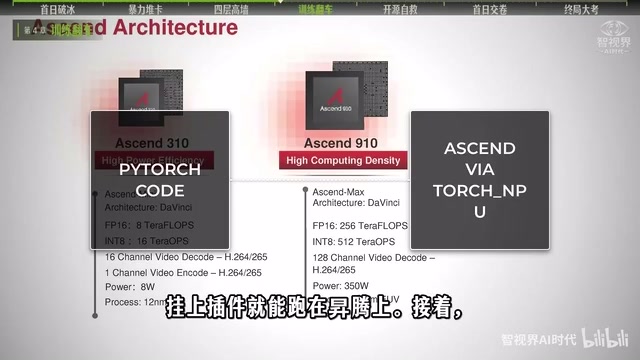
After finding that developers were reluctant to leave PyTorch, Huawei stepped back and built the Torch NPU plugin: ordinary PyTorch code can run on Ascend by attaching the plugin. It also plugged Ascend into the inference engine vLLM and adapted the Triton language. The idea is to bury CANN underneath so developers barely notice it exists. According to Huawei's own statistics, more than 40 large models have been pre-trained from scratch on Ascend—but the top-tier models that truly decide the game aren't on that list.
In the summer of 2025, the most awkward truth could no longer be hidden. Media reported that DeepSeek, encouraged by regulators, tried training its next-generation model R2 on Ascend—and hit a wall: chips ran unstably, inter-card interconnect speeds were slow, and the software toolchain lagged Nvidia by a notch. Huawei sent engineers on-site to put out fires, but DeepSeek still couldn't complete a full R2 training run, ultimately pulling training back to Nvidia chips and leaving only the far less demanding inference workload on Ascend.
Why does training crash so easily? Thousands of cards running continuously for weeks—if a single operator misbehaves or one inter-card communication stalls, the entire job must stop, and progress worth millions of dollars in burned compute must roll back to the last checkpoint. That reliability is precisely what Ascend had not yet proven.
Open-Sourcing CANN: From Seven Years Behind Closed Doors to Outside Developers Taking the Lead
On August 5, 2025, Huawei rotating chairman Xu Zhijun made a pledge at a Beijing summit: open the compiler interfaces and virtual instruction set before year-end, and fully open-source CANN. Huawei had kept this software stack behind closed doors for seven years; publishing the code meant exposing every rough edge to outsiders. On December 31, 2025, Huawei delivered, releasing the CANN operator library and related code onto the domestic code-hosting platform Gitcode, with code for its latest-generation chips opened simultaneously.
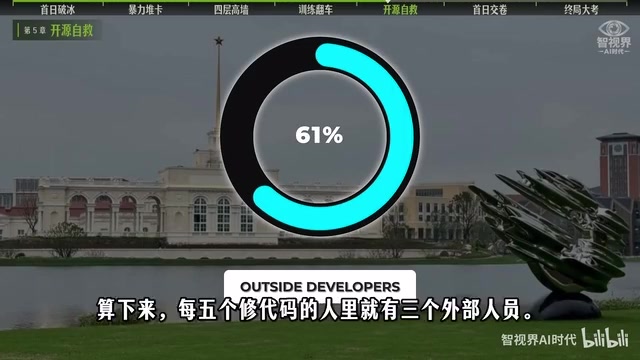
The move quickly paid off. According to Huawei's published figures, external developers account for 61% of contributors—three out of every five people fixing code are outsiders—and the project has 200 monthly active developers. Though self-reported, the direction has clearly changed: the main force fixing CANN bugs is now the people who actually use it on the front lines every day.
Huawei is also grinding away at the hardest layer—operators—with CANNbot, an AI coding assistant that writes operators and claims to speed up individual operator development by more than 5x. The more critical step was writing the Ascend plugin directly into the official GitHub vLLM project, right next to Nvidia's code, so overseas developers see an Ascend option directly in the tools they already know.
A sober accounting: a community of a few thousand open-source developers is still tiny next to 6 million CUDA developers. Nvidia's virtuous cycle—more people buy cards, and card sales fund the ecosystem—has run for 20 years. For Huawei to overturn that order, a major shift in the external market must come first.
Operators and operator fusion: An operator wraps a basic math operation such as matrix multiplication, Softmax, or LayerNorm—it is the smallest execution unit between an AI framework and a chip. Operator fusion means merging several adjacent operators into a single kernel execution, reducing intermediate-result memory reads/writes and kernel-launch overhead, which often yields substantial latency gains in inference. But fused kernels must be hand-tuned to a specific chip's memory hierarchy and parallelism—which explains why cutting-edge new operators usually appear on CUDA first: ecosystem scale determines the density of tuning manpower.
Compute-communication overlap: In large-scale distributed inference or training, inter-card data exchange (All-Reduce, All-Gather, etc.) consumes significant time. Compute-communication overlap chunks communication tasks and interleaves them with compute tasks in different parallel streams, so network transfer time is hidden behind compute time. This depends on fine-grained dependency scheduling by the communication library and compiler—a hallmark of system-level engineering capability, and one of the technical reasons Ascend could run inference on V4's launch day.
Export Controls Gave a Push—Launch-Day Inference Is Only the Starting Line
The great shift was pushed along by U.S. export controls. The H20, which was specially supplied to China in 2025, was also choked off; though the White House later allowed H200 with a 25% cut at year-end, domestic buyers had lost trust. Jensen Huang himself acknowledged that Nvidia's AI chip share in China had fallen to zero, and estimated China's AI chip market at $50 billion a year; Nvidia even rarely admitted in its financial reports that losing this market is helping rivals cultivate a globally dangerous ecosystem.
Every additional lab in China that can't buy Nvidia cards gives Ascend one more developer to help fix its code. Huawei then put new hardware on the table: Ascend 950 comes in two versions—950P2 focused on long context at a lower price, and 950DT focused on model training and answer generation, featuring self-developed HBM high-bandwidth memory for the first time, with 144Gb per card matching Nvidia's H200. According to Huawei, 950P2 delivers more than 2.8x the per-card performance of the China-specific H20.
The April 2026 DeepSeek V4 launch was the first real-world test. Semi Analysis tested major platforms on launch day: Nvidia's CUDA worked out of the box; AMD, which has chased CUDA for years, managed only one to two words per second on V4 on day one, and engineers spent a month getting speed to barely usable; Huawei's Ascend 950DT, with a complete deployment guide and custom operators, ran inference on V4 the same day it launched. It was the first time in history that an ecosystem other than Nvidia achieved same-day launch for a major new model.
Huawei's head start was half advance coordination—V4's architecture was specifically adapted to Ascend inference paths during design—and half hardcore engineering: overlapping compute and communication in parallel streams, plus operator fusion. But running on day one doesn't mean parity: developers on Ascend still must strictly lock version numbers for vLLM, PyTorch, and CANN—mix in a different version and it errors out. The global floor price for inference still belongs to Nvidia: a GB300 rack outputs 1 million tokens for just $0.155.
The Training Endgame: DeepSeek's Massive Bet and Two Unresolved Hurdles
In September 2026, DeepSeek—which had failed to train on Ascend a year earlier—made its boldest bet yet: it plans to pack at least 160,000 Ascend 950DT chips into a new data center in Ulanqab, Inner Mongolia, with the entire campus planned to draw nearly 100 million watts, roughly the output of a large nuclear power plant. Sources say DeepSeek is also lobbying authorities for a larger quota of faster Ascend chips. A year ago it needed encouragement just to try; a year later it's actively grabbing cards. On September 30, DeepSeek teamed up with Huawei to open-source a batch of Ascend-specific programming tools; the core Telang makes writing low-level operators far easier than CUDA—essentially laying the experience gained from pitfalls on Nvidia cards directly onto Ascend.
But the hardest bone has yet to be handed to Huawei: V4's pre-training still runs primarily on Nvidia clusters, and the massive Ulanqab base of over 100,000 cards is currently used mainly for inference services before and after model deployment. Pre-training a top-tier large model from scratch requires tens of thousands of cards running in sync for months—the lowest fault-tolerance job in the AI world, where a flaw that adds a mere thousandth of a second to a single inference gets amplified without limit over months of training.
Two hard hurdles remain for Huawei. Rivals won't wait: Nvidia iterates new architectures every year, and its next-generation Rubin is already benchmarking. Capacity and yield are also constrained: limited by high-end memory supply, rumors say 950DT output this year is only 200,000 to 300,000 units—DeepSeek's order alone would take over a year to fill.
Looking back at the question we opened with, the answer is clear: through open-source hardware and deep coordination, domestic chips can already break the launch-day monopoly on inference; but the real final exam lies ahead. Over the next 18 months, whether Ascend can independently complete a full pre-training run of a top-tier model will determine whether CUDA's iron law gets rewritten.
Related articles

The 15-Year Programmer Who's Been Unemployed for Two Years: The Tech Worker's Dilemma in the AI Era
A US senior software engineer with 15 years of experience has been unemployed for two years, exhausted his savings, and sought help on Hacker News. This article analyzes the structural causes of long-term unemployment among tech workers, strategies for addressing resume gaps, and the redefinition of experience value in the AI era.

Soundcore Liberty 5 Pro Drops to All-Time Low: The Go-To True Wireless Earbuds for Commutes and Calls
Soundcore Liberty 5 Pro drops to an all-time low of $129.99 (from $169.99). These Anker true wireless earbuds excel at call quality and are on sale at Amazon, Best Buy, and Walmart in four colors—ideal for commutes and online meetings.

After Anthropic's IPO, How Far Can Safety-First Go?
The Verge podcast explores Anthropic's post-IPO core tension: can a public company stay safety-first? How public market pressure reshapes AI lab safety decisions.