Hub: Manage 100 Claude Code Sessions Like You Manage 5

Open-source dispatcher Hub uses a coordinator to assign Claude Code and Codex sessions, making a hundred agents as manageable as five.
Hub is the #1 open-source project on Product Hunt, positioned as a dispatcher for Claude Code and Codex. Users write goals in a browser or Telegram, a coordinator assigns tasks to underlying agents, and only decision points that truly need sign-off are surfaced to humans—decoupling human involvement from task count. It's self-hosted, Apache-2.0, one-line install, and reuses existing Claude or ChatGPT subscriptions. Explicitly experimental, agents run without permission prompts, so users must define security boundaries; it suits engineers and small teams already using coding agents and hitting session-management bottlenecks.
Claude Code and Codex and other AI coding agents have already started taking over more and more development tasks, but a real bottleneck has emerged: when you spin up a dozen or even a hundred sessions at once, management overhead rises exponentially. Hub, the top-ranked open-source project on Product Hunt, is aimed squarely at this pain point—its tagline is blunt: "Run 100 Claude Code or Codex sessions like you manage 5."
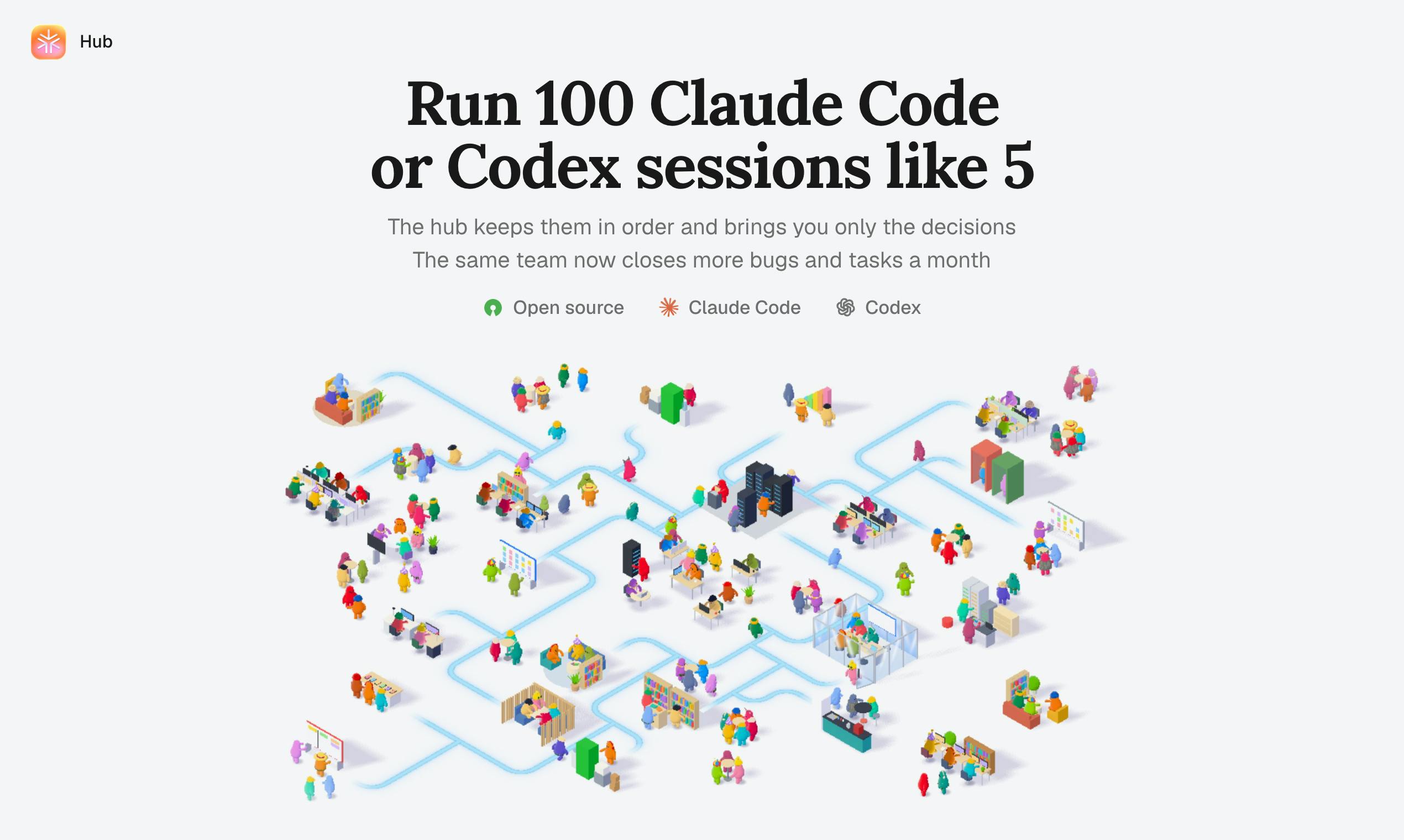
Hub in One Sentence: A Dispatcher for Your AI Agents
Hub positions itself as an open-source dispatcher. You simply write down your goal in a browser or Telegram, and a coordinator dispatches tasks to the underlying Claude Code or Codex agents for execution. What comes back to you are only the decision points that genuinely need your sign-off. In other words, you go from being an operator who watches each session's progress to a decision-maker who only handles key checkpoints.
This approach addresses the core contradiction of scaling AI coding agents: a single session is powerful, but once the number of sessions grows, human attention becomes the bottleneck. Hub tries to abstract away execution details so that the frequency of human involvement is decoupled from the number of tasks.
Key Features: Self-Hosted, Apache-2.0, Runs on Your Own Subscription
Based on the project's public information, Hub has several developer-friendly design choices:
- Self-hosted + Apache-2.0 open-source license: Code and data stay in your own environment, with no dependence on third-party hosting services.
- Reuses your existing subscription: Runs on top of your existing Claude or ChatGPT subscription, with no need to purchase additional API credits.
- One-line command install: Lowers the barrier to entry, in line with the usual habits of developer tools.
- Multiple entry points: Both the browser and Telegram can serve as interfaces for writing goals and receiving decisions.
It appears simultaneously under Product Hunt's Open Source, Developer Tools, and Artificial Intelligence categories, showing a positioning that spans open source, developer productivity, and AI.
Experimental but Aggressive: Agents Run Without Permission Prompts
Hub explicitly labels itself as an experimental project, and one key setting is that agents run without permission confirmation prompts. While this improves automation flow, it also means users must define the security boundaries themselves.
This trade-off deserves attention. The default permission confirmation mechanisms in Claude Code and Codex are essentially brakes that add "human-in-the-loop" control to automation. Hub moves those brakes to the dispatch layer for unified management while opening things up at the individual session level. For teams working in isolated environments or controlled repositories, this can significantly reduce interruptions; but if used directly on sensitive codebases, the risks need to be assessed in advance.
Who Hub Is For
Judging from its usage pattern, Hub is better suited to engineers and small teams who are already using Claude Code or Codex for real development and are starting to hit the "too many sessions to manage" problem. It's less suitable for newcomers to AI coding agents—because you first need to understand how the underlying agents work in order to design good goals for the coordinator.
On Product Hunt, 168 upvotes, 92 comments, and a #1 ranking for the day show that this kind of "agent orchestration" demand is genuinely emerging. When the capability of a single AI agent is no longer the bottleneck, how to organize and dispatch a group of agents will become the main battleground for developer tools in the next phase.
A Direction Worth Noting
Hub simplifies interaction to "write a goal, receive decisions," which is in fact redefining the granularity of human-AI collaboration. In the past we drove AI prompt by prompt; now we describe intent at a higher level and let the system break it down on its own. Whether this model can hold up reliably in complex engineering tasks still needs more practical validation, but the direction itself points to a clear trend: competition among AI agents is shifting from model capability to orchestration capability.
Background
AI Coding Agent: Refers to AI systems that can autonomously execute programming tasks, as distinct from traditional code completion tools. They typically can read repositories, edit files, run commands, and iterate on debugging, working in units of "sessions." Claude Code is Anthropic's command-line coding agent, and Codex is OpenAI's coding agent product. Both have permission confirmation mechanisms by default: operations such as writing files and running shell commands require user approval before execution, ensuring human control over automated behavior. Understanding this is essential to grasping why Hub treats "agents running without permission prompts" as a key trade-off—it moves the confirmations scattered across each operation up to unified decision-making at the dispatch layer.
Dispatcher and Coordinator Pattern: In distributed systems and the multi-agent field, a dispatcher assigns tasks to available execution units, while a coordinator maintains task state and handles dependencies and conflicts. Hub borrows this architecture, making "split one goal into multiple subtasks, dispatch them to multiple agent sessions, and aggregate the nodes that require human intervention" its core workflow. The key benefit of this pattern is decoupling: the number of sessions at the execution layer can grow linearly, while the number of decision points humans need to handle stays roughly constant after filtering by the coordinator. The cost is that the coordinator's own decomposition quality directly determines the final outcome—the vaguer the goal description, the greater the dispatch deviation.
Self-hosting and Apache-2.0: Self-hosting means the entire service runs on the user's own server or local environment, and code, task records, and data produced by agents do not pass through third-party servers—suitable for enterprises with code confidentiality requirements. Apache-2.0 is a permissive open-source license that allows commercial use, modification, and redistribution, and includes a patent grant clause, making patent risks clearer than under the MIT license. The practical implication of combining the two is that teams can audit the code themselves, build on it, and integrate Hub into internal workflows without worrying about vendor lock-in or compliance obstacles.
Permission Confirmation Mechanisms and Human-in-the-loop: Mainstream coding agents pause and request confirmation before executing destructive operations by default. This is the practical implementation of the "human-in-the-loop" principle, used to prevent accidental file deletion, dangerous command execution, or unintended code exfiltration. Hub removing confirmation at the individual session level is equivalent to concentrating that gate at the coordinator: only nodes judged to "need a decision" surface to the human. Therefore, when using it, you should pair it with isolated environments, separate branches, controlled repository permissions, and rollback-capable version control to limit the blast radius of potential mistakes to a recoverable range.
Related articles

Hunter Rescues Educated Youth: The Mountain-Chasing System Launches a New Warm-Hearted Viral Drama Formula
Bilibili's early-access period short drama *Everyone Thinks I'm a Poor Hunter* opens with a snowy-night rescue of an educated youth. Hunter Chen Shan activates the mountain-chasing system, using realistic hypothermia first-aid details and mutual-probing character dynamics to deliver a warm-hearted period drama without the sleaze.

Riemann Hypothesis Proven by AI? The Truth Has Nothing to Do With Your Reality
34-year-old mathematician Levent Alpöge claims to have proven the Riemann Hypothesis and Generalized Riemann Hypothesis with Claude, releasing 17 million lines of formal verification code. This article sorts out the facts, debunks myths about RSA collapse and new material revolutions, and analyzes the true significance of mathematics-AI collaboration.

G3 Test Drive Gone Wrong: Why Is the "Dog Poop Gun" So Hard to Use?
Bilibili creator tests the G3 rifle, from skeleton barrel and 50-round drum to combat failure, calling it a "dog poop gun." Analyzing the gap between mods and real gameplay.