Hugging Face CEO Vows to Fight for Open Source AI: The Shifting Landscape After Jensen Huang's Exit
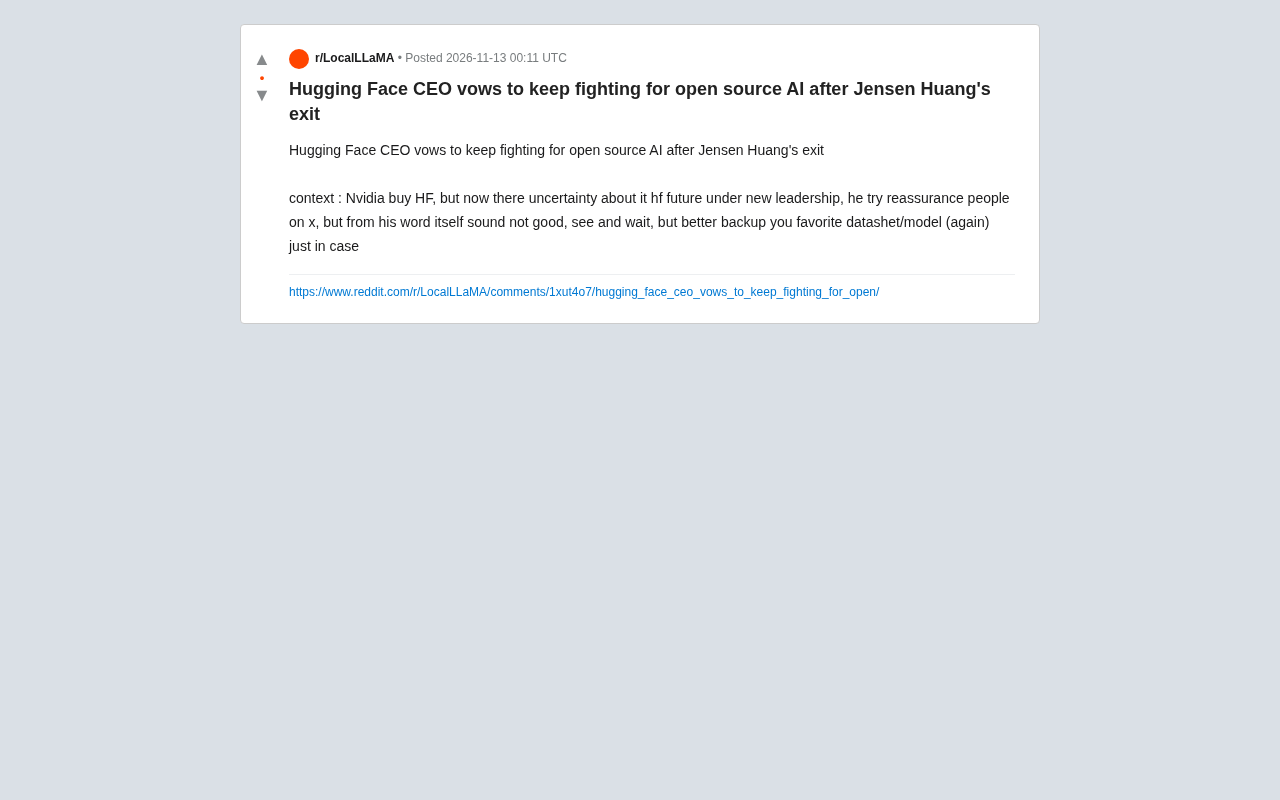
After Nvidia's acquisition of Hugging Face and Jensen Huang's exit, the open source AI community worries about governance shift and calls for model backups.
After Nvidia completed its acquisition of Hugging Face, Jensen Huang's exit sparked widespread unease about the platform's future governance. The Hugging Face CEO posted on X promising to keep fighting for open source AI, but the community read commercial pressure in the word "fight." Reddit users advise backing up models and datasets, reflecting risk awareness about single-platform dependence. The incident highlights the dilemma when commercial giants co-opt open source AI infrastructure: trust needs institutional safeguards, not personal promises, and distributed backups are becoming essential.
After Nvidia's acquisition of Hugging Face, Jensen Huang's exit has stirred unease in the community. The Hugging Face CEO spoke out on X, vowing to continue fighting for open source AI, but the uncertainty between the lines has led users to prepare for the worst.
Post-Acquisition Shockwaves: Jensen Huang's Exit and Leadership Changes
According to Reddit community discussions, after Nvidia completed its acquisition of Hugging Face, Jensen Huang's exit has cast a shadow over the future of this open source AI stronghold. The Hugging Face CEO subsequently posted on X, attempting to reassure the community and emphasizing continued commitment to the open source AI cause.
However, community users keenly picked up on subtle signals in the wording—the very phrase "vow to keep fighting" implies that the open source path may be under pressure. One user put it bluntly: "From his words alone it doesn't sound good, can only wait and see, but best to back up your favorite databases/models (again), just in case."
Such concerns are not unfounded. As the core hub for open source models and datasets, changes to Hugging Face's governance structure directly affect developers' workflows worldwide. As a commercial company, Nvidia's strategic priorities inherently conflict with the demands of the open source community.
Hugging Face was founded in 2016, initially starting as a chatbot application before transforming into a hosting and collaboration platform for machine learning models and datasets. Its core assets include Model Hub (hosting hundreds of thousands of open source models), Datasets (a dataset repository), and open source libraries such as Transformers and Diffusers, making it the de facto standard infrastructure for modern open source AI workflows. Being acquired by Nvidia means this neutral platform will be absorbed into the GPU giant's commercial empire. The community's focus of concern: whether the platform will be used to drive lock-in to Nvidia's hardware ecosystem, and whether model hosting policies, API access permissions, and dataset licenses will be adjusted for commercial interests.
Open Source AI at a Crossroads: The Tug of War Between Promises and Reality
The Hugging Face CEO's statement has sparked polarized interpretations in the open source community. Optimists believe that a public commitment itself is a constraint, and leadership changes do not mean a reversal of direction; pessimists point out that the word "fight" already indicates that the open source stance is no longer taken for granted.
From an industry perspective, this incident reflects the common dilemma facing open source AI: when core infrastructure is co-opted by commercial giants, how can community trust be maintained? Hugging Face hosts a large number of open source models, datasets, and collaborative projects, and any policy adjustment could have cascading effects.
Interestingly, the CEO chose to speak on X rather than an official blog. This informal communication channel both seems urgent and exposes the limitations of information delivery. What the community needs is institutional safeguards, not personal promises.
"Open source AI" in the strict sense does not merely mean visible code. According to the OSI definition, open source AI requires that model weights be accessible, training data be traceable, and licenses permit free use and redistribution. However, many current "open source" models only release weights, with training data and complete training pipelines remaining non-transparent—forming what is called the "open weights" model. As a hosting provider, Hugging Face's governance structure directly affects the discovery, distribution, and compliant use of these models. If the platform adjusts model review, access thresholds, or license enforcement policies after acquisition, developers relying on it for model hosting and dataset management will face migration costs and compliance risks—this is precisely the institutional reason why the community is highly sensitive to the word "fight."
Community Response: Backup Culture and Rising Risk Awareness
The most pragmatic advice in the Reddit discussion is "back up your favorite databases/models." This seemingly pessimistic reminder actually reflects the open source community's increasingly mature risk management awareness. When the platform's fate is no longer fully controlled by the community, distributed backup and mirroring strategies become a necessary line of defense.
For developers who rely on Hugging Face for model hosting and dataset management, this incident sounds a warning bell. The sustainability of open source AI depends not only on code licenses but also on the transparency and stability of governance structures.
The situation is still developing, and Hugging Face's official roadmap has not yet been explicitly adjusted. But regardless of the outcome, this turmoil has prompted the community to re-examine its dependence on a single platform and accelerated discussions about decentralized collaboration tools.
The next chapter of open source AI may no longer be just a technological race, but also a testing ground for governance models.
The "backup" strategies mentioned in the open source community include various decentralized approaches in practice. For example, using Git LFS to clone model weights locally or to self-hosted servers, backing up through distributed storage networks like IPFS for content-addressed storage, or mirroring datasets to platforms outside Hugging Face (such as Kaggle, Zenodo, or institutionally hosted repositories). Additionally, the community is discussing the adoption of standardized metadata through model cards and dataset cards to preserve license and provenance information during platform migration. The common goal of these practices is to reduce dependence on a single hosting platform and ensure research reproducibility and business continuity, rather than merely responding to a single acquisition event.
One-line Summary
After Nvidia's acquisition of Hugging Face and Jensen Huang's exit, the open source AI community worries about a governance shift and calls for backing up models.
Paragraph Summary
After Nvidia completed its acquisition of Hugging Face, Jensen Huang's exit has sparked widespread unease in the open source community about the platform's future governance. The Hugging Face CEO posted on X promising to continue fighting for open source AI, but the community interprets the word "fight" as a sign that the open source path may face commercial pressure. In Reddit discussions, users suggest backing up beloved models and datasets, reflecting risk awareness about dependence on a single platform. The incident reflects the common dilemma after open source AI infrastructure is co-opted by commercial giants: community trust requires institutional safeguards rather than personal promises, and distributed backups and decentralized collaboration tools are becoming necessary lines of defense.
Related articles
Agent Project in Practice: Real Delivery and Pitfalls from Requirements to Launch
Based on a real Agent project, this article breaks down the full process from a minimal viable loop to autonomous long-task delivery, analyzes the pitfall of over-constrained prompts, and provides acceptance criteria and pitfall records for context management, tool calling, and long-task decomposition.

When AI Becomes the Manor Lord: A Tech Experiment Behind a Murder Mystery
From YouTube interactive mystery video Brindley Manor, analyze how multi-agent AI plays eight roles, maintains information isolation, and generates dynamic murder puzzles, exploring the potential and current technical shortcomings of AI interactive narrative.

From Pulpit to Senate: A Pastor-Senator on What Sin Is
A pastor-senator at Ebenezer Church reflects on how his Senate experience reshaped his understanding of sin and hubris, making his sermons more powerful—even likening Washington to Sodom and Gomorrah.