Human Behavior: How AI Agents Close the Loop on Product Analytics Issues

Human Behavior uses AI agents to automatically detect UX issues and close the loop with code fixes.
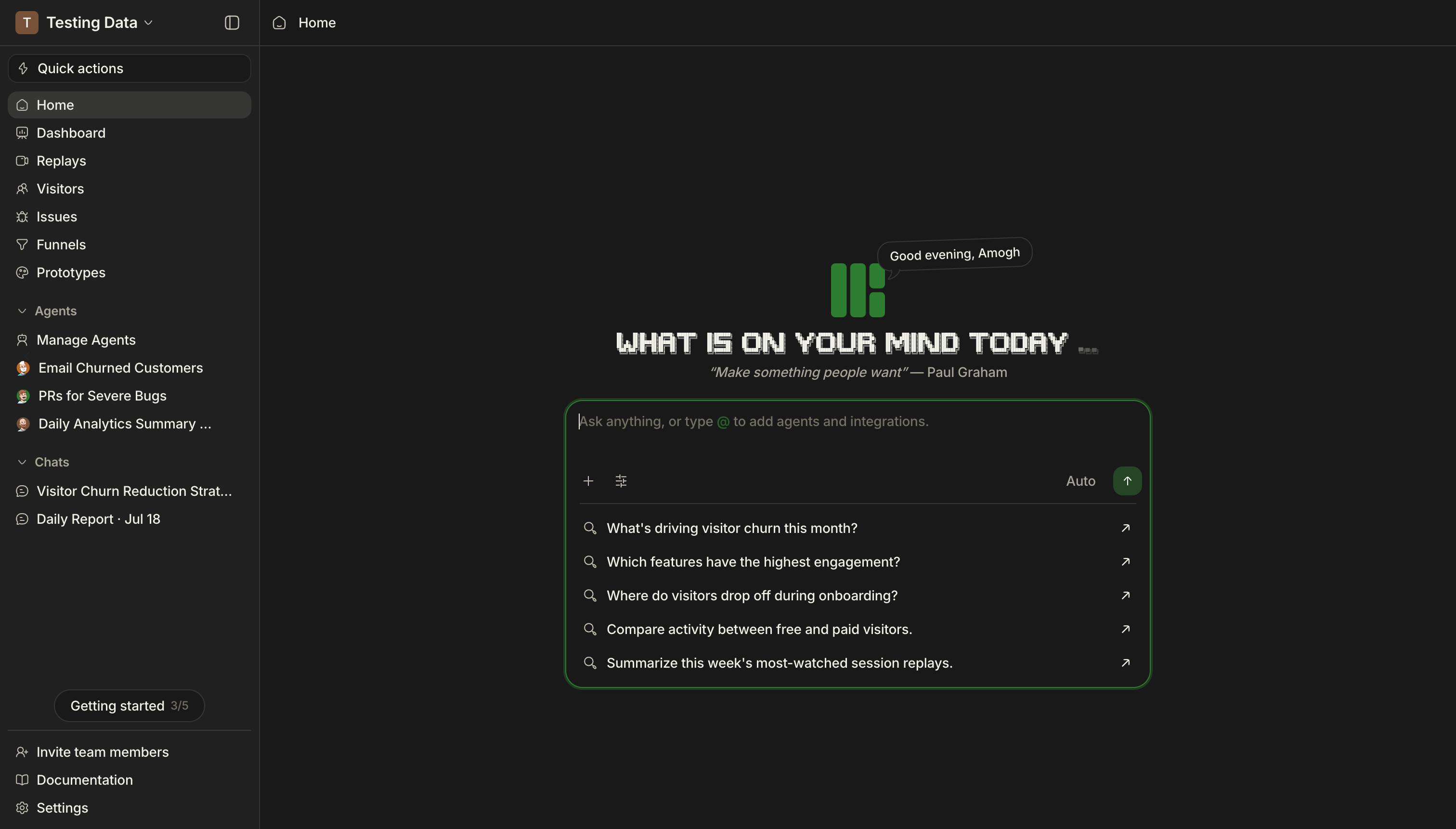
Human Behavior is a new AI-driven product analytics tool that tackles the analytics-action gap. Instead of just showing dashboards, it deploys AI agents that watch every session replay to detect rage clicks, dead buttons, and silent drop-offs, then automatically submit PRs, update project management tools, and notify affected users — all verified in a continuous feedback loop.
Dashboards Are Becoming the Graveyard of Insights
Over the past decade, product analytics tools have experienced explosive growth. From Google Analytics to Mixpanel, Amplitude, and session replay tools like Hotjar and FullStory, data collection capabilities have grown increasingly powerful. Yet an uncomfortable reality has gradually emerged: we're collecting massive amounts of data but rarely taking meaningful action on it.
Behind this lies a clear industry evolution. Product analytics tools have progressed through three stages: The first stage was page-level statistical tools represented by Google Analytics, focused primarily on macro metrics like PV, UV, and bounce rates. The second stage brought event-driven analytics platforms like Mixpanel and Amplitude, introducing user behavior tracking, funnel analysis, retention analysis, and user segmentation — enabling product teams to answer questions like "at which step are users dropping off?" The third stage saw the rise of session replay tools and data warehouse solutions (such as Snowflake + dbt + Looker), with the former reproducing qualitative experiences by recording user interaction videos, and the latter empowering teams with more flexible data exploration through SQL-driven self-service analytics. However, as tools multiplied and data grew richer, the insights actually converted into product improvement actions didn't scale proportionally — this is the so-called "analytics-action gap."
A recent product that ranked #5 on Product Hunt, Human Behavior, takes direct aim at this pain point. Its tagline is provocatively direct: "Product analytics told you what happened. We handle it." In their product description, the team writes bluntly: "Dashboards are where insights go to die."
This statement cuts to the core contradiction of the industry — traditional product analytics tools excel at "presenting" problems but fall short at "solving" them. Product managers face piles of charts and funnels every day, requiring manual interpretation, meetings, development scheduling — an entire pipeline that is lengthy and prone to breaking.
The Four-Step Pipeline: From "Data Collection" to "Closed-Loop Resolution"
Human Behavior's core innovation lies in transforming product analytics from an "observation tool" into an "action system." According to official descriptions, the entire workflow is broken down into four stages:
Collect: Event and Session Data Capture
Events, errors, and session replays are captured from the application via SDK. This step is similar to traditional analytics tools and serves as the data foundation layer.
Understand: AI Automatically Identifies User Experience Issues
This is the first key differentiator. AI proactively watches every session replay, identifying user experience issues such as "rage clicks," "dead buttons," and "silent give-ups." Compared to manual sampling of replays, AI can achieve full coverage without missing any anomalous signals.
Each of these behavioral signals carries deeper UX implications. Rage clicks are a classic signal in user experience, referring to users rapidly clicking the same element multiple times in a short period — typically indicating unresponsive buttons, slow page loads, or mismatches between interaction expectations and actual behavior. FullStory was the first to productize this concept as a quantifiable metric for user frustration. Dead buttons refer to UI elements that appear interactive but have no event handler logic bound to them, severely violating users' mental models: users judge elements as clickable based on visual cues (such as button styling or underlined text), but nothing happens when they click. Silent give-ups are an even more subtle signal, where users leave a page or close an app without any obvious frustration behavior — this type of churn shows up in traditional funnel analysis as just a number, making it difficult to trace back to specific experience issues. The value of AI analyzing session replays at full coverage lies precisely here: it can automatically extract these micro-behavioral patterns from massive volumes of video, while manual sampling typically covers less than 1% of sessions.
Act: AI Agents Automatically Execute Remediation Actions
This is the most aggressive design in the entire product. Background AI agents automatically execute a series of actions: sending emails to affected customers, updating Linear (project management tool) and CRM systems, and even directly submitting PRs (Pull Requests) with session replays attached as evidence of the issue. In other words, from discovering a problem to generating fix code, almost no human intervention is required.
Loop: Verify Results and Continuously Optimize
The agents also check the outcomes of actions, verify whether issues have truly been resolved, and continuously drive product improvements — "on its own." This forms a complete self-optimizing loop.
Ditching Dashboards: Returning Interaction to Natural Language Conversation
Another noteworthy product philosophy from Human Behavior is eliminating dashboards. The team explicitly states "No dashboard to babysit" — all information and interaction happens in Slack or SMS.
This design approach aligns with a growing trend in recent years: simplifying complex system interfaces into natural language conversations. Ditching dashboards isn't a concept unique to Human Behavior — it's an important direction in the data analytics field. The core problem with traditional BI dashboards is that they require pre-designing metrics and visualizations, while real-world questions are often ad-hoc and unstructured. Gartner predicted in 2023 that by 2025, over 50% of data analytics queries would be generated through natural language, spawning a wave of "Conversational Analytics" products — ThoughtSpot launched a search-driven analytics interface even before the LLM wave; and in the GPT era, Julius AI, Hex's Magic feature, and Databricks' Genie are all exploring natural language conversations as replacements for traditional drag-and-drop report building. Human Behavior goes a step further by not only replacing dashboards with conversations but also replacing passive queries with proactive push notifications — fundamentally transforming analytics systems from a "pull-based" model to a "push-based" model, delivering information before users even need it. This design philosophy aligns closely with the Slack-first workflow trend and echoes the concept of "Ambient Intelligence."
Product managers no longer need to log into a platform, switch tabs, or manually filter data. Instead, they passively receive proactive push notifications from AI agents — "problem + actions already taken" — just like receiving a message from a colleague.
This model lowers the barrier to using tools and fundamentally changes the relationship between people and analytics systems — from "humans actively querying data" to "systems proactively reporting and resolving issues." For small and mid-sized teams, this means no need for dedicated data analysts to maintain dashboards, allowing product teams to focus their energy on decision-making rather than monitoring.
Technical Logic and Potential Challenges of AI Agent Implementation
Human Behavior is essentially an implementation of AI Agents in the vertical domain of product analytics. It chains together the multimodal understanding capabilities of large language models (watching session replays), tool-calling capabilities (operating Linear, CRM, Git), and reasoning and planning capabilities to form an executable automated workflow.
From a technical architecture perspective, the essence of AI Agents is upgrading LLMs from passive Q&A systems to autonomous systems with perception-reasoning-action capabilities. A typical AI Agent architecture consists of three core components: a perception module (receiving environmental inputs), a reasoning and planning module (goal decomposition and decision-making based on LLMs), and a tool-calling module (interacting with external systems via APIs). In Human Behavior's case, the perception module corresponds to multimodal understanding of session replays — requiring a Vision Model capable of parsing screen recordings, identifying UI elements, and recognizing user action sequences; tool calling involves the Linear API (creating tickets), CRM API (updating customer status), Git API (submitting code changes), and email/Slack APIs (sending notifications). OpenAI's Function Calling, Anthropic's Tool Use, and the Agent module in the open-source framework LangChain all provide standardized tool-calling protocols.
The implementation challenges are concentrated in three areas:
First, accuracy of understanding. AI's judgment of "rage clicks" or "silent give-ups" relies on inferring user intent. Misclassification could lead to meaningless actions or even disturb users who weren't actually experiencing problems.
Second, safety boundaries for actions. Automatically submitting PRs and sending emails to customers are operations with real consequences. How to set up human-in-the-loop checkpoints to balance automation efficiency with risk control is critical to whether enterprises will trust the product. In practice, Human-in-the-Loop (HITL) is typically implemented through "confidence thresholds" for tiered processing: when AI's confidence in a judgment exceeds a preset threshold, it executes automatically; when below the threshold, it pauses and requests human review. For example, auto-sending customer emails is a high-risk operation (potentially impacting brand image) — the ideal approach is for AI to first generate an email draft and rationale, then have a product manager confirm with a single click in Slack before actual delivery; while creating Linear tickets is a lower-risk internal operation that can have more lenient auto-execution conditions. AI coding tools like GitHub Copilot Workspace and Devin face similar design dilemmas — auto-submitting PRs means code could enter the codebase without thorough review, so most mature solutions set mandatory human approval gates at the merge step rather than completely eliminating human involvement.
Third, reliability of closed-loop verification. The claim that agents can "check results and continuously improve" raises questions about how to quantify "problem resolved" and how to avoid falling into erroneous optimization loops — this requires more mature evaluation mechanisms. Technically, this ventures into the deep waters of Causal Inference. Traditional A/B testing establishes causal relationships through random assignment, but AI Agent auto-fix scenarios can hardly satisfy rigorous experimental design conditions — fixes are deployed to all users with no control group. Alternatives include Interrupted Time Series Analysis, which compares trends of the same metric before and after a fix; or Synthetic Control Method, which constructs a counterfactual baseline using other unaffected user groups. An even greater challenge is defining "problem resolved" itself: the disappearance of rage clicks might mean users learned to work around the issue, or it might mean users abandoned the feature entirely. Avoiding Goodhart's Law — where a metric ceases to be a good measure once it's optimized for — requires the AI system to possess a holistic understanding of overall user experience rather than merely tracking the disappearance of a single signal.
The Next Frontier of Product Analytics Is "Autonomous Action"
Human Behavior currently has 123 votes on Product Hunt, ranking #5, built by Amogh Chaturvedi, and categorized across Analytics, Developer Tools, and Artificial Intelligence. While the product is still in its early stages, the direction it represents deserves the attention of the entire industry.
In the past, the value of product analytics stopped at "insight"; but in the era of AI Agents, the gap between insight and action is being bridged. When collection, understanding, action, and closed-loop verification form a self-operating system, product optimization may gradually evolve from a labor-intensive endeavor into a "background service that runs automatically."
Of course, there's still a long road from concept to mature implementation, especially regarding the controllability of automated actions. But one thing is certain: "telling you what happened" is no longer enough — what users and teams truly want is "handle it for me."
Key Takeaways
Related articles

Chain of Thought Isn't Just for AI: How Humans Can Use CoT to Improve Thinking Quality
Chain of Thought isn't just a prompt trick for large models. Starting from a Hacker News discussion, this article analyzes why CoT works for human thinking too, breaks down actionable ways to transfer it, and highlights the key differences between human CoT and machine CoT.
Cloudflare Teams Up with OpenAI: Closi…
Cloudflare Teams Up with OpenAI: Closing the Loop from Vulnerability Discovery to Defense with AI
Cloudflare uses OpenAI Daybreak to investigate security vulnerabilities and generate reviewable remediation plans, while developers use Codex to boost coding efficiency and quality.

Orca Multi-Agent Orchestration in Practice: A Guide to Parallel Collaboration with Claude and Codex
Orca is Stable AI's free open-source agent workbench supporting 34 agents like Claude Code and Codex in parallel. Learn its Git worktree isolation, multi-model orchestration, and mobile management.