Human vs. LLM-Simulated Clients: Comparing Dialogue Patterns in Online Counseling Training

Study compares live role-play with Mixtral-simulated clients, finding similar counseling dialogue patterns with deviations.
A new study applies LLMs to client role-play in counseling training, using Mixtral 8x7b (4-bit quantized) to simulate clients and comparing sentence-level dialogue patterns with live role-play. The same novice counselors talked with both human and AI clients, with interactions coded via the Counseling Communication Patterns System. LLMs reproduced real conversational dynamics to some extent, but some counseling patterns deviated from humans, and counselors' behavior with AI differed somewhat from with humans. LLM role-play shows potential as a scalable, low-cost training supplement but needs calibration for deviating patterns; conclusions are limited by the single model and novice sample.
Psychological counseling training has long relied on live role-play, but hiring practice partners is costly and hard to standardize. A new study turns to large language models: using Mistral's Mixtral 8x7b (4-bit quantized) to simulate clients, it compares sentence-level dialogue patterns against live role-play, aiming to answer two questions—can LLMs reproduce real conversational dynamics? And do counselors communicate differently with humans versus AI?
Study Design: Breaking Counseling Dialogue Down to the Sentence Level
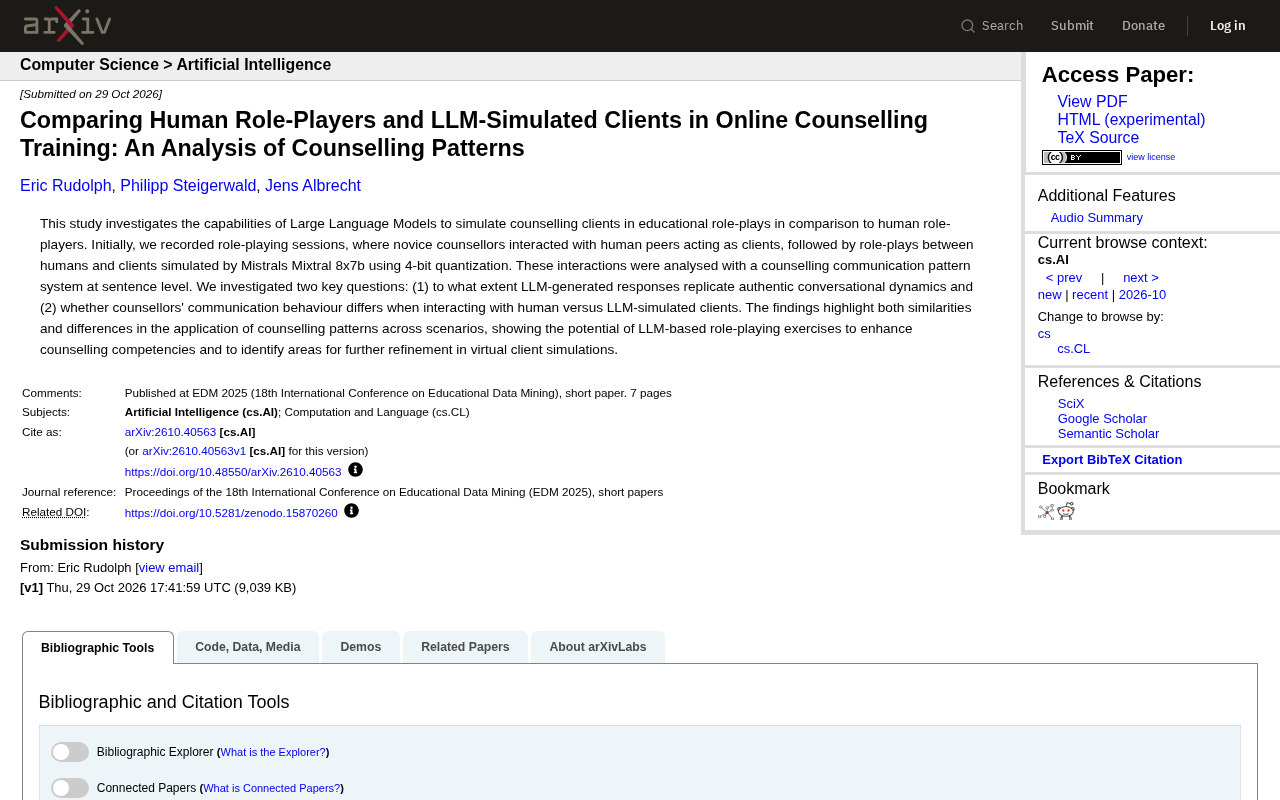
The research team first recorded role-play sessions between novice counselors and live peers (playing clients), then had the same counselors converse with clients simulated by Mixtral 8x7b. All interactions were coded and analyzed at the sentence level using the Counseling Communication Patterns System.
The clever part of this design is variable control: the same counselors, the same coding scheme, with differences arising only from whether the "client" is human or machine. Compared with questionnaires or holistic ratings, sentence-level pattern analysis captures finer-grained dialogue structure—such as question types, frequency of emotional responses, and the ratio of leading versus following.
The Counseling Communication Patterns System is a class of observational tools used to code counselor and client dialogue behaviors. It classifies each utterance by function—for example, question type (open-ended/closed-ended), emotional reflection, content paraphrase, leading statements, and following responses. Compared with holistic ratings or self-report questionnaires, sentence-level coding reveals the micro-structure of dialogue: who dominates topics, how often counselors follow clients' emotional cues, and how the ratio of questions to reflections changes over time. The system's advantage lies in its strong operability and testable inter-rater agreement, making it suitable for rigorous cross-condition comparisons (human vs. AI).
Key Findings: Similarities and Differences Coexist
The study's conclusion is not a simplistic "AI can replace humans" or "AI is nothing like humans," but rather that the application of counseling patterns across the two scenarios shows both similarities and differences. LLM-generated responses reproduce real conversational dynamics to some extent, but deviate from live role-play in the distribution of certain counseling patterns.
One detail worth noting is the behavioral shift on the counselor side: when facing LLM-simulated clients, counselors' communication behaviors were not entirely consistent with those when facing humans. This means that even when the client is AI, counselors' conversational strategies undergo subtle adjustments—a key reminder for training effectiveness: if the training goal is transfer to real counseling settings, the "non-human feel" of the simulated counterpart may subtly shape different communication habits.
Because the original article does not disclose specific pattern distribution data or effect sizes, the magnitude of these differences cannot currently be judged—a gap that future research needs to address.
4-bit quantization refers to compressing model weights from the usual 16-bit floating-point representation to 4-bit integer representation, substantially reducing memory footprint and inference cost. Common approaches include post-training quantization methods such as GPTQ and AWQ, which can run larger models on consumer-grade GPUs. The trade-off is possible numerical precision loss, affecting the fluency, diversity, or instruction-following ability of generated text. In this study, using a 4-bit quantized Mixtral 8x7b means the quality of simulated client responses may be affected by quantization—a technical variable that cannot be ignored when interpreting "whether LLMs can reproduce real conversational dynamics."
Mixtral 8x7b is a sparse Mixture-of-Experts (MoE) large language model released by Mistral AI. It contains 8 expert networks, activating only 2 per token during inference, with total parameters of approximately 46.7B but per-token computation close to a 12.9B dense model, thereby reducing inference cost while maintaining strong generation capability. The model supports multiple languages and longer contexts, and is often used for dialogue simulation, summarization, and similar tasks. Choosing this model for client simulation balances generation quality with deployment feasibility, but it also means the conclusions may not directly generalize to other architectures (such as dense models or larger-scale MoE models).
Practical Implications for Counseling Training
The study's value proposition is clear: LLM role-play practice has the potential to enhance counseling competence while helping identify areas for improvement in virtual client simulation. For training programs, this means a scalable, low-cost practice option—unaffected by the availability and fluctuating state of live actors, and allowing repeated practice of high-difficulty situations.
But "has potential" does not equal "ready for deployment." The study also points to directions for further refinement of virtual client simulation: if LLMs deviate from humans in specific counseling patterns, the interaction scripts formed during training may misalign with the needs of real clients. A reasonable approach is to position LLM simulation as a supplement to—not a replacement for—live role-play, with targeted calibration for patterns that show clear deviation.
Limitations and Future Directions
This study used a specific model (Mixtral 8x7b) with 4-bit quantization; quantization may affect generation quality, and whether the conclusions generalize to other models remains unclear. The sample consisted of novice counselors, and whether experienced counselors show the same behavioral shifts is unknown. In addition, sentence-level coding relies on manual annotation, and details such as annotator agreement are not elaborated at the abstract level.
Future research could expand coverage of models and counselor populations, quantify the degree of deviation across different counseling patterns, and establish operational evaluation criteria for the "fidelity" of virtual clients.
Inter-annotator agreement is a key indicator of coding reliability in content analysis, commonly measured with statistics such as Cohen's kappa and Krippendorff's alpha. When multiple researchers independently code the same set of dialogue sentences, low agreement indicates that coding rules are ambiguous or overly subjective, rendering comparisons of sentence-level pattern distributions unreliable. When comparing dialogue from live role-play versus LLM simulation, ensuring that both datasets are coded under the same standards and with equal rigor is an important step in controlling bias. The original abstract does not disclose this metric, and readers should keep this methodological detail in mind when evaluating the study's conclusions.
One-line Summary
A study comparing live role-play with Mixtral-simulated clients finds similar counseling dialogue patterns but with deviations.
Paragraph Summary
A new study applies large language models to client role-play in psychological counseling training, using Mistral's Mixtral 8x7b (4-bit quantized) to simulate clients and comparing sentence-level dialogue patterns against live role-play. The same novice counselors conversed with both human and AI clients, with all interactions coded at the sentence level using the Counseling Communication Patterns System. Results show that LLMs can reproduce real conversational dynamics to some extent, but the distribution of certain counseling patterns differs from live role-play; counselors' communication behaviors when facing AI also differ somewhat from when facing humans. The study concludes that LLM role-play has potential as a scalable, low-cost training supplement, but requires calibration for patterns showing clear deviation, and the conclusions are limited by the single model and novice sample.
Related articles

Coinbase Engineer: How to Determine Whether an AI Agent Can Operate Unattended
Coinbase engineer Evan Kormos shares an engineering method for judging whether an AI agent can run unattended: model processes with DAG/DCG, replace output comparison with statistical evaluation, and hand over control in three phases—supervision, sampling, and exception handling.

WorkBuddy Beginner's Guide: How AI Agents Automate Office Tasks
WorkBuddy tutorial: learn how this desktop AI agent workbench automates files, organizes data, and generates documents, compared with LLMs and Codex, plus a beginner path and cost analysis.

Doubao Work in Practice: Three Modes That Let AI Actually Get Work Done
Doubao Work practical tutorial: from chat mode to Work Mode Lite and Pro, explaining the logic for choosing among three modes with real office task demonstrations. Even complete beginners can learn to use an AI agent to handle local files, organize materials, and generate documents.