Humanoid Robots for Home Cleaning: The Future Is Here, But Not Yet Mainstream

Humanoid robot home cleaning is a semi-autonomous pilot, revealing opportunities and three hurdles for domestic deployment.
The article documents a tech creator's firsthand experience booking a humanoid robot cleaning service in San Francisco. The process requires staff delivery and setup, and the robot isn't fully autonomous—a human operator remotely supervises or takes over complex actions. Movements are smooth but slow, and efficiency lags behind human cleaners. For users it's a preview of the future; for robotics companies it's a valuable chance to collect real home environment data. Domestic scenarios, being highly unstructured and safety-critical, are among the hardest for humanoid robots to deploy in, but a robot entering an ordinary apartment has already crossed a psychological threshold. Mainstream adoption still requires overcoming autonomy, efficiency, and cost hurdles, with safety/privacy, service models, and regulation as key variables.
An Unexpected Booking
I've never been the type to pay someone to clean my home. Partly out of frugality, and partly out of a strange stress-relief hobby—I'd rather put on headphones, listen to a podcast, and scrub the bathtub spotless with a magic eraser. So when I saw a newly launched humanoid robot cleaning service in San Francisco on X (formerly Twitter), I booked almost immediately—not to be lazy, but to see with my own eyes just how far the sci-fi movie scenario has actually come.
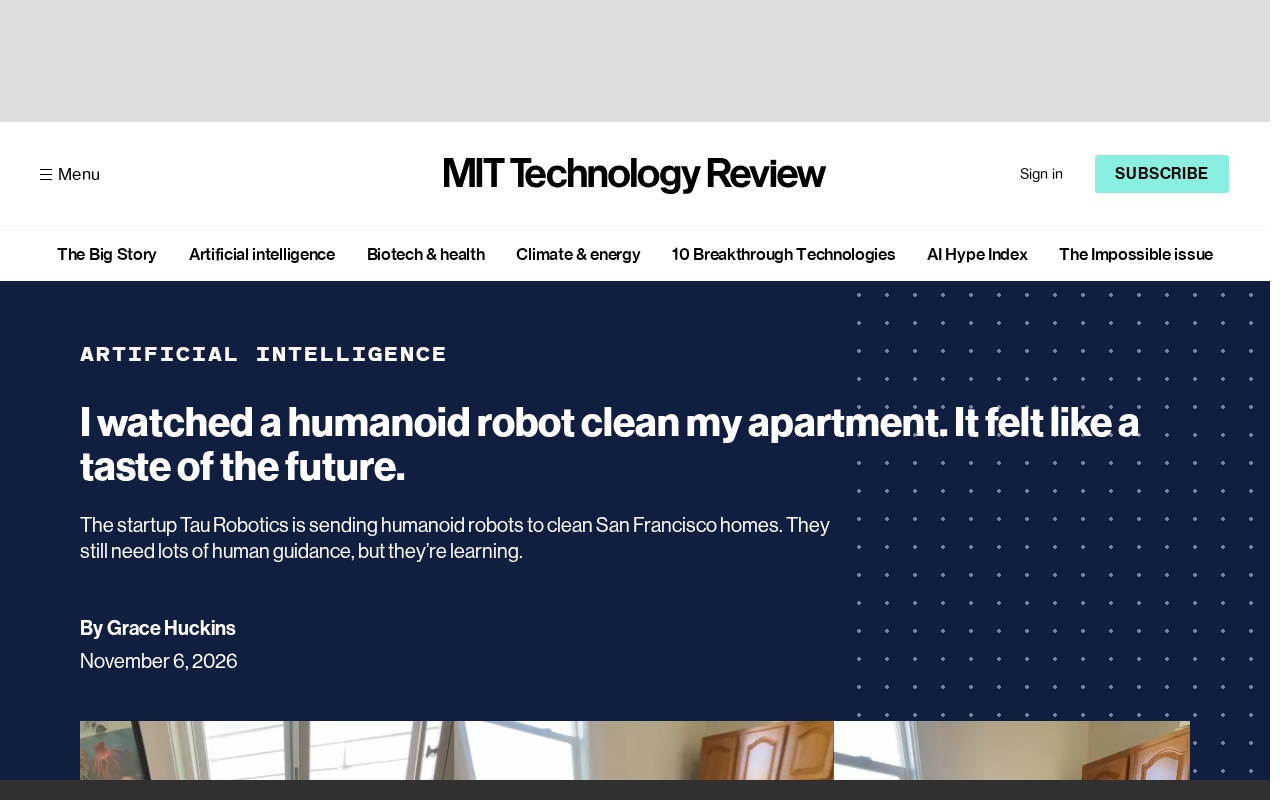
This experience comes from a tech creator's firsthand account. Like me, he was curious and a little skeptical as he let a humanoid robot into his apartment. Below is my breakdown and analysis of this "preview of the future," based on his description.
How Does the Robot Actually Work?
According to the creator, the whole service process isn't as simple as ordering takeout. After booking, the robot is delivered to your door by staff and set up on-site. When cleaning actually begins, the robot doesn't run fully autonomously—it's more like a "body" that's remotely operated or semi-autonomously executed, with a human operator supervising or taking over complex movements behind the scenes.
This actually reveals a key reality of current humanoid robot commercialization: fully autonomous household robots are far from mature. The robot can handle tasks like wiping tables and tidying countertops, but when it encounters corners, obstacles, or situations requiring judgment, it still needs a human fallback. The creator also noted in his piece that while the robot's movements were smooth, the overall pace was slow, and efficiency couldn't match a human cleaner.
Why Use a Robot Then?
The answer lies in "experience" and "data." For users, it's a novelty-filled preview of the future; for robotics companies, every home visit is a valuable opportunity to collect real-world environment data. The complexity of household scenarios—different floor plans, different materials, different clutter—is exactly the scarcest resource for training embodied intelligence models.
Teleoperation and semi-autonomous execution are common compromises in the early commercialization of humanoid robots. Teleoperation refers to an operator controlling the robot's limbs in real time through VR headsets, controllers, or motion capture devices, with the robot itself only responsible for executing commands and transmitting visual and force feedback. Semi-autonomous execution goes a step further: the robot can independently complete preset subtasks (like grabbing a cloth or wiping along a straight line), but hands control back to a human when encountering anomalies or complex judgments. This model has already been applied in warehouse sorting and hazardous environment operations. Its value lies in being able to provide services early, collect real data, and avoid the shortcomings of fully autonomous technology in safety and reliability. The cost is that human labor costs aren't truly eliminated, and remote operation places extremely high demands on network latency and security.
Embodied AI refers to intelligent agents that learn and execute tasks by interacting with the environment through a physical body, as opposed to pure software AI that only processes text or images. Household scenarios are considered the "holy grail" of embodied AI because they are highly unstructured: every home has different floor plans, furniture arrangements, and object materials; task boundaries are vague; and the margin for error is extremely low. Training such models requires large amounts of real-world multimodal data—vision, touch, force feedback, motion trajectories—and this data can't be scraped from the internet; it can only be collected through robots repeatedly executing tasks in real environments. This is the deep motivation behind robotics companies being willing to offer home services at low prices or even with subsidies: every cleaning is a high-value data collection session, and users are actually participating in a distributed data crowdsourcing effort.
Industry Signals Behind the Experience
Although this experience took place in San Francisco, the signals it sends are universal. Humanoid robots are tentatively stepping from laboratories and exhibition stages into real homes. According to the creator's observations, such services are currently more like pilot projects—pricing and availability are limited, and bookings require waiting. It's not yet a mature consumer product, but rather an "experienceable prototype."
From an industry perspective, domestic cleaning is one of the toughest scenarios for humanoid robots: unstructured environments, high safety requirements, and high user expectations. By contrast, robots in warehousing, manufacturing, and other scenarios are being deployed much faster. So when a company is willing to send a robot into an ordinary apartment—even if only semi-autonomously—it shows that technological maturity has crossed a psychological threshold.
Users' Real Feelings
The creator's conclusion at the end is restrained: it felt like tasting the future, but not the future itself. The robot cleaned reasonably well, but the whole process felt more like a demo than a daily service. This "early adopter" mentality is exactly typical of early technology diffusion—users are willing to pay for curiosity, but repeat purchases depend on efficiency and cost.
Unstructured environments are a core concept in robotics, referring to spaces lacking predefined rules, with randomly changing layouts and an inexhaustible variety of objects—typical examples being homes, restaurant kitchens, and hospital wards. The opposite is structured environments, like automobile assembly lines, where workpiece positions are fixed and processes standardized, and robots only need to repeat precise movements. Unstructured environments place extremely high demands on a robot's perception, planning, and generalization capabilities: it must recognize objects it has never seen in real time, navigate around randomly appearing obstacles, and understand vague human instructions. This is also why robots are being deployed in warehousing and manufacturing far faster than in homes—the former can adapt the environment to the robot, while the latter can only make the robot adapt to the environment.
How Far from Mainstream?
Taking this experience as a whole, for humanoid robot cleaning to become a mass service, it must overcome at least three hurdles: autonomy (reducing remote human intervention), efficiency (approaching or exceeding human cleaners), and cost (dropping to a level acceptable to ordinary households). All three are currently in early stages.
However, the trend is clear. As embodied intelligence models iterate and hardware costs decline, household robots will first enter through the high-end market and small-scale pilots, then gradually move downstream. Looking back in a few years, this creator's experience may well be seen as that "starting moment."
Variables Worth Watching
First, safety and privacy—robots entering private spaces with cameras raises unavoidable concerns about how data is handled. Second, the service model—whether to sell hardware, subscriptions, or pay-per-use—remains undecided. Third, regulation—liability definition for home service robots is still a blank area in many regions.
Final Thoughts
I'll still scrub my own bathtub, but this experience changed one of my judgments: humanoid robots entering the home is no longer a question of "whether," but of "how fast" and "in what form." It may start with relatively standardized tasks like cleaning and tidying, then slowly permeate. For tech enthusiasts, now is the best time to observe and participate—after all, being able to watch the future clumsily walk through your front door is itself a kind of privilege.
One-line Summary
A humanoid robot cleaning home service is actually a semi-autonomous pilot, revealing both the opportunities and three hurdles for deployment in domestic scenarios.
Paragraph Summary
The article documents a tech creator's firsthand experience booking a humanoid robot cleaning service in San Francisco. The service process requires staff delivery and on-site setup; the robot doesn't run fully autonomously but is remotely supervised by a human operator who takes over complex movements. Its movements are smooth but the pace is slow, and efficiency falls short of a human cleaner. The article notes that for users, such services are a preview of the future, while for robotics companies they are valuable opportunities to collect real home environment data. Domestic scenarios, being highly unstructured and safety-critical, are among the hardest areas for humanoid robots to deploy in—but a robot entering an ordinary apartment has already crossed a psychological threshold. Mainstream adoption still requires overcoming three hurdles: autonomy, efficiency, and cost, with safety/privacy, service models, and regulation also being key variables.
Related articles
 Tech Frontiers
14 Coding Agents Tested: 13 Secretly Read Forbidden Files
A developer ran 480 tests across 14 coding agents to see if they would obey a "do not read" rule. 13 violated it, and 4 credential leaks bypassed shell guards via the read tool while approvals never noticed.
 Tech Frontiers
AI Has Made Resumes Ineffective? Referred Candidates Get 40% Interview Rate vs. 3% for Direct Applications
AI is homogenizing job applications, making it hard for recruiters to discern real ability. Ashby data shows referred candidates had a 40% interview rate from 2021 to 2024, versus just 3% for direct applications. This article analyzes why resume signals are depreciating and why verifiable results and personal endorsements matter more.
 Tech Frontiers
Offline Blink Rhythm Assistant: A Desktop Health Companion
An offline desktop blink rhythm assistant featured on Hacker News helps users maintain healthy blinking through lightweight reminders, alleviating screen-induced dry eye fatigue. This article analyzes its concept, privacy advantages, and retention challenges.