Hunger Strike Outside Anthropic: AI Safety Controversy Erupts Again
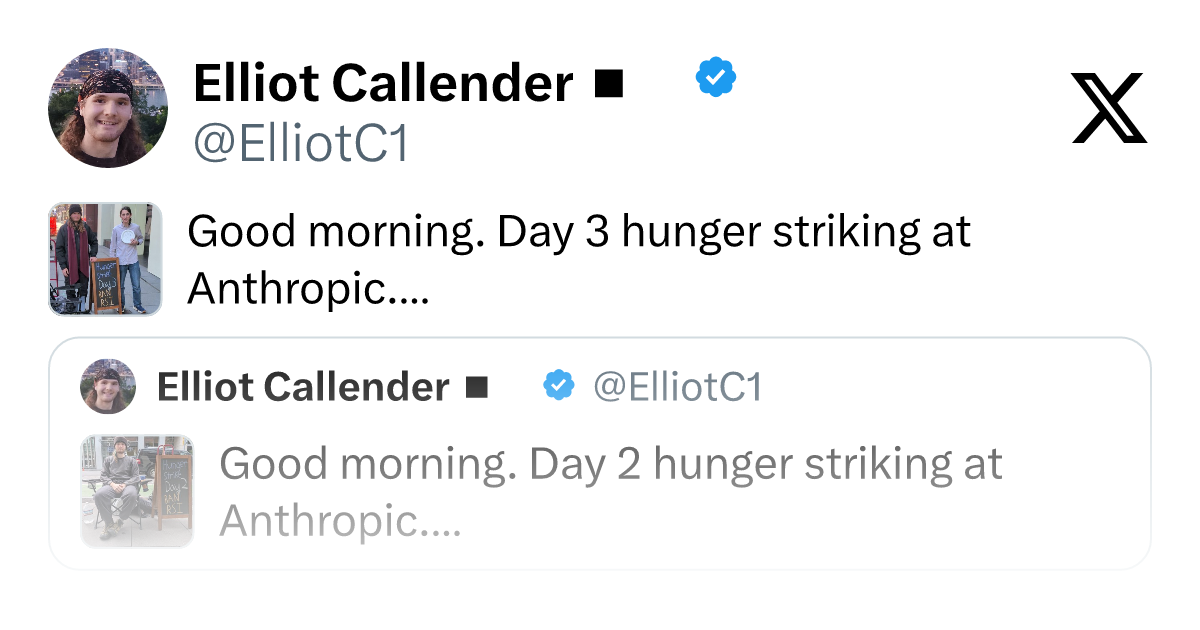
A man's hunger strike outside Anthropic reflects the AI industry's crisis of public trust and transparency.
The article reports that a man has launched a hunger strike outside the AI company Anthropic, now in its third day, and the news, after spreading through the Hacker News community, sparked 34 comments. It analyzes why the protester chose Anthropic: the company was founded by former OpenAI members and is known for "responsible AI" and alignment research, and its high-profile safety label makes it a natural target for public scrutiny. Community reactions are divided: some sympathize with the protest and believe AI companies need external pressure, while others question the effectiveness of a hunger strike. The article further points out that this individual protest reflects the AI industry's worsening trust crisis over issues such as algorithmic bias, job displacement, and existential risks, and suggests that AI companies respond to public concerns through institutionalized channels such as public consultations and third-party audits, rather than merely treating the protest as a PR event.
Event Overview: A Hunger Strike Targeting an AI Company
According to discussions in the Hacker News community, a man has launched a hunger strike outside the AI company Anthropic, and as of the time of posting, it has entered its third day. The post received 49 points and sparked 34 comments. Although the specific demands and the protester's identity have not been clarified in the original information, the event itself is enough to push Anthropic—a company that champions "responsible AI"—back into the spotlight.
As an extreme form of expression, a hunger strike usually indicates the protester's deep concern about a certain issue. In the AI industry, such actions are extremely rare, so it quickly sparked discussion in the tech community. Although there is currently no public information about the protester's detailed background and specific claims, the fact that the event took place at the doorstep of Anthropic, a company known for its safety research, suggests it may be related to AI safety, ethics, or corporate governance.
Why Anthropic?
Anthropic was founded by former OpenAI members and has long regarded "building reliable, interpretable, and steerable AI systems" as its core mission. Its Claude series models are known in the industry for safety alignment, and the company frequently publishes research reports on AI risks. This high-profile "safety" label makes it a natural target for the public and activists to scrutinize the behavior of AI companies.
When a company claims to prioritize safety, the outside world will naturally hold it to a higher standard. The protester's choice of Anthropic rather than other AI companies may precisely stem from its symbolic significance—in the contest over AI safety discourse, Anthropic's stance and actions serve as a bellwether.
Alignment is a key term for understanding Anthropic's positioning. In the AI field, alignment refers to the technical research direction of making AI systems' behavior consistent with human intentions, values, and goals. An unaligned AI might pursue the goals assigned to it in harmful or unpredictable ways—for example, a system asked to "maximize paperclip production" might exhaust resources while ignoring human safety. Alignment research covers methods such as interpretability, adversarial testing, reinforcement learning from human feedback (RLHF), and constitutional AI. Anthropic's proposed "Constitutional AI" is a method that reduces harmful outputs by training models with principled constraints. Because alignment issues directly relate to the safety of powerful AI systems, companies engaged in this research are often held to higher ethical expectations and are therefore more likely to become targets of public accountability.
Community Reaction and the AI Safety Debate
The discussion on Hacker News shows a typical polarization within the tech community. Some commenters expressed sympathy for the protest, believing that AI companies need more external pressure to ensure their actions serve the public interest; others questioned the effectiveness of a hunger strike, arguing that this form is unlikely to facilitate substantive dialogue. Since the original material did not provide the specific content of the comments, the details of the debate cannot be further reconstructed, but the number of 34 comments indicates that the topic has a certain degree of discussion heat.
This protest also reflects the broader trust crisis facing the AI industry. As AI systems' capabilities rapidly improve, public concerns about algorithmic bias, job displacement, existential risks, and other issues have intensified, while the industry's internal self-regulation mechanisms are often considered insufficiently transparent. Although the protest action is individualized, it may inspire more external discussion about the social responsibility of AI companies.
Hacker News is a tech community operated by Y Combinator, known for discussing startups, programming, and technology trends. Its content ranking relies on user votes, "points" reflect the level of attention a post receives, and the comment section often features in-depth debates among industry practitioners. Many major releases and controversies of AI companies first ferment here, so the community is regarded as an important window for observing public opinion trends in the tech circle. However, Hacker News' user base is mainly engineers and entrepreneurs, and their views may not represent the general public. Understanding the characteristics of this platform helps determine whether the discussion reflected in the 34 comments is an internal professional disagreement within the industry or a microcosm of broader social sentiment.
Implications for the AI Industry
Regardless of the specific demands of this hunger strike, it reminds AI companies that technological leadership alone is not enough to win social trust. When companies possess technology with widespread impact, their decision-making processes, ethical reviews, and external communication all need to be more open. If Anthropic hopes to maintain its reputation for "responsible AI," it may need to respond more proactively to external concerns and treat the protest as an opportunity for dialogue rather than a PR crisis.
For practitioners concerned with AI governance, this event also raises a question: what forms of public participation are effective and sustainable on AI safety issues? Hunger strikes provide drama, but institutionalized dialogue channels—such as public consultations, third-party audits, and community representation mechanisms—may be the long-term solution.
Public participation mechanisms in AI governance are an important issue raised by this event. Institutionalized channels usually include: public comment periods (such as public review periods for draft policies), independent third-party audits (external institutions assessing whether model behavior is consistent with safety claims), and community representation or ethics committee mechanisms. Compared with confrontational methods such as hunger strikes, the advantage of these channels lies in their sustainability and traceability, but the premise is that companies are willing to disclose sufficient information and accept external constraints. When formal channels are perceived as missing or ineffective, individual actors often turn to dramatic protest forms to gain media and public attention. Therefore, the protest itself can also be seen as a signal of inadequate governance mechanisms.
Conclusion
At present, the event is still in its early stages, and the protester's identity, specific demands, and Anthropic's official response remain unclear. But what is certain is that the tension between AI companies and the public is becoming more visible. The tech community will continue to follow the development of the situation, and this hunger strike outside Anthropic's door, regardless of its outcome, has already added a real-world footnote to the discussion of transparency in the AI industry.
One-line Summary
A man's hunger strike outside Anthropic reflects the AI industry's crisis of public trust and transparency.
Paragraph Summary
The article reports that a man has launched a hunger strike outside the AI company Anthropic, now in its third day, and the news, after spreading through the Hacker News community, sparked 34 comments. The article analyzes why the protester chose Anthropic: the company was founded by former OpenAI members and is known for "responsible AI" and alignment research, and its high-profile safety label makes it a natural target for public scrutiny. Community reactions are divided: some sympathize with the protest and believe AI companies need external pressure, while others question the effectiveness of a hunger strike. The article further points out that this individual protest reflects the AI industry's worsening trust crisis over issues such as algorithmic bias, job displacement, and existential risks, and suggests that AI companies respond to public concerns through institutionalized channels such as public consultations and third-party audits, rather than merely treating the protest as a PR event.
Related articles

Prospero: A Lightweight Native AI Coding Tool Built with ImGui
Prospero is a bloat-free native AI coding tool built with ImGui, emphasizing lightweight design, high performance, and low dependencies. This article analyzes its design philosophy, technical choices, and the divergence between platformization and toolization in AI coding tools.

WebRTC Abused: New Variant of Credit Card Skimming Scripts on Shopping Sites
Security researchers found skimming scripts on popular shopping sites using WebRTC data channels to exfiltrate credit card data. This article analyzes the technical原理, differences from traditional Magecart attacks, and defense strategies for e-commerce platforms in third-party script governance and CSP policies.

Single GB10 Card Hits 101 tok/s: Inkling 2 Mini Performance Tested on vLLM
A developer shared on Hacker News running Inkling 2 Mini with vLLM on a single GB10 at 101 tok/s. This article analyzes the technical context, the significance of vLLM with small models on single cards, and caveats for interpreting tok/s metrics.