Hybrid Forecasting Models Compared: Which Is Most Accurate for Short-Term Building Thermal Load Prediction?

EMD-LSTM-Markov tops 13 hybrid models for building thermal load forecasting but still underestimates extreme power peaks.
This arXiv comparative study systematically evaluates 13 hybrid forecasting models for short-term building heating and DHW load prediction using real Scottish household data and weather forecasts. The EMD-LSTM-Markov model — combining signal decomposition, sequential dependency modeling, and state-transition characterization — achieves the highest day-ahead accuracy. Methods like SVM-SA and RF-ISSA-LSTM produce smoother curves with lower overall error but consistently underestimate power peaks. Notably, even the top-performing model struggles with high-amplitude swells and spikes, revealing a shared limitation of current hybrid approaches in extreme scenarios.
Why Building Thermal Load Prediction Matters
Heating and domestic hot water (DHW) energy consumption accounts for a significant share of residential energy use. Accurately forecasting short-term — especially day-ahead — thermal loads has real-world implications for optimizing heat dispatch, peak shaving, and improving overall energy system efficiency. However, thermal loads are influenced by multiple factors including weather, user behavior, and building physical characteristics, resulting in strong nonlinearity and high volatility that make it difficult for any single model to simultaneously capture trends and identify peaks.
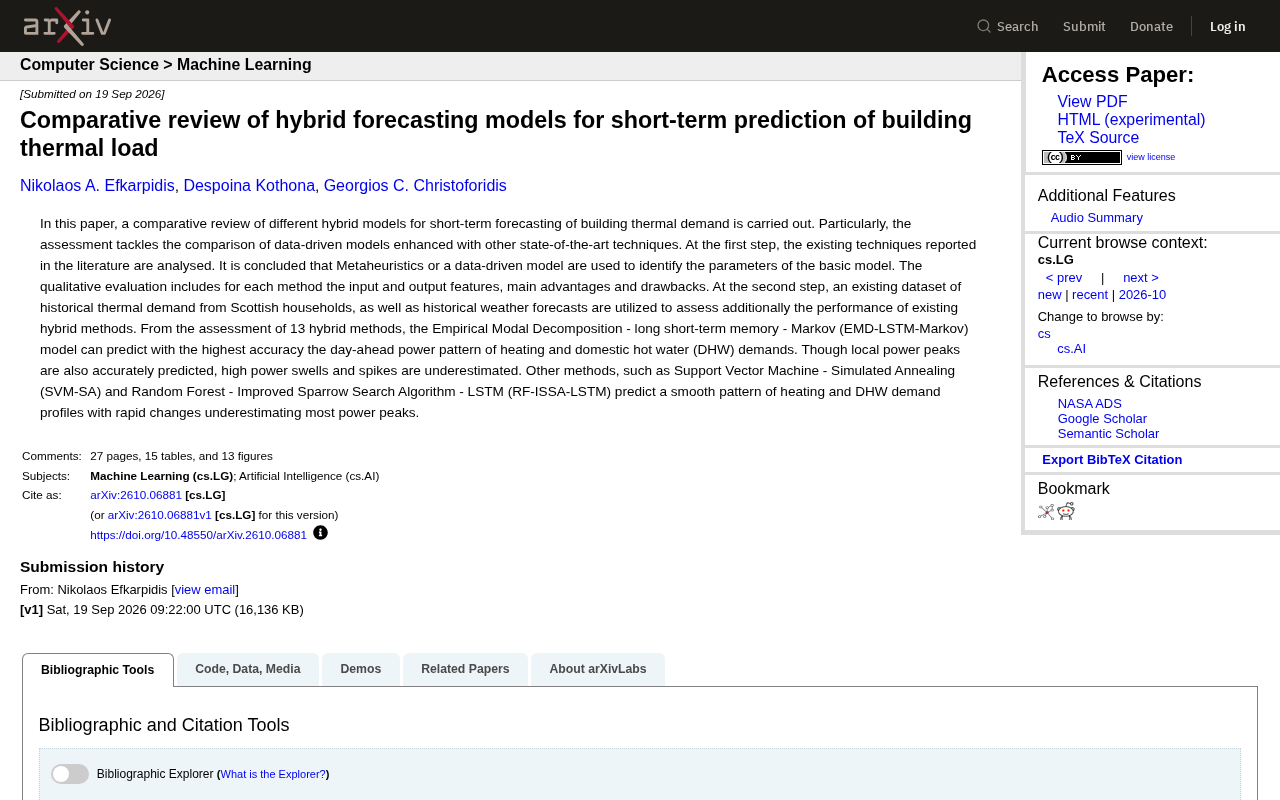
A recent comparative study published on arXiv (arXiv:2610.06881v1) systematically evaluates multiple hybrid forecasting models for short-term building thermal load prediction. Hybrid models typically layer metaheuristic optimization or other advanced techniques on top of a base data-driven model to improve parameter identification and prediction accuracy.
Research Methodology: Qualitative Analysis Plus Empirical Evaluation
The study unfolds in two stages. The first involves reviewing and qualitatively assessing techniques reported in the literature. The authors find that existing hybrid approaches share a remarkably consistent core idea: either using metaheuristic algorithms to identify base model parameters, or using another data-driven model to accomplish the same task. Each approach is annotated with its input/output characteristics, key strengths, and limitations, forming a fairly comprehensive technical landscape.
The second stage is empirical evaluation. The researchers used historical thermal load data from Scottish households combined with historical weather forecast data to conduct a head-to-head performance comparison of existing hybrid methods. This "real dataset + multi-model competition" approach makes the findings far more actionable than purely theoretical analysis.
The Contest Among 13 Hybrid Models
Among the 13 hybrid methods evaluated, the standout performer is the EMD-LSTM-Markov model — a combination of Empirical Mode Decomposition (EMD), Long Short-Term Memory networks (LSTM), and Markov processes. This model achieved the highest accuracy when predicting day-ahead power patterns for heating and DHW demand.
The logic behind this combination is quite instructive: EMD decomposes complex raw signals into a set of smoother sub-sequences, LSTM excels at capturing short- and long-term dependencies in time series, and the Markov process further characterizes state transition properties. Together, they preserve a grasp of overall trends while improving responsiveness to local variations.
That said, the study is candid about its limitations: although EMD-LSTM-Markov can predict local power peaks with reasonable accuracy, it still underestimates high-amplitude power swells and spikes. This means that in extreme energy consumption scenarios, the model may not fully reflect the sharp fluctuations in actual demand.
Empirical Mode Decomposition (EMD) is an adaptive signal processing method proposed by Huang et al. in 1998, designed specifically for analyzing nonlinear, non-stationary time series. Unlike Fourier transforms or wavelet decomposition, EMD does not rely on predefined basis functions — it is entirely data-driven, progressively decomposing a raw signal into a series of Intrinsic Mode Functions (IMFs) and a residual trend component. Each IMF represents an oscillation at a particular scale in the original signal; the IMFs are mutually independent and sum back to the original. In thermal load prediction, EMD's advantage lies in its ability to decompose complex load curves — which are overlaid with weather cycles, user behavior patterns, and random noise — into smoother sub-sequences. This allows the subsequent LSTM network to model each sub-sequence separately, reducing overall learning difficulty and improving prediction accuracy. Markov processes are a class of stochastic processes with the "memoryless" property: the system's next state depends only on its current state, not on its history. In thermal load prediction, load levels can be discretized into state intervals, and a state transition matrix can characterize the probability of loads jumping between intervals — enabling probabilistic correction of LSTM's continuous predictions and enhancing the model's ability to capture sudden transitions.
Characteristics and Shortcomings of Other Models
Beyond the top performer, the study also comments on several other representative approaches, including SVM-SA (Support Vector Machine + Simulated Annealing) and RF-ISSA-LSTM (Random Forest + Improved Sparrow Search Algorithm + LSTM).
The heating and DHW demand curves predicted by these methods are relatively smooth, leaving them insufficiently responsive to rapid changes and causing them to consistently underestimate most power peaks. In other words, they are better suited to capturing average trends but fall short at the critical task of peak identification.
This contrast reveals a fundamental trade-off in hybrid model design: smooth predictions may not perform poorly on overall error metrics, but in practical heat dispatch, accuracy at peak prediction is often far more critical — underestimating peaks can directly lead to insufficient heating supply or delayed system response.
Metaheuristic optimization algorithms are a common parameter identification tool in this class of hybrid models. The Simulated Annealing (SA) in SVM-SA and the Improved Sparrow Search Algorithm (ISSA) in RF-ISSA-LSTM both fall into this category. The shared idea behind metaheuristic algorithms is to simulate search behaviors observed in nature or physical processes (such as annealing cooling or collective foraging) to find globally optimal solutions in high-dimensional, non-convex parameter spaces — avoiding the tendency of gradient descent methods to get trapped in local optima. In hyperparameter tuning or weight initialization for machine learning models, metaheuristic algorithms can replace or supplement traditional optimizers. However, these algorithms generally carry significant computational overhead, and their search processes have an inherent randomness that can cause convergence results to vary across runs. In thermal load prediction tasks, if metaheuristic optimization primarily serves overall fitting accuracy rather than peak response, the resulting model tends toward "regression to the mean" — predicting values that gravitate toward average load levels, thereby systematically underestimating demand peaks.
Implications for Energy Modeling Practice
From this comparative study, several directions worth considering for engineers and researchers can be distilled. The combination of signal decomposition techniques (such as EMD) with deep learning (such as LSTM) has been shown to be an effective path toward improving thermal load prediction accuracy. Introducing state-transition modeling (such as Markov processes) further helps characterize the dynamic nature of demand patterns.
At the same time, the universal underestimation of extreme peaks across all evaluated methods suggests that future research should pay greater attention to modeling capability for tail events and sudden-change scenarios. Pursuing average accuracy metrics alone may obscure the risk of model failure at critical moments.
For teams looking to deploy forecasting models in building energy management or intelligent heating systems, this head-to-head evaluation provides a pragmatic selection reference: there is no universally optimal model. The key is to first clarify whether the application scenario prioritizes trend tracking or peak capture, then select the appropriate hybrid architecture accordingly.
Related articles

Chain of Thought Isn't Just for AI: How Humans Can Use CoT to Improve Thinking Quality
Chain of Thought isn't just a prompt trick for large models. Starting from a Hacker News discussion, this article analyzes why CoT works for human thinking too, breaks down actionable ways to transfer it, and highlights the key differences between human CoT and machine CoT.
Cloudflare Teams Up with OpenAI: Closi…
Cloudflare Teams Up with OpenAI: Closing the Loop from Vulnerability Discovery to Defense with AI
Cloudflare uses OpenAI Daybreak to investigate security vulnerabilities and generate reviewable remediation plans, while developers use Codex to boost coding efficiency and quality.

Orca Multi-Agent Orchestration in Practice: A Guide to Parallel Collaboration with Claude and Codex
Orca is Stable AI's free open-source agent workbench supporting 34 agents like Claude Code and Codex in parallel. Learn its Git worktree isolation, multi-model orchestration, and mobile management.