Hybrid Private MoE Routing: Cutting Agent Intermediate Reasoning Token Costs by 70%

Private MoE routing plus selective cloud fallback cuts agent intermediate reasoning costs by ~70%.
The article notes that most cloud inference spend in multi-agent workflows comes from intermediate mechanical steps—intent classification, schema validation, retry loops—not the final answer. Sending everything to frontier APIs mismatches cost; downgrading to dense small models causes retry loops. One team's four-tier architecture uses a deterministic router, a private zero-egress MoE for format tasks, cloud only for complex reasoning, and a two-failure schema escalation guard, cutting bills 68%–74% and time-to-first-token from 1200ms to 340ms.
Production teams running multi-agent workflows often make a counterintuitive discovery: the biggest line item in their cloud inference bill is almost never the final user-facing response. The real money sink is the intermediate mechanical work—intent classification and task decomposition, schema validation and structured JSON checks, AST validation and intermediate code comparison, failure retries and tool routing loops. When an agent needs to make 6 intermediate tool calls to complete a single task, paying frontier-model prices (e.g., Claude 3.5 Sonnet or GPT-4o at $3–15 per million tokens) for every one of them directly erodes software gross margins.
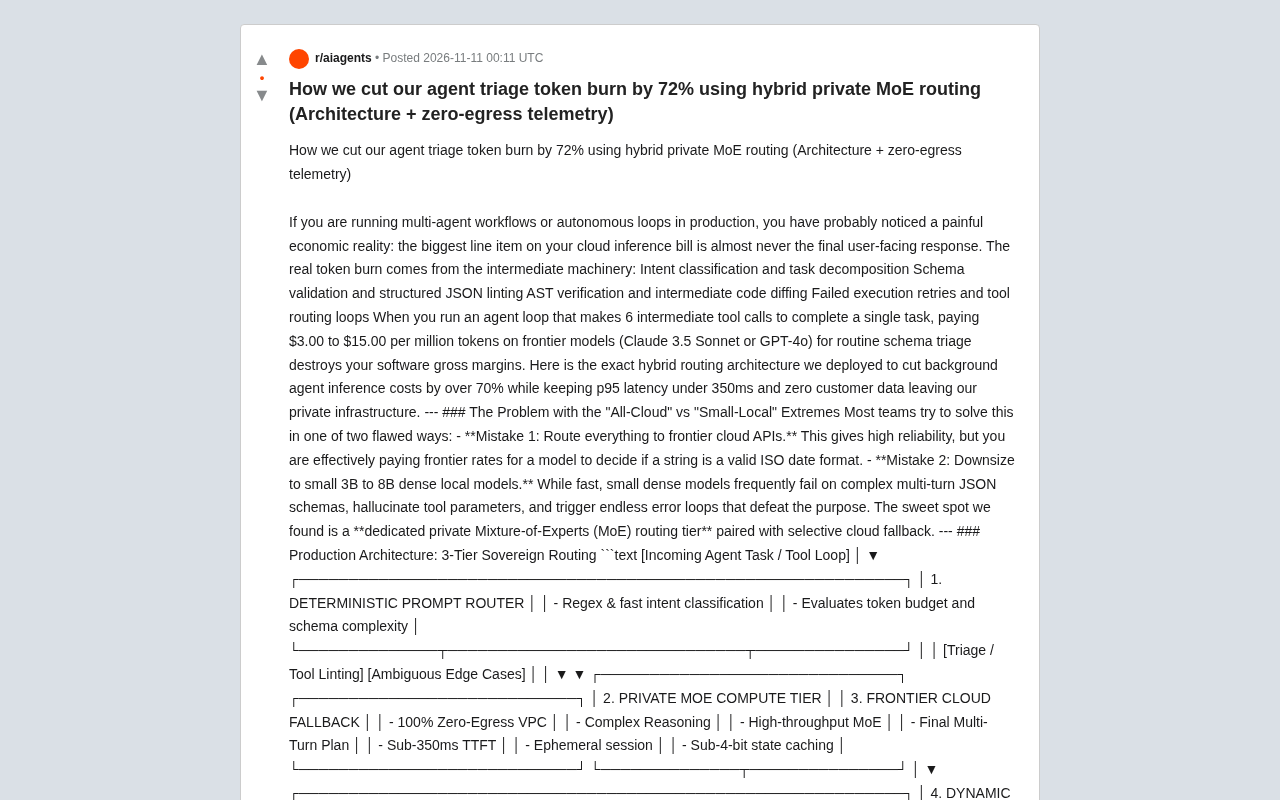
A team of engineers shared their solution on Reddit: a three-tier architecture combining a "private MoE routing layer + selective cloud fallback" that cuts background agent inference costs by roughly 70%, keeps p95 latency under 350ms, and ensures zero egress of customer data.
Why the Two Extreme Approaches Both Fail
Most teams fall into one of two traps when trying to solve this problem.
First, routing everything to frontier cloud APIs. Reliability is fine, but it amounts to paying frontier-model prices to determine whether a string matches the ISO date format—a completely mismatched cost structure.
Second, downgrading to dense local small models of 3B to 8B parameters. Fast, but small dense models frequently fail on complex multi-turn JSON schemas, hallucinate tool parameters, and trigger endless error loops—the savings get eaten up by retries.
The middle ground this team found is: a dedicated private MoE routing layer paired with selective cloud fallback. What makes this approach noteworthy is that it doesn't choose between "capability" and "cost"—it routes based on task difficulty.
The core difference between MoE (Mixture of Experts) models and dense models lies in how parameters are activated. Dense models invoke all parameters on every forward pass, whereas MoE sets up multiple "expert" subnetworks at each layer and activates only a few of them through a gating mechanism. This means the total parameter count can be very large (e.g., tens of billions), but the actual computation per inference is equivalent to a much smaller model. For a routing layer that needs high throughput, low latency, and some degree of semantic sophistication, MoE provides better representational capacity under limited compute than a dense model of equivalent compute—this is the underlying reason the team chose a private MoE over 3B–8B dense small models.
The Production Architecture of Three-Tier Sovereign Routing
The architecture has four layers, with the following flow:
- Deterministic prompt router: Uses regex and fast intent classification for initial screening, while also evaluating token budget and schema complexity. Sorting and tool-check requests go to private compute; ambiguous edge cases go to the cloud.
- Private MoE compute layer: Deployed in a 100% zero-egress VPC, high-throughput MoE inference, time-to-first-token under 350ms, with sub-4-bit state caching.
- Frontier cloud fallback: Handles only complex reasoning and final multi-turn planning, using ephemeral sessions.
- Dynamic retry and escalation guard: The private MoE continues execution if it passes schema validation; if a format failure is detected, it escalates to the cloud tier.
The key design lies in the routing decision logic: the vast majority of intermediate steps are deterministic format work that should never have been sent to frontier models in the first place; only the parts that genuinely require reasoning are worth paying a premium for.
Four Technical Breakthroughs from Production
Prefix caching and state reuse (over 90% hit rate)
Agent frameworks replay large amounts of system instructions, OpenAPI schemas, and context history at almost every step. The team enabled aggressive prefix caching and state reuse on private inference nodes, eliminating repeated prompt ingestion overhead. Time-to-first-token dropped from 1200ms in the cloud to under 340ms locally. This step improves latency by an order of magnitude.
Prefix caching is an inference optimization technique: when multiple requests share the same prompt prefix, the model only needs to compute and cache the KV (key-value) states for that prefix on the first request, and subsequent requests reuse them directly, skipping redundant attention computation. Agent workflows are naturally suited to this optimization because system instructions, tool schemas, and conversation history are replayed repeatedly at every step. The higher the cache hit rate, the more prefill computation is saved, and the more noticeably time-to-first-token (TTFT) drops. Note that prefix caching is sensitive to prompt structure—only parts that are exactly identical from the very beginning can hit the cache, so a stable system prompt layout is a prerequisite for realizing its benefits.
Sub-4-bit state quantization, zero schema loss
The team tested multiple quantization configurations for structured JSON generation. Standard uniform quantization often breaks punctuation and bracket matching, whereas asymmetric sub-4-bit caching of key-value states maintained 100% syntactic compliance across thousands of automated tool calls without memory bloat.
Quantization refers to representing model weights or activations with lower bit widths to save memory and bandwidth. Uniform quantization divides the value range into equal intervals—simple to implement, but at very low bit widths (e.g., below 4 bits) it introduces large errors for unevenly distributed key-value states, easily corrupting predictions for precision-sensitive characters like brackets and quotes in JSON. Asymmetric quantization learns a separate zero point and scale factor for each quantization group, better fitting the actual distribution; key-value cache quantization compresses only the KV states rather than the weights, reducing memory usage without changing the model's core precision. The combination of the two is the key to maintaining syntactic compliance for structured output at low bit widths.
Context shift protection
The fastest way to crash a local inference daemon is for an unbounded tool loop to blow past the context length. The team implemented dynamic context shifting: summarizing historical draft steps into deterministic checkpoints, avoiding memory-overflow stalls while preserving task continuity.
Data sovereignty
For legal, healthcare, and financial workloads, sending raw user conversation records or proprietary codebase diffs to public API endpoints directly triggers compliance issues. Keeping intermediate sorting on private hardware means sensitive payload data never passes through third-party servers. For regulated industries, this may matter more than the cost savings.
The Economics and Reproducible Engineering Parameters
According to the data the team published: monthly API bills dropped by an average of 68% to 74%; median sorting response time fell from about 1.1 seconds to about 320 milliseconds; and under the guard that forces escalation after two consecutive schema validation failures, the task completion rate stayed within 0.5% of the pure-cloud baseline.
It should be noted that these figures come from a single team's internal workloads and customer benchmarks, not independent third-party verification, and actual gains will vary with task distribution. However, their engineering parameters—prefix cache hit rate, sub-4-bit caching, and escalation after two failures—provide reproducible directions for tuning.
For teams struggling with agent intermediate reasoning costs, the core takeaway from this path is: first route by the determinism of the task, then talk about model selection. Hand format validation to cheap private compute and leave genuine reasoning to the cloud, and the cost structure immediately becomes healthy.
One-line Summary
A private MoE routing layer plus selective cloud fallback cuts agent intermediate reasoning costs by about 70%.
Paragraph Summary
The article points out that the bulk of cloud inference bills in multi-agent workflows is not the final answer but intermediate mechanical steps like intent classification, schema validation, and retry loops. Routing everything to frontier cloud APIs is a mismatched cost structure, while downgrading to dense small models leads to retry loops from format failures. One team adopted a four-tier architecture: a deterministic router for initial screening, a private zero-egress MoE for format tasks, the cloud only for complex reasoning, and a two-failure schema escalation guard. Combined with prefix caching, sub-4-bit asymmetric quantization, and context shifting, monthly bills dropped 68%–74%, time-to-first-token fell from 1200ms to 340ms, and task completion stayed within 0.5% of the pure-cloud baseline.
Related articles

Did the Iran War Accidentally Accelerate the Clean Energy Transition? An Energy Expert's Deep Dive
Columbia professor Jason Bordoff analyzes how the Iran war unexpectedly accelerated the global clean energy transition: the Strait of Hormuz crisis, diesel price shocks, China's strategic reserves, and why energy security drives green tech adoption more than climate goals.
Gemini Audio Classification in Practice: Real-Time Emotion and Topic Recognition
Build a real-time audio classification app with Streamlit and Gemini audio decision model, demonstrating emotion, sentiment, whisper detection, and topic recognition, plus its technical path and current limitations.
Immortality of Consciousness: How Scientists Aim to Let the Brain Outlive Life
MIT Technology Review roundtable on 'mind immortality': scientists explore brain preservation and consciousness continuation, confronting identity and ethical dilemmas.