HyFlash: A New Prefix-Memory Paradigm for On-Device Speculative Decoding

HyFlash uses a prefix-memory prior to separate long-range and local modeling, solving the memory bottleneck of on-device draft models.
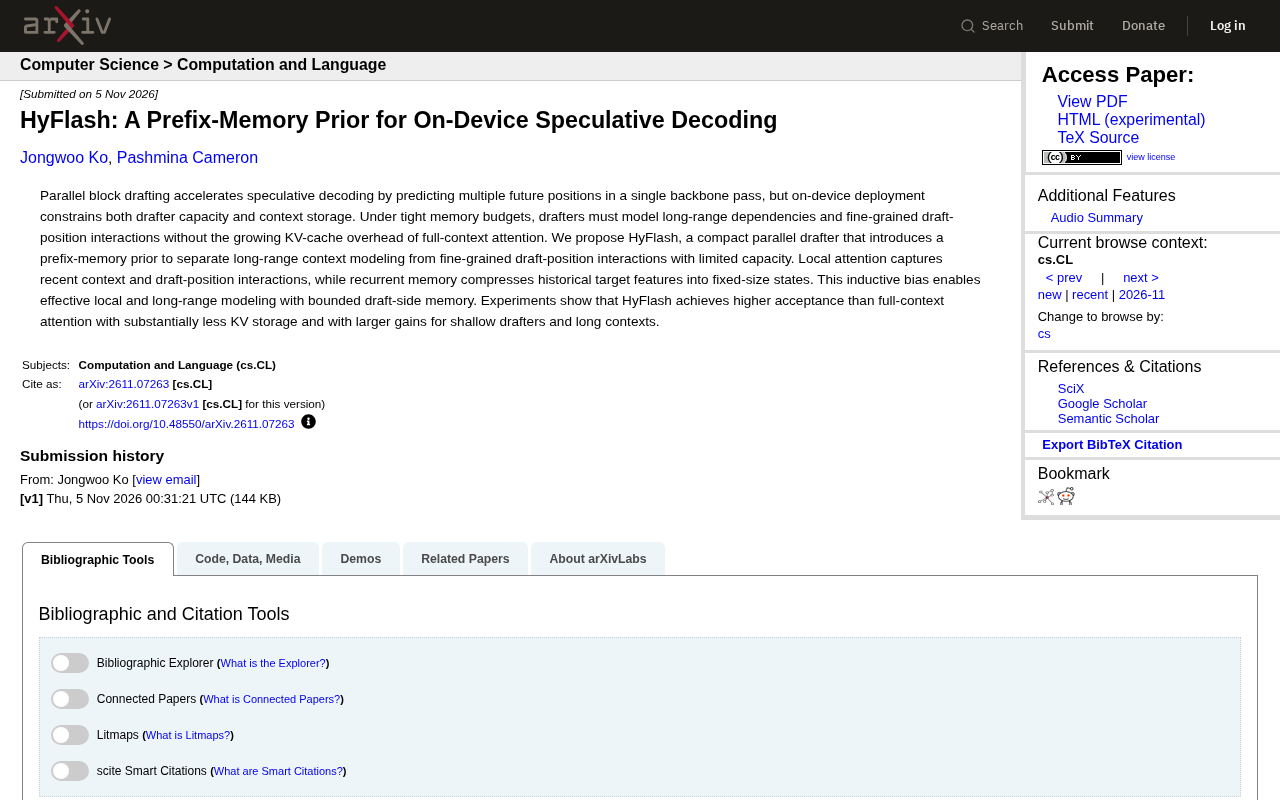
Targeting the dual constraints of on-device parallel block draft models under tight memory budgets, HyFlash proposes a prefix-memory prior that decouples long-range context modeling from fine-grained draft-position interaction. A local attention path captures recent context at constant overhead, while a recurrent memory path compresses historical features into a fixed-size state, keeping draft-side KV storage bounded. Experiments show higher acceptance rates than full-context attention, substantially reduced KV storage, and larger gains in shallow-draft and long-context scenarios. The design reveals an on-device optimization approach—replacing unbounded context caches with structured memory priors—transferable to long documents and multi-turn conversations.
Title
HyFlash: A New Prefix-Memory Paradigm for On-Device Speculative Decoding
Meta Description
HyFlash introduces a prefix-memory prior that separates long-range context modeling from fine-grained draft-position interaction, achieving higher acceptance rates for on-device speculative decoding under limited memory, with dramatically reduced KV storage and notable gains in shallow-draft and long-context scenarios.
Article Content
Speculative Decoding is a key technique for accelerating large-model inference, and Parallel Block Drafting further improves drafting efficiency by predicting multiple future positions in a single backbone forward pass. However, when this technology is deployed on edge devices, the dual constraints of draft-model capacity and context storage become bottlenecks. How can a draft model, under a tight memory budget, both model long-range dependencies and capture fine-grained draft-position interactions while avoiding the KV-cache bloat caused by full-context attention? The latest research, HyFlash, offers an elegant answer: decouple long-range context from local interaction using a Prefix-Memory Prior.
The Dilemma of On-Device Speculative Decoding
The core advantage of parallel block drafting is "one forward pass, multiple position predictions." In traditional speculative decoding, the draft model generates candidate tokens one by one, whereas a parallel draft model can output predictions for multiple positions at once, greatly reducing the computational overhead of the drafting stage. But the constraints of edge deployment are extremely stringent: the draft model itself has limited capacity, and context storage (KV cache) cannot grow indefinitely.
Under a tight memory budget, the draft model faces two tasks that must be accomplished simultaneously: modeling long-range dependencies (understanding the influence of distant preceding context on the current prediction) and capturing fine-grained draft-position interactions (the associations among different draft positions within the same batch). Although full-context attention can handle both at once, its KV cache grows linearly with context length and quickly exhausts memory on edge devices. HyFlash's starting point is precisely this: can effective local and long-range modeling be achieved simultaneously using limited draft-side memory?
Speculative Decoding works as follows: a lightweight draft model quickly generates several candidate tokens, and then the target large model verifies these candidates in parallel, thereby reducing the number of target-model forward passes while keeping the output distribution unchanged. The draft model's "acceptance rate" directly determines the speedup—the more accurate the draft, the more tokens are accepted by the target model. Parallel block drafting further enables the draft model to output predictions for multiple positions in a single forward pass rather than generating them autoregressively one by one, which places higher demands on the draft model's representational efficiency and context-modeling capability.
The KV cache (Key-Value Cache) is a mechanism in Transformer autoregressive inference that caches the Key/Value tensors of historical tokens, avoiding recomputation at each step. Its memory footprint grows linearly with context length and quickly becomes a bottleneck under the limited memory of edge devices. HyFlash specifically targets this cache bloat on the draft-model side.
HyFlash's Core Design: The Prefix-Memory Prior
HyFlash proposes a compact parallel draft model whose core is the introduction of a prefix-memory prior that separates long-range context modeling from fine-grained draft-position interaction. Specifically, the model adopts a dual-path design:
- Local attention path: responsible for capturing interactions between recent context and draft positions. Local attention only attends to the most recent tokens within a window, keeping computational overhead and storage requirements at a constant level.
- Recurrent memory path: compresses historical target features into a fixed-size state. Unlike the KV cache, the size of the recurrent memory state does not grow with context length, thereby achieving bounded draft-side memory.
This inductive bias enables HyFlash to possess both local and long-range modeling capabilities under limited capacity. Local attention ensures that fine-grained interactions among draft positions are not diluted, while recurrent memory acts as a compressed summary of long-range information, providing the draft model with a "memory" of distant preceding context.
The "recurrent" in the recurrent memory path refers to RNN-style state updates: the model maintains a fixed-dimensional hidden state, and each time a new token is read, it updates that state via a gating mechanism, so that historical information is progressively compressed into this fixed-size vector. Unlike Transformers, which must retain the KV of all historical tokens, the state size of RNN-like structures is independent of sequence length—this is precisely the key to HyFlash's bounded memory. The cost is limited state capacity, where distant details get diluted, which is why a local attention path is needed to supplement fine-grained information.
Inductive bias refers to the prior assumptions that a model structure itself imposes on the solution space. Through its dual-path structure of "local attention + recurrent memory," HyFlash assigns "local interaction" and "long-range dependency" to different modules for processing—equivalent to telling the model at the architectural level that these two types of information should be modeled separately, so that effective representations can still be learned when parameters and memory are constrained.
Experimental Performance: Higher Acceptance Rate and Less KV Storage
According to the paper's experimental results, HyFlash surpasses full-context attention schemes in draft acceptance rate while substantially reducing KV storage requirements. More critically, this advantage is more pronounced in shallow draft models and long-context scenarios.
Shallow draft models have smaller capacity, and full-context attention struggles to learn both local interaction and long-range dependency well under limited parameters; HyFlash's structured prior separation allows even shallow models to effectively leverage long-range information. In long-context scenarios, the KV-cache bloat of full-context attention is most prominent, whereas HyFlash's fixed-size recurrent memory exhibits a significant memory advantage. The paper notes that HyFlash's acceptance-rate gains are larger under long contexts, meaning it is especially suited to practical scenarios on edge devices such as processing long documents and multi-turn conversations.
"Shallow draft model" refers to a draft network with fewer layers. The fewer the layers, the more modeling responsibilities each layer must bear simultaneously; full-context attention struggles to balance local interaction and long-range dependency under limited parameters. HyFlash, by decoupling the two types of tasks through structural priors, frees shallow models from having to learn this division of labor by stacking parameters, hence the more pronounced gains. This also explains why the structure is particularly friendly to capacity-constrained deployment environments such as edge devices.
Implications for On-Device AI Deployment
The value of HyFlash lies not only in a better draft-model structure, but also in the way it reveals an approach to on-device inference optimization: replacing unbounded context caches with structured memory priors. On edge devices, memory is one of the scarcest resources, and any component that grows linearly with input length becomes a deployment obstacle. By compressing historical features into a fixed state through recurrent memory, HyFlash essentially performs a "lossy but efficient" information-bottleneck design on the draft-model side.
This design approach can be transferred to other on-device inference scenarios. For example, in an on-device long-conversation assistant, the draft model needs to reference multi-turn history but cannot retain a full KV cache for every turn; HyFlash's recurrent memory offers a viable compromise. Similarly, in on-device document summarization or code completion scenarios, contexts are often long, and a fixed-size prefix memory allows the draft model to maintain global awareness under limited memory.
Of course, the compression of recurrent memory inevitably entails information loss; HyFlash's strength lies in keeping this loss within an acceptable range and compensating for fine-grained interaction through local attention. The paper's conclusion that "gains are larger for shallow draft models" also suggests that the structure is more friendly to capacity-constrained scenarios, which aligns closely with the reality of edge deployment.
Conclusion
HyFlash provides a pragmatic structural innovation for on-device speculative decoding: separating long-range modeling from local interaction via a prefix-memory prior to achieve higher acceptance rates under limited draft-side memory. Its experimental results—higher acceptance rate, less KV storage, and larger gains in shallow and long-context scenarios—directly address the core pain points of edge deployment. For researchers and engineers focused on accelerating on-device large-model inference, HyFlash's recurrent memory design is worth including in technical selection considerations.
One-line Summary
HyFlash uses a prefix-memory prior to separate long-range and local modeling, solving the memory bottleneck of on-device draft models.
Paragraph Summary
Targeting the dual constraints of on-device parallel block draft models under tight memory budgets, HyFlash proposes a prefix-memory prior that decouples long-range context modeling from fine-grained draft-position interaction. The model adopts a dual-path design: a local attention path captures recent context and draft-position interaction at constant overhead, while a recurrent memory path compresses historical target features into a fixed-size state, keeping draft-side KV storage bounded. Experiments show that HyFlash's draft acceptance rate exceeds that of full-context attention schemes, KV storage requirements are substantially reduced, and gains are larger in shallow draft models and long-context scenarios. The design reveals an on-device inference optimization approach that replaces unbounded context caches with structured memory priors, transferable to scenarios such as long documents and multi-turn conversations.
Related articles
 Tech Frontiers
How Do You Stop AI Agent Emails From Sounding Like AI? One Developer's Solution
AI agent emails always sound like AI? A developer shares reright: a rewrite step that validates numbers, names, and links, preventing humanizers from tampering with key info. Test data and integration details inside.
 Tech Frontiers
Starlink Mobile: SpaceX's Carrier Ambitions and the 5G Deployment Challenge
SpaceX plans to make Starlink Mobile a mainstream carrier, deploying thousands of direct-to-cell satellites and building a terrestrial 5G network to challenge AT&T, Verizon, and T-Mobile. This article analyzes its dual-track strategy, 5G deployment challenges, and the competitive landscape.
 Tech Frontiers
OpenAI Raises Another $11 Billion, Valuation Hits $1.25 Trillion
OpenAI has raised an additional $11 billion in a new funding round at a valuation of $1.25 trillion. The deal is not yet closed and is expected to be completed in the coming weeks, further consolidating its leading position in AI.