HyperFrames Studio: The First Video Editor Built for AI Agents

HyperFrames Studio lets AI coding agents like Codex and Claude Code serve as your video editor via natural language.
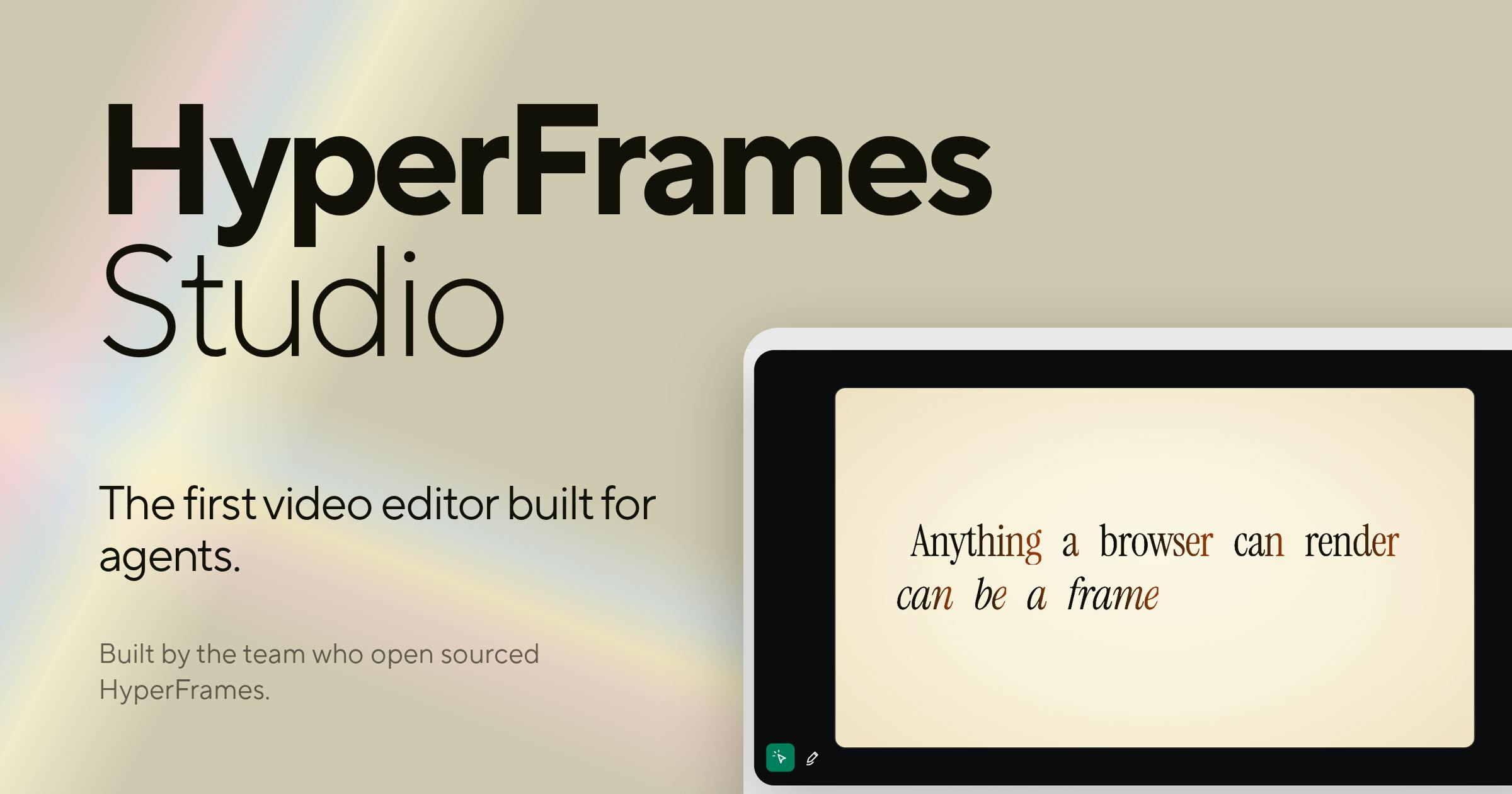
HyperFrames Studio is a desktop video editor built by HeyGen's open-source team. Its core innovation brings the tool-use capabilities of coding Agents like Codex and Claude Code into video editing — users describe what they want in natural language, the Agent calls HyperFrames to generate and edit the video, while the user stays in the director's seat to guide and refine. The product is open-source, making it especially attractive for developers and teams building programmatic video pipelines. It ranked #7 on Product Hunt with 94 votes, representing a new trend of AI Agent capabilities expanding from code into multimedia creation — though real-world quality and controllability still await validation.
When Video Editing Meets AI Coding Assistants
Video creation has long been a labor-intensive craft: dragging timelines, aligning clips, adjusting transitions, rendering over and over. Even with AI generation tools, the editing phase remains stubbornly hands-on. HyperFrames Studio aims to rewrite that workflow — positioning itself as "the first video editor built for Agents," turning AI coding assistants into your personal editor.
This desktop product was built by the team behind HeyGen's open-source HyperFrames project. It recently launched on Product Hunt, earning 94 upvotes and ranking #7, with tags spanning Open Source, Artificial Intelligence, GitHub, and Video.
Core Concept: Turning Coding Agents into Video Editors
HyperFrames Studio's biggest differentiator is a fundamental shift in interaction paradigm. Traditional video editing software requires users to manually manipulate every element. Here, the approach is different — you describe the video you want in natural language, an AI Agent calls HyperFrames to generate and edit it, and you play the role of "director."
The product supports integration with mainstream coding Agents, with Codex and Claude Code explicitly called out. In other words, you don't need to learn a new AI toolchain — you simply repurpose the coding assistants you're already using to handle video production tasks. This design philosophy extends the Agent capabilities that have exploded in the coding world into the realm of multimedia creation.
The "Director's Seat" Collaboration Model
The official description repeatedly emphasizes a single concept: you always sit in the director's seat. This means the Agent isn't a fully automated black box — it works collaboratively with the human. The general flow goes: you describe the video you want in a sentence, the Agent uses HyperFrames to generate a draft, and then you and the Agent continue refining the details together inside the same Studio editor.
This "human-AI co-editing" model addresses a critical question — how do humans intervene when AI-generated content quality is inconsistent? HyperFrames Studio's answer is to integrate generation and editing into a unified interface, so human edits and Agent capabilities connect seamlessly, rather than handing off and walking away after generation.
Codex is OpenAI's code generation model and one of the foundational technologies behind GitHub Copilot — it understands natural language instructions and converts them into executable code. Claude Code is Anthropic's command-line Agent for developers, designed to execute complex, multi-step tasks within real codebases. What both share is "tool use" capability — the Agent doesn't just output text; it can actively call external functions or APIs to complete tasks. HyperFrames Studio leverages exactly this mechanism: video editing operations are wrapped as callable tool interfaces for the Agent, transforming what would normally be manual GUI interactions into sequences of function calls the Agent can execute automatically.
Open-Source DNA and Team Background
The team's background is worth noting. HyperFrames was originally open-sourced by the HeyGen team, and HeyGen itself is a well-known name in AI video generation. The Studio version continues that open-source tradition, as reflected in its Product Hunt tags — it carries both Open Source and GitHub labels.
Being open-source means developers can inspect the underlying implementation, extend its functionality, and even integrate HyperFrames' capabilities into their own workflows. For teams looking to build programmatic video production pipelines, that openness is far more appealing than a closed SaaS product.
Target User Base
From a positioning standpoint, HyperFrames Studio is best suited for two groups: developers and technically-minded creators who already use Agents like Codex and Claude Code — they can quickly migrate their existing tools into video workflows — and teams that need to produce video content at scale and programmatically, such as in marketing, education, or content creation, where natural-language-driven workflows can significantly cut the cost of repetitive editing.
HeyGen is an AI video generation company founded in 2020, best known for its "digital human" technology that lets users upload a likeness and batch-generate multilingual talking-head videos. It went viral with AI-powered lip-sync translation demos and was once valued at over $500 million. HyperFrames, as an open-source project spun out of HeyGen, represents a distillation of its internal video processing capabilities. The journey from internal tooling at a commercial SaaS company, to an open developer framework, to a full Studio product, signals that the team is carving out a community-facing ecosystem path alongside HeyGen's core B2B market.
What Trend Does This Represent?
The emergence of HyperFrames Studio reflects a broader pattern: AI Agents are expanding beyond "writing code" and into creative production more broadly. Over the past year, the capability frontier of coding Agents has kept advancing, and plugging them into traditionally specialized domains like video editing is a genuinely interesting experiment.
That said, a realistic view is warranted: the information available right now is primarily from product marketing. Actual generation quality, editing precision, and the controllability of Agent operations all need real-world use to verify. A Product Hunt score of 94 votes shows it's attracted meaningful attention, but the road to a mature product still requires validation.
For readers tracking AI application development, HyperFrames Studio offers an interesting case study — when Agent capabilities become powerful enough, software interaction may shift entirely from "operating an interface" to "issuing instructions," with the human's role elevated to that of a director setting the vision. That may well be a glimpse of how creative tools will evolve.
Related articles

Chain of Thought Isn't Just for AI: How Humans Can Use CoT to Improve Thinking Quality
Chain of Thought isn't just a prompt trick for large models. Starting from a Hacker News discussion, this article analyzes why CoT works for human thinking too, breaks down actionable ways to transfer it, and highlights the key differences between human CoT and machine CoT.
Cloudflare Teams Up with OpenAI: Closi…
Cloudflare Teams Up with OpenAI: Closing the Loop from Vulnerability Discovery to Defense with AI
Cloudflare uses OpenAI Daybreak to investigate security vulnerabilities and generate reviewable remediation plans, while developers use Codex to boost coding efficiency and quality.

Orca Multi-Agent Orchestration in Practice: A Guide to Parallel Collaboration with Claude and Codex
Orca is Stable AI's free open-source agent workbench supporting 34 agents like Claude Code and Codex in parallel. Learn its Git worktree isolation, multi-model orchestration, and mobile management.