I Don't Want to Read What You Didn't Write: The Trust Crisis of AI-Generated Content

AI ghostwriting severs real thinking from authorship and quietly transfers the cost of verification to readers.
Tech blogger Colin Breck's article sparked heated debate on Hacker News with a core argument: writing is the externalization of thought, and using AI to generate content while putting your own name on it deceives readers into thinking they're engaging with a genuine mind. The article also highlights how near-zero generation costs shift the burden of verifying accuracy onto readers — especially in technical tutorials, where model hallucinations can waste hours of debugging time. The HN community is divided: some oppose AI ghostwriting outright, while others distinguish between AI as a helpful tool versus AI as a full stand-in, arguing the real issue is whether the author genuinely thought things through and takes responsibility for the content.
A Blog Post That Ignited Hacker News
Tech blogger Colin Breck's article I Don't Want to Read What You Didn't Write earned 257 upvotes and 95 comments on Hacker News, sparking a heated debate in the tech community about AI-generated content. The title itself is a blunt declaration of principle — one that cuts to a question no content consumer can avoid today: when more and more text is ghostwritten by large language models, how much meaning does reading still hold?
The central tension of the article is this: writing has never been merely an accumulation of words — it is the externalization of thought. When an author uses AI to "generate" content and then puts their name on it, the time and trust a reader invests may be exchanged for nothing more than a product of zero genuine thinking.
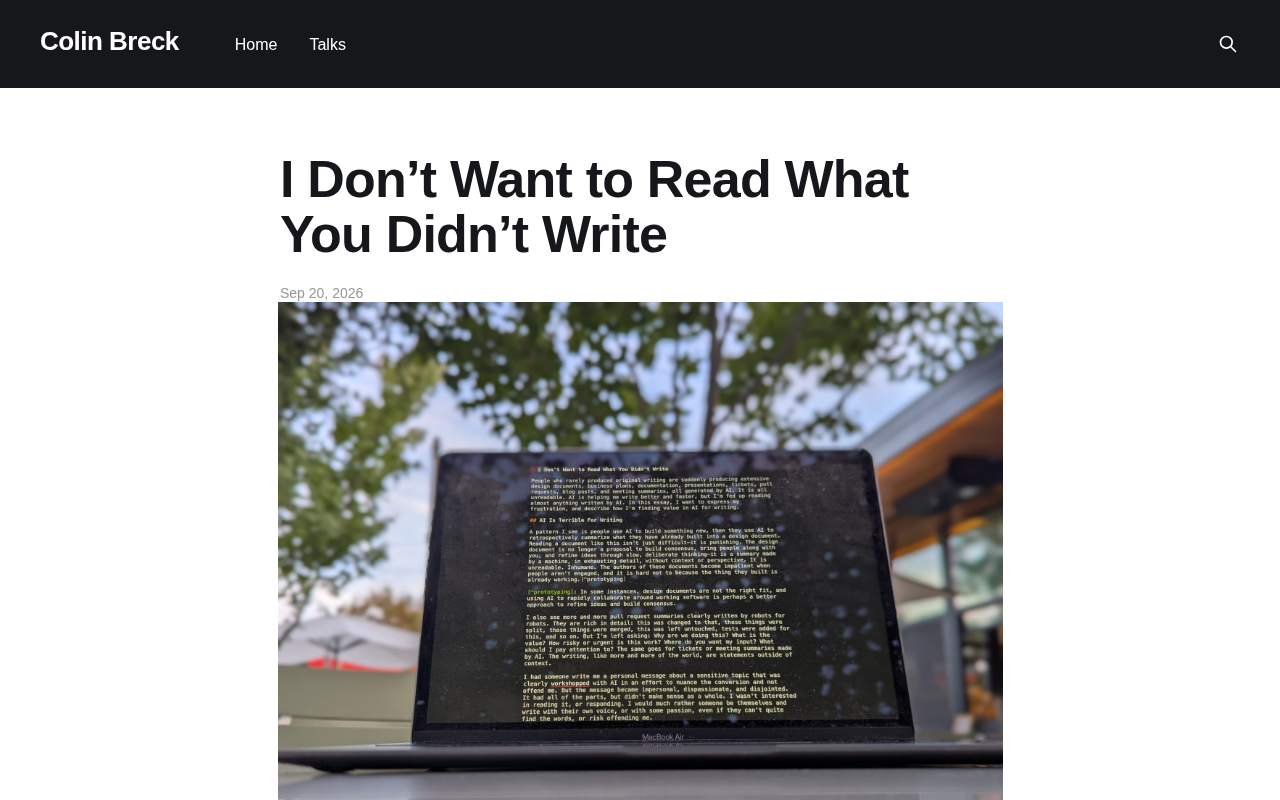
Writing Is Thinking, Not Just Producing Text
Breck's argument is grounded in an ancient and solid observation: writing is a tool for thinking. The act of actually writing something clearly forces the author to untangle logic, identify gaps, and form a coherent point of view. The reason you want to read someone's article in the first place is because you want to know what that person concluded after thinking something through — not to read a probabilistic stitching-together of vast text by a statistical model.
When someone tosses a prompt to a model, copies and pastes the output, and puts their name on it, that chain of thinking is severed. The reader believes they're engaging with a mind that has genuinely wrestled with something; in reality, they're facing hollow words. This "attribution deception" is the core of what the article's title protests — not a rejection of AI itself, but a rejection of using AI to pretend you wrote, thought, and understood something.
The Cost Is Quietly Shifted to the Reader
One perspective worth examining: AI-generated content moves costs from the production side to the consumption side. In the past, writing an insightful article required significant time and effort from the author — and that investment itself served as a quality threshold and a signal of sincerity. When readers encountered a long-form piece, they could reasonably assume a proportional amount of thinking had gone into it.
Now that the cost of generation has approached zero, that signal has completely broken down. Readers are forced to spend extra effort judging for themselves: Is this a genuine insight, or a model hallucination? Is the code in this tutorial something the author actually ran, or an API endpoint the AI invented out of thin air? This verification burden has been quietly handed off to every single reader — and this is precisely what many in the tech industry find infuriating. Their time is being wasted at scale, systematically.
The hallucination problem with large language models is especially dangerous in technical documentation and tutorial content. Hallucination refers to a model outputting information that is factually nonexistent or entirely wrong — with high confidence — including invented function names, nonexistent API parameters, deprecated syntax, and fabricated citations. Such output is nearly indistinguishable in form from correct content: the prose flows, the logic seems coherent, which makes it even harder for readers to stay alert. For engineers who rely on technical articles to solve real problems, hitting one of these errors can burn hours of debugging time before they even consider the possibility that the article itself was simply wrong. This is the hidden cost readers silently absorb — not just reading time, but the cascading investigation costs that follow.
The Divide in the Hacker News Community
With 95 comments, the community response was far from unanimous. A portion of participants strongly agreed with Breck's position, arguing that AI-ghostwritten content lacks soul and accountability, diluting the already-scarce original thinking on the internet.
Another set of voices offered a more nuanced distinction: using AI as a tool versus using AI as a stand-in are fundamentally different things. Using AI to polish language, check grammar, or help organize ideas is morally and practically distinct from having AI generate an entire piece from scratch. The real question, this camp argued, may not be "whether AI was used" but rather "whether the author genuinely thought it through and takes responsibility for the content's accuracy." This distinction elevates the discussion from a simple anti-AI stance to a deeper reflection on writing integrity itself.
Hacker News (HN) is a tech community run by startup accelerator Y Combinator, with engineers, founders, and researchers as its primary user base. It has long been a hub for high-quality discussion in the tech world. The platform uses community voting to rank content, and both post popularity and comment quality are governed by community norms — low-effort, low-information content gets downranked. A blog post earning 257 upvotes and 95 comments on HN typically means it has struck a genuine nerve with the platform's core users, rather than simply being clickbait. This context makes the discussion more representative than most viral controversies on general social media — the participants are largely actual users of AI writing tools and among the most discerning consumers of technical content.
What This Means for Creators
For content creators, this article is a wake-up call. In an era flooded with AI writing tools, readers' attention and trust are depreciating fast. What will cut through the noise and actually be remembered is still writing that carries a distinctive perspective, genuine experience, and personal thought.
Tools can improve efficiency, but they cannot replace thinking itself. When you use AI to generate content, the question you really need to ask yourself is: Is this what I want to express after thinking it through, or am I just outsourcing the thinking because I can't be bothered? Putting your name on something means accepting responsibility — for the accuracy of the content, and for the reader's time. That may be the most practical reminder this whole debate leaves for anyone who writes.
Related articles

Understanding DeepSeek in 3 Minutes: The Rise from a Quant Hedge Fund to an Open-Source AI Leader
DeepSeek's history in 3 minutes: from High-Flyer Quant's compute build-up to V2's MLA inference cost cuts, V3's $5.576M training bill, R1's open-source global shock, and V4 with a $7B Series A.

Local Creative Writing Model Showdown: Fine-tuned Qwen3.8 27B Wins, DeepSeek v4.1 Underwhelms
Bilibili creator tests seven local creative writing models: Hemingway and HumanLike Chat based on Qwen3.8 27B perform best, DeepSeek v4.1 is plain, Dongfang Shuo ranks last with confused characters. Includes three test prompts, scores, and usage advice.

Liang Wenfeng's Three Big Bets: Why Did DeepSeek Open-Source Its 82% Gross Margin?
Why did DeepSeek open-source DeepInfer, its 82% gross margin inference framework, and then launch a hundred-billion funding round? An analysis of Liang Wenfeng's three big bets and the open-source strategy.