IBMARL: A New Framework for Imitation-Bootstrapped Multi-Agent Reinforcement Learning

IBMARL uses round-robin behavior cloning and a gated imitation penalty to help multi-agent RL efficiently surpass demonstration policies.
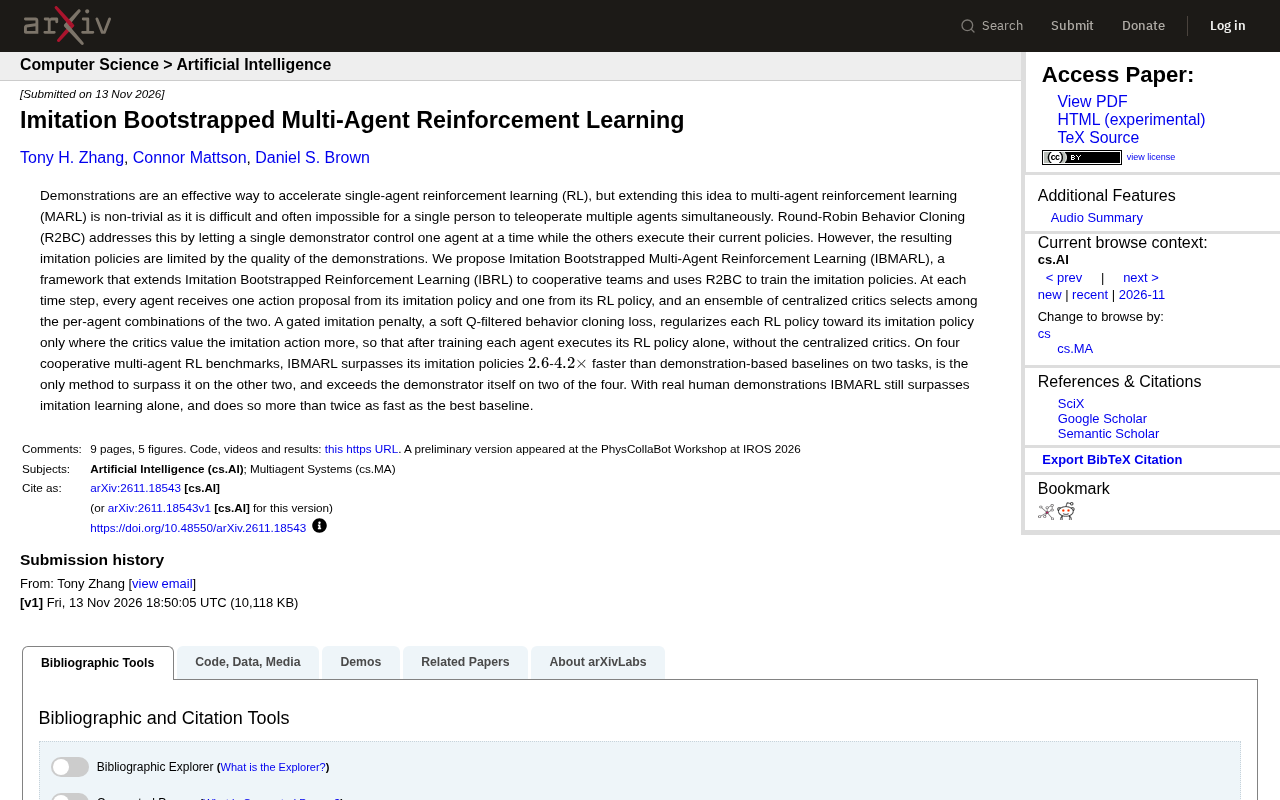
Multi-agent RL has low training efficiency, and single-agent imitation learning is hard to transfer directly since it requires controlling multiple agents simultaneously. IBMARL uses round-robin behavior cloning (R2BC) to generate per-agent imitation policies, and at each step has centralized critics arbitrate between imitation and RL actions, with a gated imitation penalty that regularizes the RL policy toward imitation only when the critic deems the imitation action more valuable. After training, each agent runs its RL policy independently. On four collaborative benchmarks, IBMARL surpasses imitation policies 2.6–4.2x faster than baselines, exceeds the demonstrator on two tasks, and still beats pure imitation learning with real human demos at over 2x speed. Its limitations are reliance on centralized critics during training and unverified generalization.
Multi-agent reinforcement learning (MARL) holds great potential for collaborative tasks, but training efficiency has always been a pain point. Imitation learning can accelerate single-agent RL, yet it hits a wall when extended to multi-agent settings—having a person simultaneously teleoperate multiple agents is both difficult and often unrealistic. A recent paper proposes the IBMARL framework, which cleverly sidesteps this obstacle using "round-robin behavior cloning."
The Core Challenge of Multi-Agent Imitation Learning
In single-agent settings, demonstration data can significantly accelerate RL training. But in multi-agent collaborative tasks, a single demonstrator cannot operate multiple agents simultaneously, which makes directly applying single-agent imitation learning methods unworkable.
Round-Robin Behavior Cloning (R2BC) offers a compromise: the demonstrator controls only one agent at a time while the remaining agents execute the current policy. This can produce an imitation policy, but its quality is limited by the level of the demonstration data—it is hard to surpass the teacher.
Behavior Cloning (BC) is the most basic form of imitation learning. In essence, it treats the demonstrator's "state→action" mapping as a supervised learning target, training a policy network with cross-entropy or mean squared error. Its advantages are simplicity and no need for environment interaction, but it suffers from the classic distribution shift problem: once the policy deviates from the demonstration trajectory at some state, it enters regions not covered by the demonstration data, and errors accumulate and amplify. In single-agent settings, this problem can be mitigated through interactive methods like DAgger; in multi-agent settings, however, because other agents' behaviors are also changing synchronously, the state distribution keeps drifting during training, further amplifying the fragility of behavior cloning. This also explains why the imitation policy produced by R2BC can only serve as a starting point and requires further RL optimization.
How IBMARL Works: Dual Policies and Centralized Critics
IBMARL extends Imitation Bootstrapped Reinforcement Learning (IBRL) to collaborative team settings. At each time step, each agent receives two action proposals: one from the imitation policy and one from the RL policy. A set of centralized critics then selects among the two action combinations for each agent.
The key design is a gated imitation penalty—a soft Q-filtered behavior cloning loss. It regularizes each RL policy toward its imitation policy only where the critics judge the imitation action to have higher value. After training, each agent can execute its RL policy independently, without the centralized critics.
Centralized critics are the core component of the "centralized training, decentralized execution" (CTDE) paradigm in MARL. Each critic takes the global state or the joint observations and joint actions of all agents as input, thereby alleviating the non-stationarity inherent in multi-agent environments during training—because from a single agent's perspective, other agents' policies are continuously updating, making the environment appear constantly changing. Typical examples include MADDPG and QMIX. IBMARL's innovation lies in using critics for action arbitration rather than merely value estimation: for each agent, the critic separately evaluates the Q-values of "imitation action" and "RL action" combined with other agents' actions, selects the better one, and uses this as a gating signal to decide whether to apply imitation regularization. During execution, the critics are discarded, and each agent runs its RL policy relying only on local observations, satisfying the requirement of decentralized execution.
Soft Q-filtering draws on the idea of Q-filtering from offline RL: rather than unconditionally cloning demonstration actions, it uses a value function to filter actions. Specifically, a sample is included in the behavior cloning loss only when the critic estimates the imitation action's Q-value to be higher than that of the RL action; otherwise it is skipped or down-weighted. The intuition is that not every action in the demonstration data is superior to the current policy in terms of long-term return—blind imitation can actually degrade performance. The gating mechanism further turns this filtering into a differentiable or hard switch, allowing the regularization strength to adjust dynamically with training: early in training when the RL policy is weak, it relies more on imitation; later, when the RL policy catches up with or even surpasses the demonstration, the imitation penalty automatically weakens and eventually shuts off, ensuring the policy can ultimately "surpass the teacher."
Benchmark Performance: Surpassing Imitation Policies Faster
On four collaborative multi-agent RL benchmarks, IBMARL demonstrated advantages. On two tasks, it surpassed its imitation policy 2.6 to 4.2 times faster than demonstration-based baselines; on the other two tasks, it was the only method able to surpass the imitation policy; and on two of the four tasks, it even exceeded the demonstrator itself.
When using real human demonstrations, IBMARL still outperformed pure imitation learning, and more than twice as fast as the best baseline.
Significance and Limitations
The value of IBMARL lies in making imitation learning genuinely integrated into multi-agent RL training, rather than remaining confined to the pre-training stage. Through the gating mechanism, the RL policy only moves toward the imitation policy when imitation actions are better, avoiding blind cloning of low-quality demonstrations.
However, the method relies on centralized critics. Although critics are not needed during fully decentralized execution, centralized information is still required during training. In addition, the paper validates only on four benchmarks, and generalization to more complex scenarios remains to be tested.
One-line Summary
IBMARL uses round-robin behavior cloning and a gated imitation penalty to enable multi-agent RL to efficiently surpass demonstration policies.
Paragraph Summary
Multi-agent reinforcement learning suffers from low training efficiency, and single-agent imitation learning is difficult to transfer directly because it requires simultaneously controlling multiple agents. The IBMARL framework uses round-robin behavior cloning (R2BC) to generate imitation policies for each agent, and at each time step has centralized critics arbitrate between imitation actions and RL actions, combined with a gated imitation penalty—regularizing the RL policy toward the imitation policy only when the critics judge the imitation action to have higher value. After training, each agent can execute its RL policy independently. On four collaborative benchmarks, IBMARL surpasses imitation policies 2.6 to 4.2 times faster than baselines, exceeds the demonstrator on two tasks, and still outperforms pure imitation learning with real human demonstrations at more than twice the speed. Its limitations are that it relies on centralized critics during training, and its generalization capability awaits validation in more scenarios.
Related articles

From 0 to 1: Vibe Coding an AI Knowledge Base — A Practical Retrospective and Tech Stack Breakdown
A retrospective on building the AI knowledge base OilBook from scratch with Vibe Coding: Next.js+Neon stack, Oil Dev Skill workflow, Stripe paywall security, interview-style writing, AI-flavor control, and Vercel deployment.

GLM-5.4 Hands-On: Native Vision Meets a New Vibe Coding Workflow
Hands-on with Zhipu GLM-5.4: native vision tested across a 3D product demo, pure-code video generation, and remote-control Vibe Coding, compared with GPT-6.2 and Gemini Neon.

AI and Humans Claim to Prove the Riemann Hypothesis: Machine-Verified, Yet Nobody Can Understand It
Anthropic mathematician and AI Claude claim to prove the Riemann Hypothesis with 17 million lines of Lean code, machine-verified but unreadable by humans. This article analyzes the event, the zero proportion record from 41.6% to 67.2%, and the gap between machine verification and human understanding.