Ideogram 4.5 Lands on Replicate: A New Tool for Multi-Turn, Fine-Grained Image Editing

Ideogram 4.5 lands on Replicate with multi-turn fine-grained image editing for brand assets.
Ideogram 4.5 is now on Replicate, offering ultra-fine multi-turn image editing that lets users progressively refine composition, text, and details instead of regenerating from scratch. Positioned for editorial mockups, brand assets, and artifact-free imagery, it can be integrated into developer workflows via API. Specific parameters and pricing are not yet disclosed, and real-world stability still needs validation.
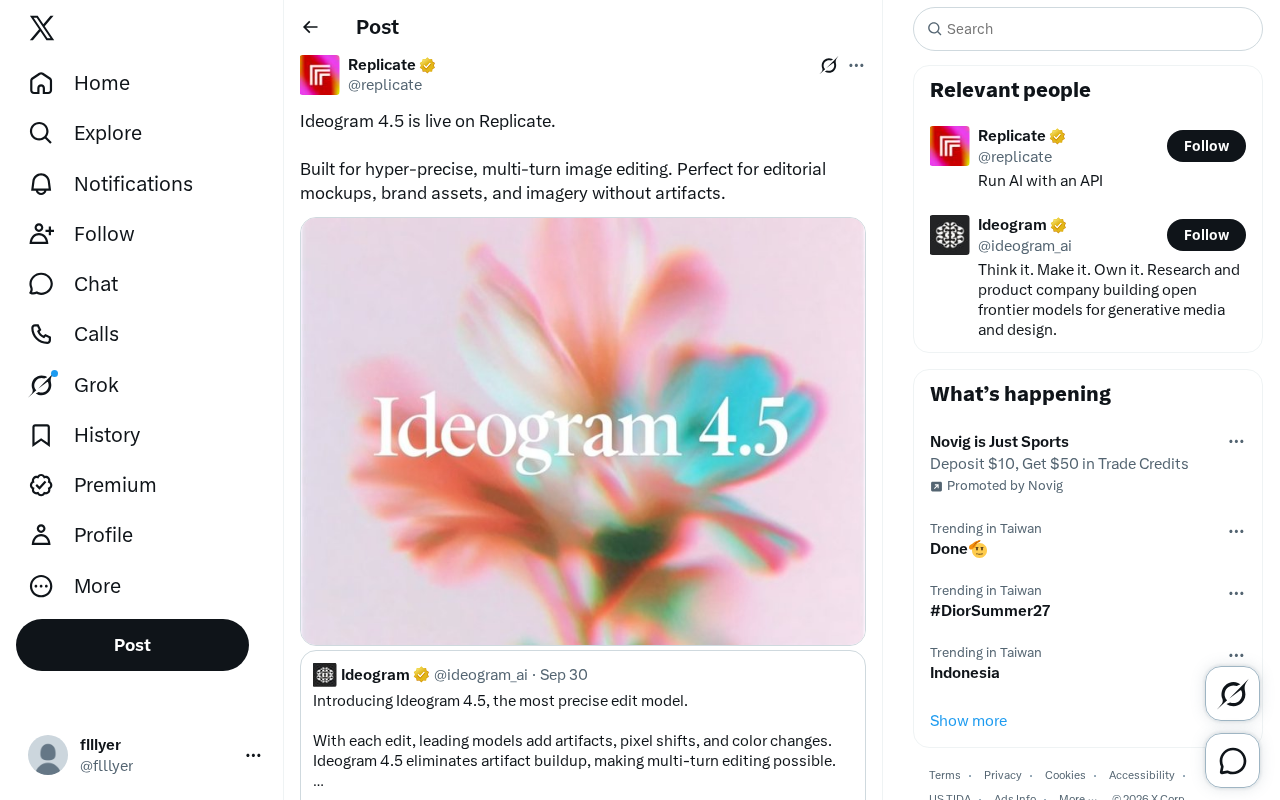
Ideogram 4.5 is now officially available on the Replicate platform, with a focus on ultra-fine multi-turn image editing capabilities. Unlike traditional one-shot generation workflows where the first output is final, it lets users repeatedly adjust an existing image, progressively closing in on the desired result. It is officially positioned as an ideal tool for editorial mockups, brand visual assets, and the creation of imagery without artifacts.
Multi-Turn Editing: From "Rolling the Dice" to Fine-Tuning
The core pain point of traditional text-to-image models is controllability: a slight deviation in the prompt often leaves you with no option but to regenerate, making it hard to make local modifications while preserving the structure of the original image. The multi-turn editing that Ideogram 4.5 emphasizes is essentially turning image editing into an ongoing conversation—each round of modification builds on the previous result, allowing users to progressively refine composition, text, and details.
This is clearly significant for creative workflows that require repeated fine-tuning. Take editorial mockups as an example: cover layout, headline text, and image proportions often need to be compared across multiple versions, and multi-turn editing can substantially reduce the waste of "starting over from scratch."
Multi-turn editing borrows the concept of "multi-turn interaction" from conversational AI: the model receives new editing instructions in each round and generates conditioned on the previous round's output image, rather than resampling from a text prompt each time. From a technical standpoint, this requires the model to have stable image-conditioning capabilities (such as inpainting and instruction-based editing) and to suppress error accumulation across iterations—otherwise details degrade round by round. Compared with one-shot text-to-image generation, multi-turn editing is closer to the way traditional photo-editing software works, but replaces selections and layers with natural language, which places higher demands on the model's ability to understand local instructions while maintaining global consistency.
Targeting Brand Assets and Imagery Without Artifacts
The official description specifically mentions brand assets and imagery without artifacts. Brand assets have extremely high consistency requirements: logo placement, color guidelines, and typography style must not drift. The value of multi-turn editing is that users can first lock in the overall framework and then correct details item by item, rather than introducing new random deviations with each generation.
As for the artifact problem, it has long been a stumbling block for generative imagery in production. By making "artifact-free" a selling point, Ideogram 4.5 indicates that it has made targeted optimizations in detail restoration and edge handling, but actual results still need to be verified in real-world scenarios.
Artifacts refer to visual errors in generated images that do not conform to real imaging patterns. Common types include: broken or garbled text strokes, abnormal finger counts, edge aliasing and halos, texture repetition, local blurring, and structural misalignment. Their causes are mostly related to the decoding process of diffusion models, the distribution of training data, and the ability to model details at high resolution. For brand assets, artifacts are fatal—a distortion at the edge of a logo can make the material unusable commercially. The industry typically mitigates this through higher-resolution training, post-processing super-resolution, local repainting, and manual screening. Making "artifact-free" a product selling point implies that the model has been specifically optimized in high-frequency error areas such as text rendering and edge handling.
What It Means to Launch on Replicate
Replicate is known for API-based invocation and model hosting. Ideogram 4.5 landing on this platform means developers can directly integrate multi-turn editing capabilities into their own products and workflows through the interface, without having to build their own inference environment. For teams that need to process brand materials in bulk, this is a lighter-weight integration path.
At present, the officially disclosed information focuses on capability positioning; specific parameters, pricing, and usage limits have not yet been detailed in the source material. Teams that are interested are advised to first run small-scale tests on Replicate, focusing on verifying the stability of multi-turn editing and detail fidelity, before deciding whether to incorporate it into production workflows.
Overall, Ideogram 4.5 targets a key link in generative imagery's transition from "usable" to "good to use"—controllability and iterability. Whether multi-turn fine-tuning can truly replace repeated regeneration depends on its performance in real editing tasks.
Replicate is a model hosting and inference API platform. Developers can call open-source or commercial models hosted on the platform through a REST API without building their own GPU environment, and are billed by usage. Its typical value lies in unified interface wrapping, on-demand scalable inference resources, and reproducible model version management. For image-editing models, API integration means multi-turn editing can be embedded into CMSs, design tools, or e-commerce asset pipelines, with programs managing session state and image versions. It is worth noting that multi-turn editing involves passing intermediate images across multiple calls, so integrators need to design their own state management and storage solutions.
One-line Summary
Ideogram 4.5 launches on Replicate, focusing on multi-turn fine-grained image editing for brand asset scenarios.
Paragraph Summary
Ideogram 4.5 is officially available on the Replicate platform. Its core capability is ultra-fine multi-turn image editing: users can repeatedly adjust composition, text, and details based on the previous round's result, progressively approaching the target effect, rather than regenerating from scratch every time a prompt deviates. It is officially positioned as an ideal tool for editorial mockups, brand visual assets, and artifact-free image creation, emphasizing consistency and artifact control. Launching on Replicate means developers can integrate multi-turn editing into their own products and bulk asset workflows via API, lowering the barrier to building their own inference environments. Specific parameters, pricing, and usage limits have not yet been disclosed, and actual multi-turn stability and detail fidelity still need verification in real-world scenarios. Overall, the model targets the controllability and iterability link in generative imagery's transition from "usable" to "good to use."
Related articles

Chain of Thought Isn't Just for AI: How Humans Can Use CoT to Improve Thinking Quality
Chain of Thought isn't just a prompt trick for large models. Starting from a Hacker News discussion, this article analyzes why CoT works for human thinking too, breaks down actionable ways to transfer it, and highlights the key differences between human CoT and machine CoT.
Cloudflare Teams Up with OpenAI: Closi…
Cloudflare Teams Up with OpenAI: Closing the Loop from Vulnerability Discovery to Defense with AI
Cloudflare uses OpenAI Daybreak to investigate security vulnerabilities and generate reviewable remediation plans, while developers use Codex to boost coding efficiency and quality.

Orca Multi-Agent Orchestration in Practice: A Guide to Parallel Collaboration with Claude and Codex
Orca is Stable AI's free open-source agent workbench supporting 34 agents like Claude Code and Codex in parallel. Learn its Git worktree isolation, multi-model orchestration, and mobile management.