Ideogram 4 Local Deployment Test: Cinematic Quality on 8GB VRAM

Ideogram 4 delivers Midjourney-level aesthetics locally on 8GB VRAM with an automated ComfyUI workflow.
Ideogram 4 is an open-source image generation model that rivals Midjourney's aesthetic quality while running on modest hardware (8GB VRAM + 32GB RAM). It excels at cinematic visuals, realistic portraits, and text rendering. Its structured JSON prompt system has a steep learning curve, but a fully automated ComfyUI workflow powered by Qwen3 VL handles prompt formatting automatically — making it highly accessible for local deployment users.
A New Open-Source Image Model: Ideogram 4
The open-source community recently gained a highly talked-about image generation model — Ideogram 4 (also nicknamed "Idio 4" among Chinese users). Its biggest selling point: visually striking output with an aesthetic sensibility that rivals Midjourney, while supporting local deployment on mid-to-low-end hardware with just 8GB VRAM and 32GB RAM.
It's worth noting that open-source image generation models have evolved through multiple generations — from Stable Diffusion 1.x and SDXL to the Flux series. Ideogram 4 marks a new phase in this space, where aesthetic quality is genuinely beginning to match commercial closed-source models while retaining the core advantage of local deployment. Midjourney became the industry's aesthetic benchmark partly because it underwent extensive aesthetic preference tuning via RLHF (Reinforcement Learning from Human Feedback), and incorporated high-quality visual design materials into its training data.
RLHF was originally developed by OpenAI for language model alignment and has since been widely adopted in image generation. The core process involves first training a Reward Model that learns aesthetic scoring from large volumes of human-annotated image preference pairs ("A is better than B"), then using that reward signal to guide parameter updates in the generation model, nudging outputs toward human aesthetic preferences. Midjourney heavily adopted this mechanism in its early iterations, continuously refining its style by collecting implicit preference signals from users' Upscale and Favorite actions on Discord. For open-source models, the primary obstacle to achieving similar results is the lack of large-scale real user interaction data. Some teams have turned to the LAION Aesthetics scoring dataset or open-source reward models like ImageReward as alternatives. Ideogram 4 positioning itself against this benchmark suggests its training pipeline similarly involved comparable data filtering and aesthetic score fine-tuning.
For local deployment enthusiasts long frustrated by the high barriers and costs of closed-source models, this is a signal worth paying attention to. This article combines hands-on testing to break down the model's strengths, limitations, and how a "fully automated workflow" can dramatically lower the barrier to entry.
Strength 1: Genuinely Compelling Aesthetic Quality
The first impression of Ideogram 4's output is that it has texture. Unlike many models that produce flat, atmosphere-free images, it more readily delivers a sense of sophistication in lighting, composition, and color grading.
It particularly excels in directions that demand photographic realism, cinematic feel, and design sensibility — scenes like posters, brand visuals, and cinematic character portraits all tend to yield satisfying results.
Interestingly, its portrait style leans toward realism. When generating real people, Ideogram 4 keeps skin texture intact and avoids rendering faces as flawlessly perfect — the overall result is closer to reality than to the heavily filtered "influencer face" aesthetic. This stylistic tendency stems from the distribution of its training data. Compared to models trained predominantly on heavily retouched commercial portraits, Ideogram 4's training set preserves more photography with natural skin textures and authentic lighting, giving its output a documentary photography–like quality.
This characteristic cuts both ways:
- Users who prefer polished, clean, idealized portraits may find it "not pretty enough";
- Users who appreciate natural, photographic, or artistic portraiture will find it full of character.
In short, it's not a model that renders every face from the same template — it takes a more authentic, artistic approach.
Strength 2: Reliable Text Rendering
The Ideogram series has always had a traditional strength in text rendering, and Ideogram 4 continues that legacy.
The reason image generation models generally struggle with text comes down to fundamentals: mainstream diffusion models perform iterative denoising in pixel space, and the precise stroke structure of text is extremely sensitive to this process — even minor noise perturbations can cause characters to collapse. At a deeper level, the training objective of diffusion models is to maximize the log-likelihood of pixel distributions, not to recognize the semantic structure of characters. This means the model's "learning" of text strokes is essentially a form of visual texture simulation rather than true glyph understanding. The Ideogram series specifically addressed this pain point — according to public information, additional structural constraint loss functions were introduced in text regions, significantly improving text generation stability compared to general-purpose image models.
Many image generation models produce great visuals but fall apart the moment text appears — missing letters, garbled characters, distorted letterforms, broken layouts.
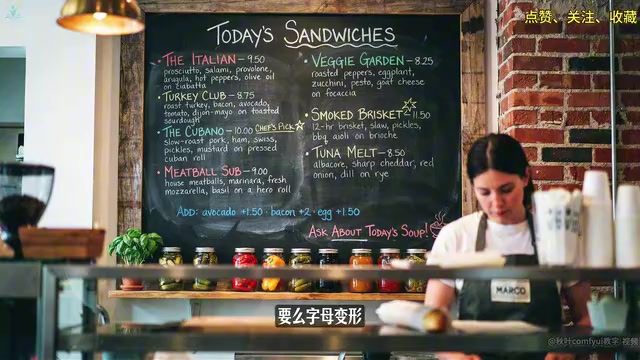
In contrast, Ideogram 4 achieves notably higher success rates with short English headlines, brand slogans, and poster copy — making it especially well-suited for posters, covers, product promotional materials, and text-bearing social media content.
That said, it's not 100% accurate. Chinese text or longer content still requires multiple attempts to get satisfying results.
The Pain Point: Structured Prompts Have a High Learning Curve
One of Ideogram 4's biggest friction points is the official structured prompt template. It's thorough and carefully designed, but filling it out properly is genuinely tedious. Many users just want to quickly generate an image — opening the interface and seeing a wall of fields may cause them to give up before they ever hit generate.
The key to understanding this system: Ideogram 4 prompts are not a single descriptive sentence — they're an "image generation specification". A complete JSON prompt is organized into three main sections:
Breaking Down the Three-Part Structure
Part 1: High-Level Description
Summarize the entire image in one sentence. For example: "A young woman with long hair sitting atop a giant caramel-colored bucket bag, the scene conveying a soft, romantic fashion advertisement atmosphere."
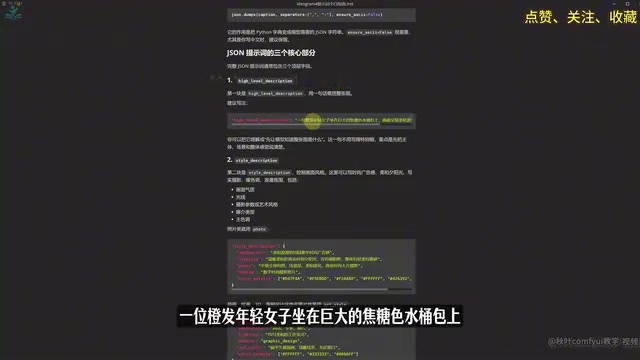
Part 2: Style Description
Controls the visual style. For photographic results, use photo (e.g., fashion ad feel, soft sunset light, realistic photography, warm tones); for illustrations, 3D, poster design, or other non-photographic effects, use art style. Don't use both simultaneously.
Part 3: Compositional Deconstruction
background: describe the background environment;elements: list the main visual elements in the scene;- Elements can be given bounding boxes (0–1000 coordinates) to control their position in the frame;
- A
color palettecan be specified (e.g., caramel, moss green, rose pink, sunset gold).
Bounding boxes are a standard computer vision technique for localizing regions within an image, typically expressed as normalized coordinates (0–1 or 0–1000) representing the top-left and bottom-right corners of a rectangle. The concept originated in object detection tasks (e.g., YOLO, Faster R-CNN frameworks) for annotating the spatial positions of objects. Introducing this mechanism into Ideogram 4's prompt structure allows users to precisely specify the spatial placement of each visual element within the frame — a significant structural extension beyond traditional free-form natural language prompts. This approach shifts image layout from "model-decided" to "user-explicitly-constrained," which is one of the key reasons Ideogram 4 produces more predictable results with more stable compositions than general-purpose models.
The core logic: first describe what the overall image is, then describe the desired style, then the background, then break down the subject and key elements clearly. The more structured the prompt, the more stable and on-target the output.
The Solution: A Fully Automated ComfyUI Workflow
To address these friction points, the prompt rules can be compiled into an instruction template and embedded directly into a ComfyUI workflow. Users don't need to hand-write complex JSON or memorize field names.
ComfyUI is a Stable Diffusion frontend built on a node graph architecture, drawing design inspiration from professional visual effects software (such as Nuke and Blender Compositor). Each node represents a processing step (text encoding, latent space sampling, image decoding, etc.), and nodes connect via data flows — naturally supporting the chaining of multiple AI model calls into a fully automated pipeline. In the workflow described here, the LLM node essentially acts as a "prompt compiler": translating the user's natural language intent into the structured instruction format the model prefers, similar to a DSL (Domain-Specific Language) transformation layer in software engineering. This architecture makes it very natural to insert an LLM prompt conversion step before image generation — the user's natural language description is processed by the LLM node, automatically output as structured JSON in Ideogram 4's required format, then passed to the sampler node for generation.
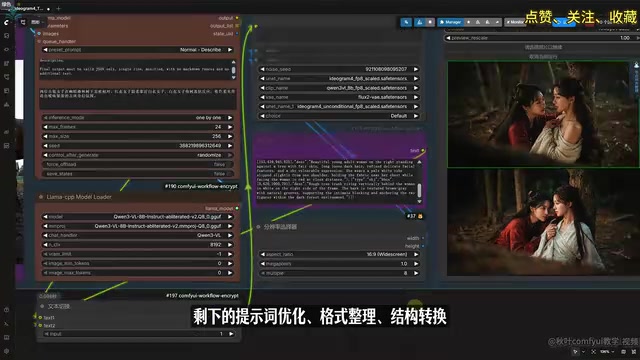
Streamlined Usage
In practice, you only need to care about two things:
- What image you want to generate (a simple description in the input field is enough);
- What aspect ratio you want.
All prompt optimization, formatting, and structural conversion is handled automatically by the workflow.
The key behind the workflow is the integration of Qwen3's VL 8B text model and image-vision encoding model. Qwen VL (Vision-Language) is a multimodal large language model series developed by Alibaba, capable of understanding both image and text inputs, with strong performance in image captioning, visual question answering, and cross-modal reasoning. Its technical foundation connects a visual encoder (typically based on a ViT architecture) to a language model via a cross-modal alignment layer, enabling visual features to be directly processed by the language model's attention mechanism. The 8B parameter version maintains relatively low computational resource requirements while providing sufficient language understanding and generation capability — making it particularly well-suited as an intermediate processing layer for prompt expansion and format conversion. When you input a simple description, the model automatically expands it into a complete, structured JSON format preferred by Ideogram 4, then passes it to the sampler for generation.

Image Reverse-Engineering Mode
If you don't even want to write prompts, there's an "image reverse-engineering" template: replace the prompt conversion instruction with an image reverse-engineering instruction, remove the hand-written prompt, drop in a reference image, and click generate. The workflow will automatically derive a prompt from the reference image and proceed with generation. This approach leverages Qwen VL's image understanding capability to convert an input image into a structured description in Ideogram 4's format, using it as the starting point for secondary creation — useful for style transfer or generating variations of existing assets. Technically, this is an "image → text → image" round-trip conversion process, and its quality ceiling is determined by how deeply the vision-language model understands the original image.
Small Model, Big Results
The most impressive aspect of this combination is that several models running at around 8GB each can produce output of this quality. These aren't tens or hundreds of gigabytes of massive models, yet they can cover diverse directions — portrait photography, product posters, dreamy commercial aesthetics, realistic styles — with genuine aesthetic sensibility in lighting, color, atmosphere, and textural realism.
From an architectural perspective, Ideogram 4's ability to achieve high-quality output at a relatively small parameter scale is largely attributable to the adoption of the Diffusion Transformer (DiT) architecture, along with targeted data mix optimization. DiT was proposed by Meta AI Research in 2022, with the core innovation of replacing the previously dominant U-Net backbone with a Transformer. U-Net relies on the local receptive field of convolutional layers for feature extraction, while the Transformer's self-attention mechanism can capture global dependencies within an image — giving the model an advantage in understanding holistic visual properties like composition and lighting distribution. In the diffusion process, DiT divides the image latent space into patches, injecting timestep and conditioning information into each layer via adaLN (adaptive layer normalization). This architecture achieves significantly better FID (Fréchet Inception Distance) scores than contemporary U-Net models at the same parameter scale, with better scalability. Compared to earlier U-Net–based diffusion models, the DiT architecture strikes a more favorable balance between parameter efficiency and generation quality — which is why mainstream high-quality image models in recent years (including Flux, SD3, and others) have broadly shifted to this architecture.
Additionally, its understanding of Chinese prompts is quite capable — no need to translate into English every time; describing in Chinese directly works fine.
For local deployment users or those with limited VRAM, the "Ideogram 4 + Qwen3 VL automated workflow" combination offers considerable practical value: it lowers the barrier to entry while preserving output quality.
Summary
Ideogram 4 represents a new direction for open-source image models: delivering aesthetic quality, text rendering capability, and realism while bringing hardware requirements within reach of mid-to-low-end setups. While limitations remain — particularly in polished portraiture, long-form text, and Chinese character rendering — paired with an automated ComfyUI workflow, it can already provide stable, usable output for most creative use cases. Users seeking authentic photographic realism and design sensibility will find it well worth trying.
Related articles
SoulFlow-Orchestrator: A Self-Hosted, Vendor-Lock-In-Free AI Agent Runtime
SoulFlow-Orchestrator is an open-source, self-hosted AI agent runtime with no vendor lock-in. Supports 9 neutral backends (Claude, OpenAI, Ollama), 141-node workflow engine, multi-agent loops, and HITL gates.
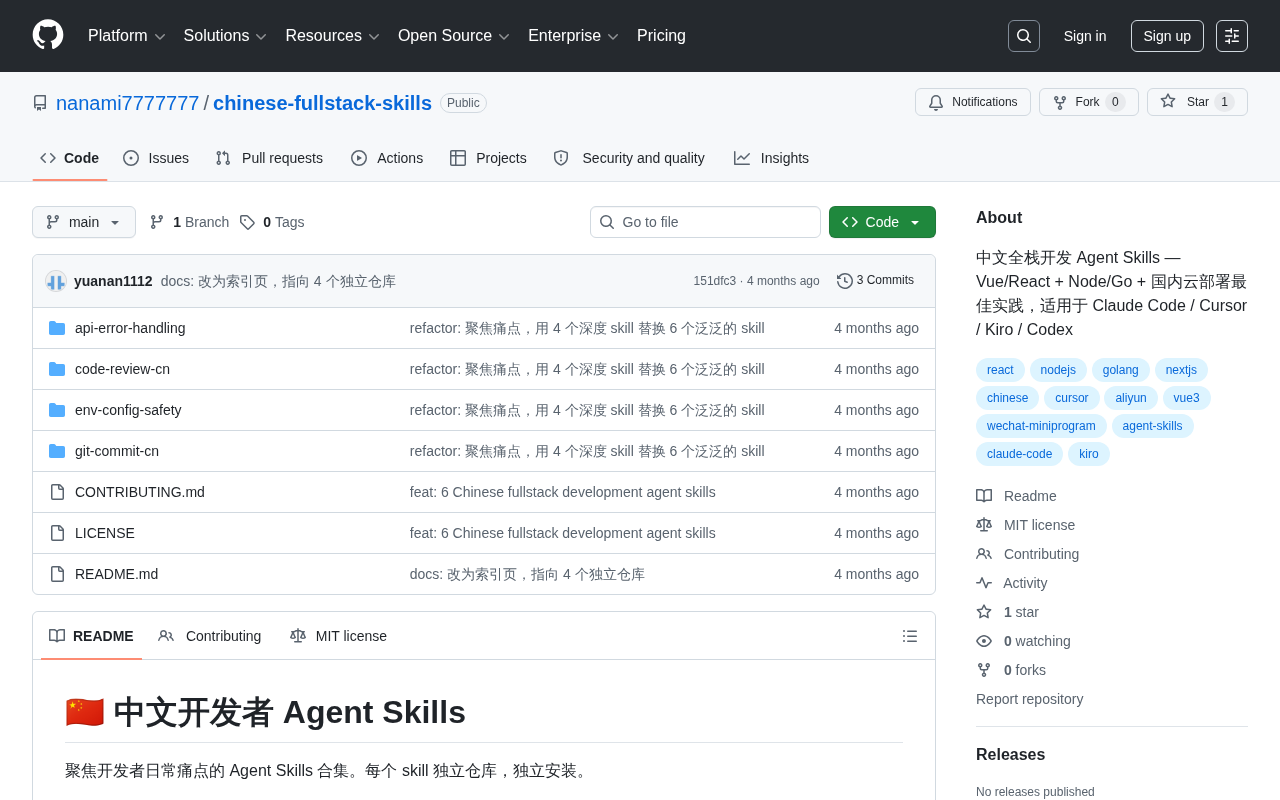
Chinese Full-Stack Agent Skills: A Skill Library Tailored for Domestic AI-Assisted Development
chinese-fullstack-skills is an Agent Skills library for Chinese full-stack development, covering Vue/React, Node/Go, and domestic cloud deployment best practices. Compatible with Claude Code, Cursor, Kiro, and Codex.
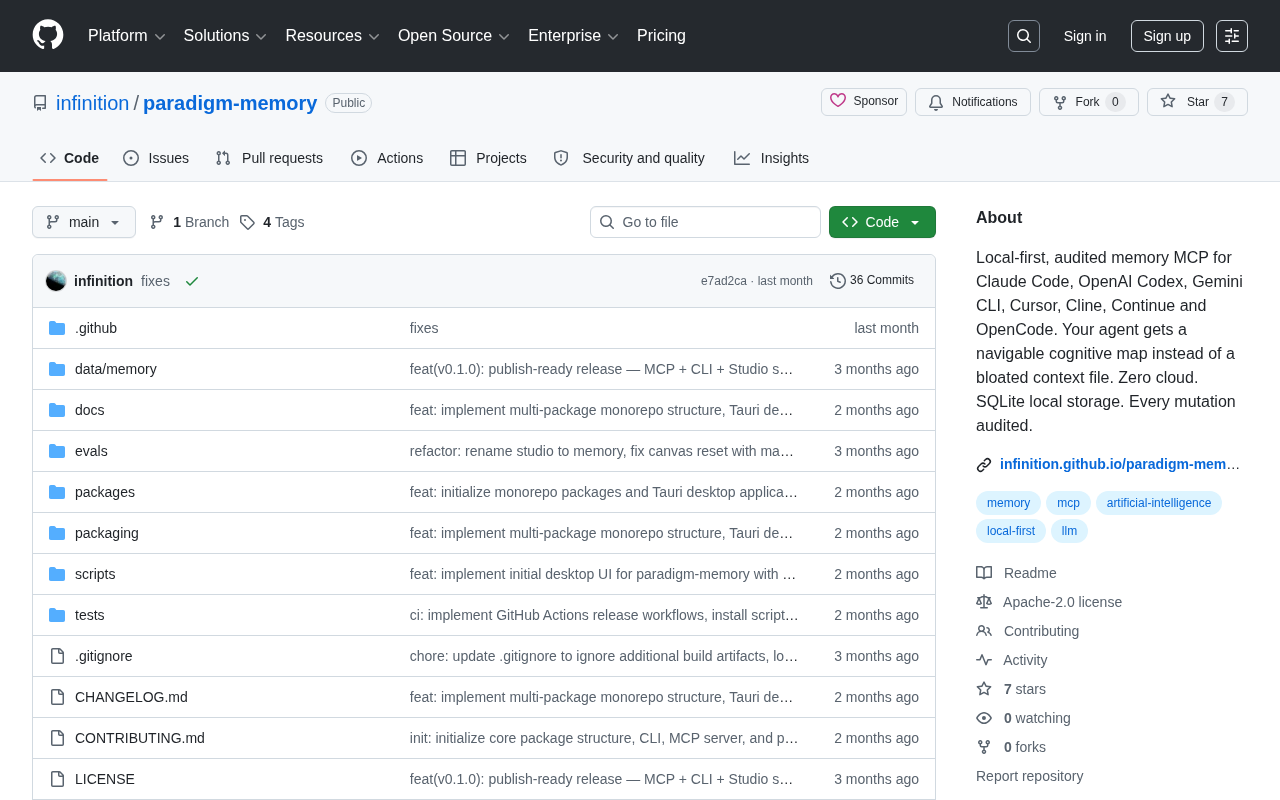
Paradigm Memory: A Local-First Memory System for AI Coding Assistants
paradigm-memory is a local MCP memory tool for Claude Code, Cursor, and Cline. It uses SQLite local storage, zero cloud, full audit trails, and a navigable cognitive map instead of bloated context files.