If Every Photo and Text Leaked: A Privacy Doomsday Thought Experiment
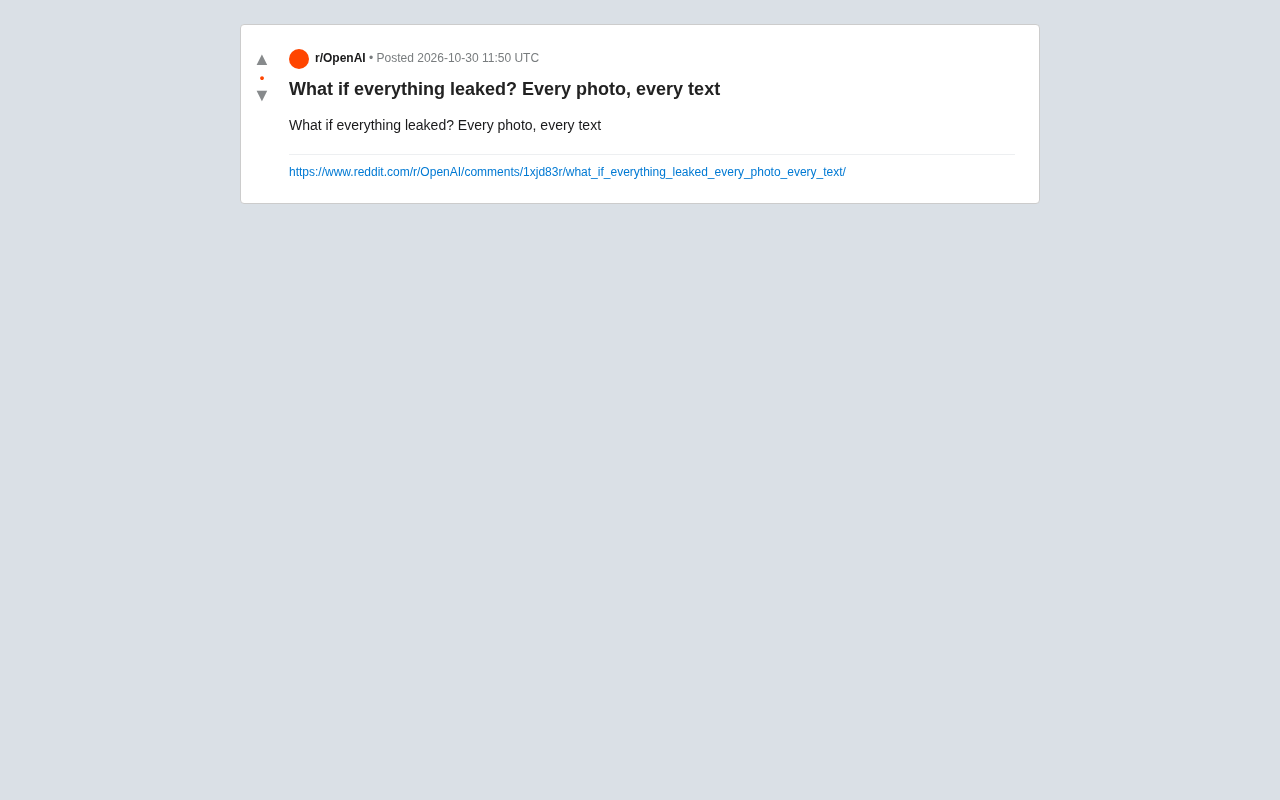
A one-line Reddit hypothetical—"what if everything leaked"—forces us to confront the deep fear of panoptic digital exposure.
Starting from an extreme Reddit hypothetical—"what if every photo and text leaked"—the article explores the nature of privacy anxiety in the digital age. What leaks was never just content, but the ability to present ourselves contextually. Technically, total exposure isn't far-fetched: scattered personal data combined with AI-powered correlation makes it possible through stacked small leaks. The article ends with three practical responses: minimize exposure, accept irreversibility, and change sharing defaults.
A single-sentence post on Reddit sparked a massive discussion: "What if everything leaked? Every photo, every text." No technical details, no case studies—just a precise hit on the deepest anxiety of the digital age: what would our lives look like if privacy leaks went from "might happen" to "happened to everything"?
What This Discussion Is Really Asking
The post itself offers no answers, but the question it raises is sharper than most privacy debates. Usually when we discuss leaks, the scope is a single data breach, a single platform, a single batch of users. But "everything leaked" pushes the variable to its limit: not partial exposure, but total disclosure—every photo, every text message, every chat log that was supposedly deleted.
The value of this extreme hypothetical is that it forces us to confront a fact we usually ignore on purpose: our digital lives have long been panoptic—it's just that the fragmentation of leaks makes us think we still have an exit. When all the fragments assemble into a complete picture, there is no exit.
What Leaks Was Never Just Content
A single photo leaking might just be embarrassing; all photos leaking is a complete dossier of your movements. A single text leaking might be trivial; all texts leaking is a psychological profile—your spending habits, relationships, mood swings, even the things you've said to yourself.
One consensus implicit in the Reddit discussion: the real value of privacy isn't in hiding secrets, but in controlling how information is presented. We show different versions of ourselves to different people in different contexts—this is a basic mechanism of how society functions. Total exposure doesn't destroy secrets; it destroys the ability to express ourselves contextually.
Technically, "Everything Leaked" Is Not Far-Fetched
From an attack-surface perspective, the fragmented storage of personal data is actually the biggest risk factor. Photos live in cloud albums, texts in instant messengers, payment records in finance apps, location in system services—every entry point is a potential leak. An attacker doesn't need to breach one super-system; they just need enough local data, then correlate and stitch it together.
What's more alarming is that AI has drastically lowered the cost of that stitching. Cross-platform data that once required manual comparison can now be automatically correlated by models. Facial recognition binds photos to identity; natural language processing binds text to real personality. "Everything leaked" doesn't technically require a single catastrophic event—it can be built from countless small-scale leaks stacked together.
End-to-End Encryption (E2EE) is an encryption method where only the communicating parties can read message content: data is encrypted at the sender, decrypted at the receiver, and intermediaries like service providers only transmit ciphertext they cannot decrypt. It's repeatedly mentioned in privacy discussions because it partially decouples "the platform being breached" from "the content being leaked"—even if the server falls, the attacker only gets ciphertext. But E2EE is not a panacea: it protects the transmission and storage phases, but cannot prevent the recipient from taking screenshots, the device from being infected with malware, or the account itself from being taken over. So it's a tool for "reducing the consequences of a single-point leak," not the ultimate answer under the "everything leaked" hypothetical.
Data linkage / re-identification refers to matching seemingly anonymous data fragments from different sources through common identifiers (such as device IDs, timestamps, location trajectories, facial features) to reconstruct a person's identity and full behavioral profile. Its danger lies in this: a single dataset may be de-identified and appear harmless, but the intersection of multiple datasets drastically narrows the candidate pool until it uniquely locks onto one person. AI's involvement turns this step from manual comparison into something automated and at scale—which also explains why "everything leaked" can be achieved by stacking multiple small-scale leaks, without breaching all systems at once.
Why This Topic Resonates on Reddit
Reddit's user base consists mainly of deep internet users, who are more attuned to digital footprints than average users. The popularity of this post shows one thing: when people discuss privacy, what they truly fear isn't the data itself being seen, but that the "complete version" of themselves being seen can no longer be accepted by society.
This fear has a real basis. Once digital content leaves its original context, the power of interpretation shifts to the viewer. A photo taken in a specific situation may be read as something completely different in another context. Total exposure means all contexts collapse simultaneously.
Facing the Extreme Hypothetical: What Real Responses Look Like
This topic offers no solutions, but it points to several directions worth taking seriously.
Minimize the exposure surface. Not all data is worth uploading to the cloud. Local storage, end-to-end encryption, regularly clearing history—these basic practices remain effective even under the extreme "everything leaked" hypothetical: reducing total data volume is reducing the attack surface.
Accept irreversibility. Digital footprints already created cannot be retracted. Rather than fantasizing about complete deletion, it's better to focus energy on controlling the quality of new data.
Re-examine the default value of "sharing." Most platforms default to encouraging sharing, and user inertia turns those defaults into de facto standards. Proactively changing default settings is the lowest-cost privacy protection action.
This Reddit post ultimately reaches no conclusion, but the question it raises is worth every internet user pausing to consider: if all your content were made public tomorrow, would you behave differently today? If the answer is yes, that means the current defaults are the problem.
One-line Summary
A single Reddit hypothetical—"what if everything leaked"—forces us to confront the deep fear of panoptic exposure in digital life.
Paragraph Summary
Starting from an extreme Reddit hypothetical—"what if every photo and every text leaked"—the article explores the nature of privacy anxiety in the digital age. The author points out that what leaks was never just content, but the ability to present ourselves contextually—the core value of privacy lies in controlling how information is displayed, not merely hiding secrets. Technically, "everything leaked" is not far-fetched: personal data is scattered across multiple platforms, and attackers only need enough local data to correlate and stitch together, with AI drastically lowering that cost. The resonance among Reddit users reveals a deeper fear: the "complete version" of oneself being seen can no longer be accepted by society. The article concludes with three practical directions: minimize the exposure surface, accept the irreversibility of digital footprints, and proactively change platforms' sharing defaults.
Related articles
Agentic Coding with Small Models: 100x Lower Cost, Double the Success Rate
Explore how to build efficient agentic coding workflows with small language models, balancing cost, privacy, and latency. Learn about model types, local running advantages, evaluation methods, and practical tips to achieve 100x lower cost and double the success rate.
Jetpack AppState: Taking Compose State Beyond the UI Layer
Jetpack AppState extends Compose snapshot state into the data and domain layers: transform uses headless composition to derive state, and State Store enables cross-component sharing and persistence, solving Flow orchestration and process-death pain points.

Android Developer Verification: Four Paths and Global Rollout Timeline
Android Developer Verification explained: Google unveils four verification paths—Play developers, independent distributors, students/hobbyists, and power users—plus developer console API automation, 24-hour safety delay, and global phased enforcement timeline.