If Jensen Huang Were Replaced, Would Open Source AI Change? Reddit Debates
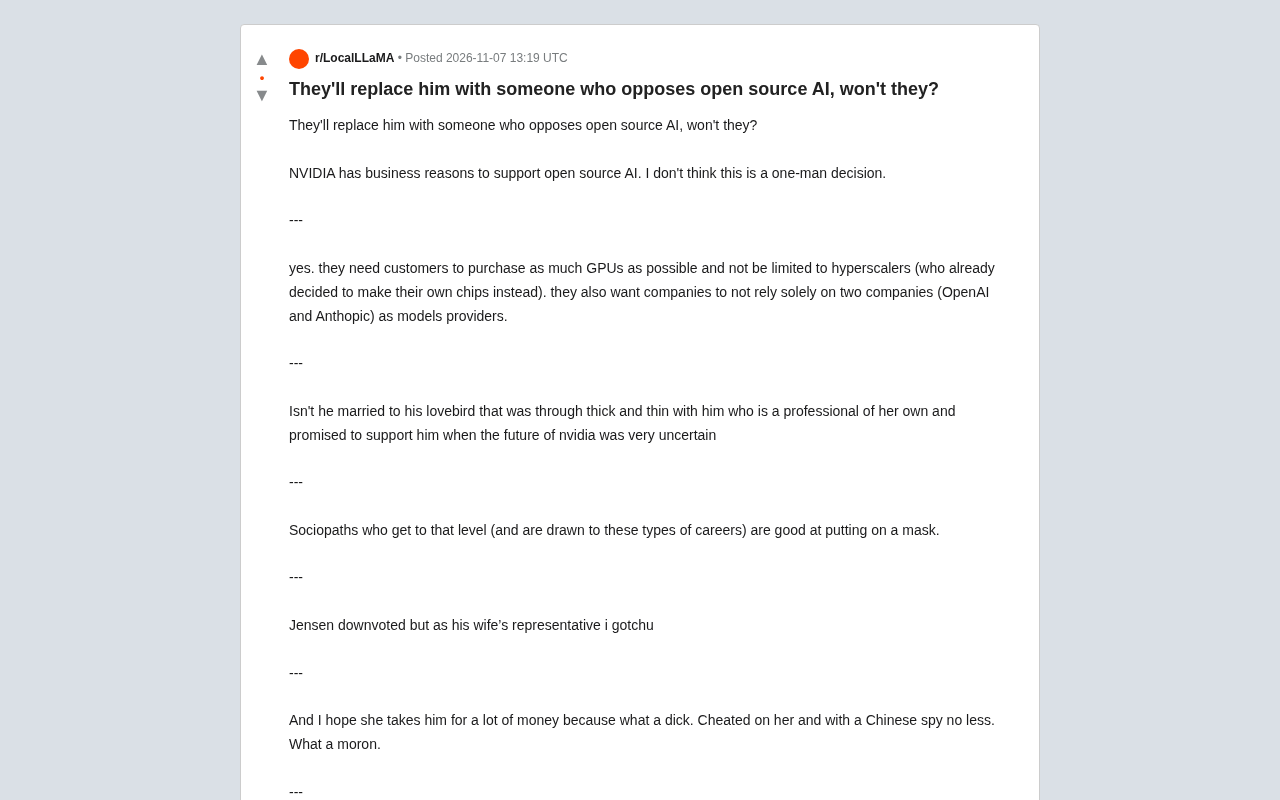
Reddit discussion argues Nvidia's support for open source AI stems from business interests, not Jensen Huang's personal preference, and leadership changes won't reverse it.
The article centers on a hypothetical Reddit question: If Jensen Huang were replaced, would Nvidia turn against open source AI? The mainstream view is that Nvidia's support for open source AI is based on clear business logic—open source models lower the barrier to AI R&D, activate long-tail customer demand for GPUs, and avoid over-reliance on large customers like OpenAI and Anthropic that may develop their own chips. The trend of hyperscalers developing their own chips further strengthens this strategy. Although the discussion includes speculation about Jensen Huang's personal life and geopolitics, it is weakly related to the main line of open source AI. The conclusion: Nvidia's business interests are deeply tied to the open source ecosystem, and leadership changes are unlikely to completely reverse this direction.
A Debate Sparked by a Hypothetical
A Reddit user's question set off ripples of discussion: If Jensen Huang were replaced, would Nvidia turn against open source AI? This hypothetical seems far-fetched, but it touches the most sensitive nerve in the current AI hardware and software ecosystem—is the fate of open source models tied to one person, or to business logic?

The discussion quickly split into several viewpoints. Some argued that Nvidia's support for open source AI is not Jensen Huang's personal passion, but stems from clear business interests. Others, from a more human angle, commented on Jensen Huang's personal life, but these topics have little to do with the direction of open source AI. Still others turned their attention to geopolitics, speculating whether there is a power struggle behind the scenes.
Business Logic: Open Source Is Nvidia's Customer Strategy
One commenter hit the core: "Nvidia has business reasons to support open source AI. I don't think this is one person's decision." This statement received much agreement.
Supporting open source models is a multi-benefit strategy for Nvidia. First, open source models lower the barrier to AI research and development, allowing more companies and research institutions to participate, and they all need GPUs for training and inference. Second, Nvidia does not want customers to rely solely on OpenAI and Anthropic as model providers, because these two companies have their own computing power arrangements and may even develop their own chips. Nvidia needs a thriving model ecosystem to ensure GPU demand is not concentrated among a few hyperscale customers.
The comments explicitly pointed out that hyperscalers have already decided to develop their own chips, and Nvidia must support a broader customer base to maintain growth. Open source models can precisely activate the long-tail market. Therefore, even if leadership changes, as long as Nvidia's business model remains the same, support for open source AI is hard to reverse.
Hyperscalers refer to large cloud service providers such as Amazon AWS, Microsoft Azure, Google Cloud, and Meta, which operate millions of servers. These providers are the largest buyers of GPUs, but in recent years they have all launched their own chip initiatives: Google has TPU, Amazon has Trainium and Inferentia, Microsoft is investing in Maia, and Meta also has MTIA. The purpose of developing their own chips is to reduce dependence on Nvidia and optimize the cost of specific workloads. For Nvidia, this means its largest customer base may gradually reduce the proportion of external GPU purchases, so it must expand a more diversified customer base—and small and medium-sized companies, research institutions, and startups in the open source model ecosystem恰好 constitute such a long-tail market.
Personal Factors and Geopolitical Speculation
The discussion also included judgments about Jensen Huang's personal life, but these contents are weakly related to the open source AI discussion. Some comments sarcastically mentioned his marriage, even involving unverified rumors. Such remarks are more emotional venting than serious analysis.
Another thread pointed to geopolitics. Some speculated that certain actions surrounding Jensen Huang might be pressure from the United States. Comments mentioned that China cannot ask TSMC to manufacture Nvidia-level GPUs, nor can it obtain HBM3e from the three major memory manufacturers. China needs EUV lithography machines more than Nvidia's chip secrets. Some netizens corrected that TSMC is in Taiwan, not the same "China," and mentioned that TSMC once manufactured chips for Huawei but was banned by the United States.
Although these discussions deviate from the main line of open source AI, they reflect the complex international environment Nvidia is in. Every link in the chip supply chain touches the nerves of major powers, and the advancement of open source AI is inevitably constrained by this macro background.
HBM3e (High Bandwidth Memory 3e) is the third-generation extended version of high bandwidth memory, produced by the three major memory manufacturers SK Hynix, Samsung, and Micron. HBM stacks multiple layers of DRAM chips vertically and packages them with the GPU to achieve bandwidth far exceeding traditional video memory, making it an indispensable component for training and inference of large models. Nvidia's high-end GPUs such as H100, H200, and B200 all rely on HBM3e. Due to limited HBM3e production capacity and extremely high technical barriers, export controls have made it one of the key bottlenecks in geopolitical games.
EUV lithography machines (extreme ultraviolet lithography) are the core equipment for manufacturing advanced process chips below 7 nanometers, exclusively supplied by the Dutch company ASML. EUV lithography machines use extreme ultraviolet light with a wavelength of 13.5 nanometers to carve circuits on silicon wafers, with a unit price exceeding $150 million. US export controls restrict the export of EUV lithography machines to China, which directly constrains China's domestic advanced chip manufacturing capabilities, and is the background for the comment that "China needs EUV lithography secrets more than Nvidia chip secrets."
The Fate of Open Source AI Is Not Tied to One Person
Returning to the original question: If Jensen Huang were replaced, would Nvidia oppose open source AI? From the consensus of the discussion, the answer tends to be no. Nvidia's business interests are deeply tied to the open source ecosystem—it needs as many customers as possible to buy GPUs, rather than betting its fate on a few giants. As long as this logic holds, support for open source AI is company strategy, not personal preference.
Of course, a leader's style can affect the pace and manner of strategy, but it is difficult to completely reverse the business direction. For those concerned about open source AI, rather than speculating about personnel changes, it is more worth paying attention to how Nvidia balances its own interests with the development of the open source community, and whether open source models can continue to obtain computing power support in the cracks of geopolitics.
This Reddit discussion did not provide a definitive answer, but it reminds us: In the AI era, open source and business are never opposing poles, but forces that shape each other.
One-line Summary
Reddit discussion believes Nvidia's support for open source AI stems from business interests, not Jensen Huang's personal preference, and leadership changes are unlikely to reverse it.
Paragraph Summary
The article revolves around a hypothetical question on Reddit: If Jensen Huang were replaced, would Nvidia turn against open source AI? The mainstream view in the discussion is that Nvidia's support for open source AI is based on clear business logic—open source models lower the barrier to AI research and development, activate long-tail customer demand for GPUs, and avoid over-reliance on large customers like OpenAI and Anthropic that may develop their own chips. The trend of hyperscalers developing their own chips further strengthens this strategy. Although the discussion includes speculation about Jensen Huang's personal life and geopolitics, it is weakly related to the main line of open source AI. The conclusion is: Nvidia's business interests are deeply tied to the open source ecosystem, and leadership changes are unlikely to completely reverse this direction.
Related articles
 Tech Frontiers
Coldframe: A Honeypot Disguised as a Supermarket Freezer Controller
Coldframe is a honeypot disguised as Danfoss AK-SM 800A and Dixell XWEB freezer controllers, built as a single Python file that detects CVE-2025-41450 attempts and is identified as real devices on Shodan.
 Tech Frontiers
GRFNet: A Lightweight PyTorch Model Designed for Multichannel Time-Series Classification
GRFNet is a lightweight PyTorch model for multichannel time-series classification, originating from EEG decoding research. With only 3,847 parameters, it is based on the ROCKET architecture, combining random convolution kernels with learnable spatial filters, supports arbitrary input lengths, and will soon be evaluated on the PhysioNet dataset.
 Tech Frontiers
CUDA-Accelerated Rocket League Simulator: A Player-Made Hardcore Experiment
A Reddit post shows a "100% Accurate" Rocket League simulator accelerated with CUDA. We analyze its technical context, CUDA's value in game physics simulation, and the significance and limitations of such community projects.