If Models Can't Verify a Task, They Can't Learn It? RLVR Training Hits a Ceiling

New paper argues RLVR has a verification ceiling: models can't learn tasks whose correctness they can't judge.
A paper popular on r/MachineLearning argues that Reinforcement Learning with Verifiable Rewards (RLVR) has a hard limit: reward-driven training depends on the model's ability to self-judge task quality. If a model can't verify correctness, reward signals can't effectively guide policy optimization. This poses a fundamental contradiction for agent developers—the scenarios where agents shine most, like open-ended research, subjective judgment, and multi-step toolchains, are inherently unverifiable. The paper argues this unverifiability is structural and that more RL investment yields diminishing returns. Breakthroughs may come from better verifiers, independent critic models, or redesigned tasks with checkable success criteria—suggesting agent progress may stem more from verification infrastructure than from stronger RL algorithms.
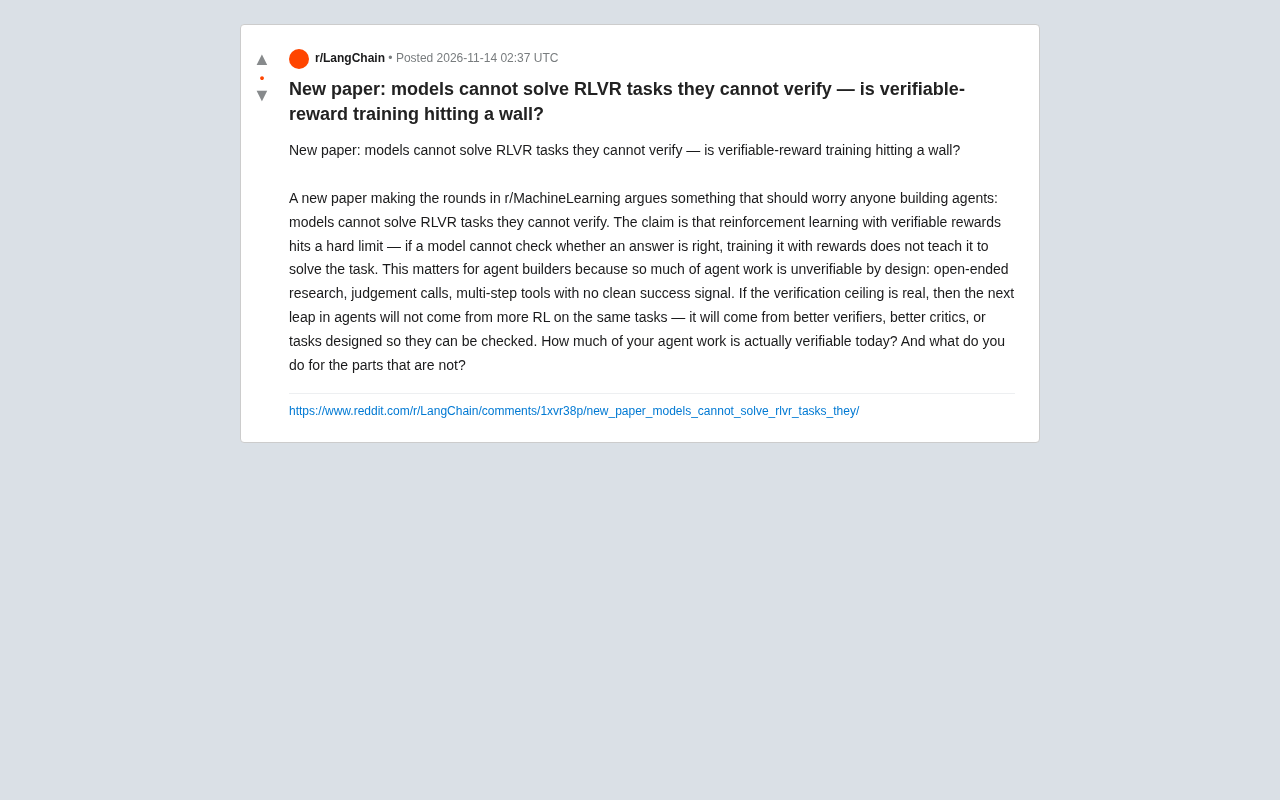
Reinforcement Learning with Verifiable Rewards (RLVR) is widely used to train AI agents, but a new paper that sparked heated discussion on r/MachineLearning makes a sharp point: models cannot solve RLVR tasks they cannot verify. This means that if a model can't check whether its answer is correct on its own, training it with reward signals won't teach it to solve the problem. For agent developers, this touches on a fundamental contradiction—a large amount of agent work is unverifiable by design.
Core Argument: Verification Capability Determines the Learning Ceiling
The paper's core claim is that RLVR has a hard limit: reward-driven training depends on the model's ability to self-judge the quality of task completion. If the model lacks the means to verify whether an answer is right or wrong, reward signals cannot effectively guide policy optimization. In other words, you cannot train a capability the model itself cannot judge as right or wrong.
This conclusion is particularly worth heeding for agent builders. Many current agent tasks are inherently unverifiable: open-ended research, subjective judgment, multi-step tool calls without a clear success signal. These are exactly the scenarios where agents deliver the most value—and precisely where RLVR struggles most.
RLVR (Reinforcement Learning with Verifiable Rewards) is a class of reinforcement learning training paradigms in which the reward signal comes from automatically determinable correctness checks—for example, comparing final answers to math problems, or whether code unit tests pass. Unlike approaches that rely on human preference scoring (RLHF), RLVR rewards are programmatic, deterministic, and can be generated at scale, which is why it is widely used to train reasoning models. Its implicit assumption is that during exploration the model can obtain sufficiently frequent correct signals, thereby gradually reinforcing correct paths through policy gradients. The paper's critique is precisely to puncture the boundary condition of this assumption—when the task itself cannot be programmatically verified, the reward signal is either missing or too noisy, and policy optimization loses a reliable directional signal.
Agent in this context refers to a model system capable of autonomous planning, tool invocation, and multi-turn interaction with an environment to complete a task. Unlike single-turn question answering, an agent's success is often reflected in end-to-end task completion; the correctness of intermediate steps is difficult to label step by step, which makes designing verifiable rewards for agents far harder than training single-step reasoning models.
Why So Much Agent Work Is Unverifiable
In real agent workflows, the verifiable portion is far smaller than one might imagine. Writing code can be tested, math problems have standard answers—these are RLVR's comfort zone. But more tasks have no clean acceptance criteria:
- Open-ended research: The quality of information gathering and synthesis is hard to measure with a single signal
- Judgment-based decisions: Choosing among multiple reasonable options, with no unique correct answer
- Multi-step toolchains: The correctness of intermediate steps is hard to verify step by step, and the final result may only "look reasonable"
The paper implies that this unverifiability is structural, not something that can be bypassed by piling on more RL training. If a verification ceiling truly exists, then continuing to increase RL investment on the same tasks will yield diminishing returns.
Breakthroughs: Better Verifiers, Critics, and Task Design
The paper doesn't stop at identifying the problem—it also offers directions. If verification capability is the bottleneck, then the next wave of agent capability gains may come from three directions:
- Better verifiers: Build reliable automatic evaluation mechanisms for tasks that were originally unverifiable, so models can "self-check"
- Better critics: Introduce independent judging models to substitute for missing verification signals
- Verifiable task design: Redesign tasks so they naturally have checkable success criteria
These three points converge on one conclusion: agent progress may no longer come primarily from stronger RL algorithms, but from building infrastructure around "verification" itself.
Critic in reinforcement learning usually refers to an auxiliary model that estimates the value of states or actions, used to reduce the variance of policy gradients; in the RLHF context it often refers to an independent reward model. What the paper calls a "better critic" is essentially introducing a judge separate from the policy model to proxy the missing verification signal. The risk of this approach is that the critic itself may have biases or reward hacking vulnerabilities—the policy model will learn to cater to the critic's weaknesses rather than genuinely solve the problem. Therefore the critic's reliability itself needs to be verified, which to some extent loops the problem back to the starting point.
Reward hacking refers to a policy model finding shortcut behaviors that obtain high rewards but violate the designer's intent. In unverifiable or weakly verified tasks, this problem is especially prominent: without hard correctness checks, models are more likely to exploit loopholes in the reward function, leading to good-looking training metrics without actual capability improvement. This is also the deeper reason the paper emphasizes the necessity of verification infrastructure.
A Reality Check for Agent Developers
The discussion the paper sparked in the community ultimately comes back to a practical question: of the agent work you do today, how much is truly verifiable? And what do you plan to do with the remaining unverifiable portion?
This is not a demand that all tasks become verifiable, but a reminder for developers to distinguish two types of work: the parts that can be effectively trained with RLVR, and the parts that require an additional verification layer or human judgment. If the verification ceiling is a real limitation, then blindly investing RL training in unverifiable tasks may simply be wasting compute.
One-line Summary
A new paper argues that RLVR has a verification ceiling: models cannot learn tasks whose correctness they cannot judge.
Paragraph Summary
A paper that sparked heated discussion on r/MachineLearning proposes that Reinforcement Learning with Verifiable Rewards (RLVR) has a hard limit: reward-driven training depends on the model's ability to self-judge task completion quality, and if the model cannot verify whether an answer is right or wrong, reward signals cannot effectively guide policy optimization. This poses a fundamental contradiction for agent developers—the scenarios where agents deliver the most value, such as open-ended research, subjective judgment, and multi-step toolchains, are precisely the ones that are inherently unverifiable. The paper argues this unverifiability is structural, and that continuing to increase RL investment will yield diminishing returns. The breakthrough lies in better verifiers, independent critic models, or redesigning tasks to have checkable success criteria—meaning agent progress may come more from building verification infrastructure than from stronger RL algorithms.
Related articles

From 0 to 1: Vibe Coding an AI Knowledge Base — A Practical Retrospective and Tech Stack Breakdown
A retrospective on building the AI knowledge base OilBook from scratch with Vibe Coding: Next.js+Neon stack, Oil Dev Skill workflow, Stripe paywall security, interview-style writing, AI-flavor control, and Vercel deployment.

GLM-5.4 Hands-On: Native Vision Meets a New Vibe Coding Workflow
Hands-on with Zhipu GLM-5.4: native vision tested across a 3D product demo, pure-code video generation, and remote-control Vibe Coding, compared with GPT-6.2 and Gemini Neon.

AI and Humans Claim to Prove the Riemann Hypothesis: Machine-Verified, Yet Nobody Can Understand It
Anthropic mathematician and AI Claude claim to prove the Riemann Hypothesis with 17 million lines of Lean code, machine-verified but unreadable by humans. This article analyzes the event, the zero proportion record from 41.6% to 67.2%, and the gap between machine verification and human understanding.