iFixit Tears Down Apple HomeView: Repairability Far Worse Than Expected

iFixit teardown shows Apple's HomeView is far harder to repair than recent products, with a sealed design that bucks the repairability trend.
iFixit's teardown of Apple's HomeView hub shows it doesn't continue the easy-teardown trend of the iPad and HomePod. Heavy adhesive use, tightly packed non-modular components, heat-required shell removal, and risky screen connections make repairs costly. Battery or motherboard failures often need full replacement, shortening device life. The report notes Apple's repairability gains vary by product line, and HomeView prioritizes design over maintainability, potentially fueling repair monopoly disputes and Right to Repair legislation.
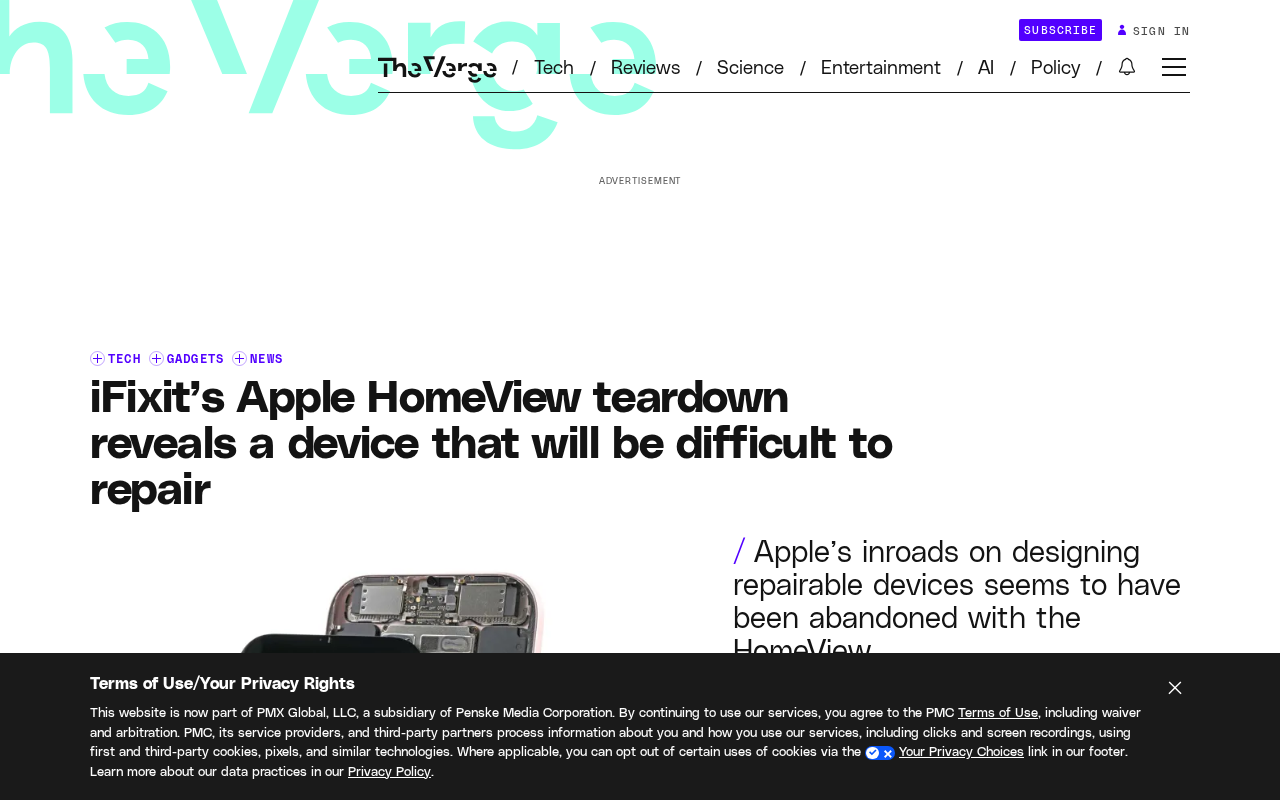
Apple has recently seemed to improve on repairability, and the reduced teardown difficulty of the iPad and HomePod had iFixit hopeful about new products. But the newly launched HomeView hub device—a product that looks like a seven-inch tablet stuck onto a smart speaker—left the teardown team stunned. iFixit's teardown report shows that this device is far harder to repair than recent Apple products, with an internal design closer to sealed consumer electronics than a maintainable device.
The Gap Between Expectation and Reality
Before the teardown, iFixit had optimistically predicted that the HomeView would continue the recent easy-teardown trend of the iPad and HomePod. After all, Apple has sent some positive signals in recent years regarding battery replacement and modular design. However, the actual teardown process ran into obstacle after obstacle. The device's interior relies heavily on adhesive, components are tightly packed, and key parts are difficult to remove independently. This design approach runs counter to Apple's recent improvements in repairability, raising questions about whether the HomeView's product positioning leans more toward an all-in-one sealed device.
iFixit's repairability scoring system: iFixit is a well-known repair guide community and tool supplier, and its teardown reports typically give a repairability score from 0 to 10, with higher scores meaning the device is easier for users or third-party repair shops to fix. The score is mainly based on teardown difficulty, fastening method (screws or adhesive), the degree of component modularity, and whether the official manufacturer provides repair manuals and original parts. In recent years, the scores of the iPad and HomePod have rebounded somewhat, mainly because Apple began offering a self-service repair program and some modular parts. The HomeView's low score means it lags across all these dimensions, not just in a single area.
The Repair Barriers Revealed by the Internal Structure
The HomeView integrates a seven-inch display and smart speaker functionality into a compact body, and this form factor itself limits maintainability. iFixit found that removing the outer shell requires heating to soften the adhesive, and the connection method between the screen and the main body increases the risk of damage. Core components such as the battery and motherboard are not modularly designed, so once a part fails, it often requires a full replacement or high-risk deep teardown. For ordinary users and third-party repair shops, this means repair costs and time rise substantially.
The risks of adhesive fastening and heat-based disassembly: Common fastening methods in consumer electronics fall into three categories: screws, clips, and adhesives. Adhesive fastening can compress body thickness and improve water and dust resistance, but disassembly requires using a heating pad or heat gun to soften the adhesive to a specific temperature range (usually 60–80°C). If the temperature is too low, the adhesive won't fail; if too high, it may damage the screen cable, battery, or plastic parts. After heating, you also need to use a pry tool to slowly separate along the seam, and a slight mistake can tear the flexible cable or shatter the screen. This process turns repair from "turning screws" into high-risk precision work that ordinary users can hardly do themselves, and third-party repair shops also need specialized heating stations and training.
Impact on Users and the Repair Ecosystem
The HomeView's repair difficulty affects not only individual users but also deals a blow to the third-party repair market. Apple has faced regulatory pressure from multiple countries in recent years over repair monopoly issues, and the HomeView's design may intensify the controversy. iFixit noted in its report that this sealed design shortens the device's lifecycle and increases electronic waste after retirement. Although Apple has shown willingness to improve repairability on some product lines, the HomeView is clearly not among them.
The Right to Repair movement and regulatory context: The Right to Repair movement advocates that consumers and independent repair shops should have the right to obtain original parts, repair manuals, and diagnostic tools. Multiple U.S. states have proposed related bills, and since 2021 the EU has required household appliances and electronic devices to provide repairability information and spare parts supply. Apple has been criticized repeatedly for restricting the flow of original parts and using software locks to bind components (such as serial number pairing for screens and batteries). If the HomeView adopts a highly sealed design and does not provide independent parts, it could become new evidence cited by regulators and advocates, further pushing legislation to require manufacturers to disclose repair resources.
The Divergence in Repairability Trends
The HomeView teardown result reminds us that Apple's repairability improvements are not advancing across the board. Different product lines adopt different strategies based on positioning and cost considerations. For emerging categories such as smart home hubs, Apple seems to prioritize industrial design and functional integration over maintainability. Consumers need to weigh the device's long-term cost of use before purchasing, while Right to Repair advocates may use the HomeView as a new case to push legislation.
iFixit's teardown report provides an important reference for potential HomeView buyers: this device has not inherited the recent improvements in Apple products in terms of repair friendliness, and its sealed design may make subsequent maintenance tricky.
One-line Summary
iFixit's teardown shows Apple's HomeView is far harder to repair than recent products, with a sealed design that departs from the repairability improvement trend.
Paragraph Summary
iFixit's teardown report on Apple's HomeView hub device shows that this product, which combines a seven-inch screen with a smart speaker, has not continued the recent easy-teardown trend of the iPad and HomePod. The device's interior relies heavily on adhesive, key components are tightly packed and lack modular design, removing the shell requires heating to soften the adhesive, and the connection between the screen and the main body increases the risk of damage. Failures of core parts such as the battery and motherboard often require full replacement or high-risk deep teardown, driving up repair costs and shortening device lifespan. The report notes that Apple's repairability improvements are diverging across product lines, with the HomeView prioritizing industrial design and functional integration, which may intensify repair monopoly controversies and provide a new case for Right to Repair legislation.
Related articles

Michael Nielsen Takes Down His Classic Neural Network Textbook, Sparking Community Discussion
Michael Nielsen's classic free textbook Neural Networks and Deep Learning has been taken offline, sparking discussion on Hacker News about the reasons and impact.

Inside the AI Training Data Market: The Trade-off Between Exclusivity and Discounts
G2i founder Gabe Greenberg reveals the dual-track pricing of the AI training data market: labs pay a premium for exclusive data or accept discounts that allow others to buy it.

SessionGraph: Unifying All Coding Agent Sessions in One Interactive Graph
SessionGraph aggregates coding agent sessions into an interactive graph, helping developers review, debug, and manage AI coding workflows across sessions. This article examines its positioning, value, and open questions.